Watch the film
| Size in ft: | Width: 10' x Length: 13'8" |
| Size in Inch: | Width: 120" x Length: 164" |
| Size in meters: | Length: 4.17 x Width: 3.05 m |
| Colors: | Deep Red, Blue, Green |
| Shape: | Rectangular |
| Woven: | Hand-Knotted |
| Pile: | Wool |
| Origin: | Persia |
| Design: | Hunting Floral |
| Age: | 1970's |
| Condition: | Excellent |
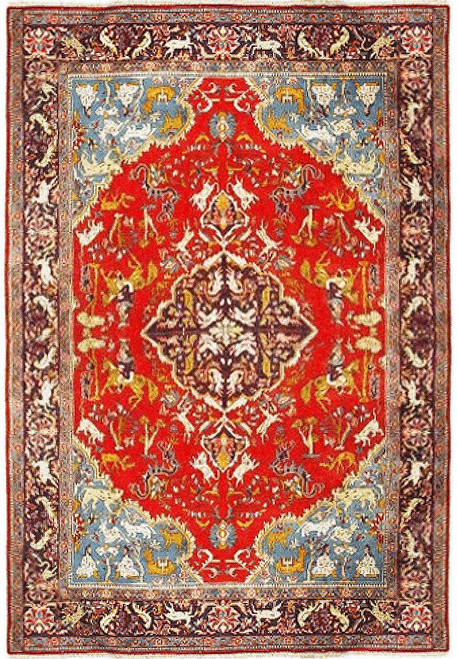
10' x 13'8" Persian Bijar Rug | Animal Hunting Design | Deep Red Field | 1970s
A hunting rug, shekargah in Persian, is the hardest thing a village loom can attempt, because every animal has to be drawn in knots rather than borrowed from a repeat. This one was woven in Bijar in the 1970s and it carries lions, gazelles, hounds, ibex and winged beasts across a deep red field that has held its color beautifully for roughly 50 years. The pile is thick and even, the handle is heavy the way a Bijar should be, and the ivory cotton fringe is original and intact. At 10' x 13'8" it covers a full seating group or a 10 seat table without crowding, which puts it squarely in the practical range of 10x14 Persian rugs. It ships with a certificate of authenticity.
Please Note About the Photographs:
The first overhead photograph was taken under studio lighting and reads a little cooler and softer than the rug is in person. The daylight close-ups show the true tone, a clear deep red field with navy, ivory and light blue. Nothing in that first frame is fade, wear or damage.
Design and Motifs
The center holds a compact navy medallion built around an olive brown rosette of 16 cream and navy teardrops, with a cobalt blue heart and a single green diamond at its core. Around it the field opens into a full hunting ground: cream gazelles in mid leap, blue hounds running them down, a lion pulling a bull to the ground, ibex, birds and paired winged creatures with spotted wings and animal faces coiling through the navy spandrels. Large 8 petal cornflowers, curling serrated leaves and small four petal blossoms fill every space between the animals, so the eye never reaches an empty patch. The navy corner spandrels enclose ivory cartouches holding facing lions and a star rosette. The wide ivory main border continues the story with paired red peacocks, grey and rose birds, vases and heavy cabbage roses in crimson and pink, flanked by narrow navy guard stripes of turtle palmettes and small rosettes and a fine sawtooth minor band.
The Deep Red, Navy and Ivory Palette
The field is a true deep red, a warm madder tone that photographs slightly brick in daylight and turns richer under lamplight, and it is laid down evenly from end to end with no abrash streaking. Against it the weaver worked two separate blues: a dark indigo navy used for the spandrels, the medallion ground and the blossom centers, and a soft mid blue used for the hounds, the winged beasts and many of the leaves, which keeps the animals readable across a red ground. Ivory does the heavy lifting in the main border and reappears inside the field as leaping gazelles, small daisies and outlines that separate one motif from the next. Green runs through the leaves and rose foliage in two tones, a deep bottle green and a paler sage, while olive gold gives the lions their coats and the medallion its frame. Rose pink and coral pick out the cabbage roses, the bird plumage and the tips of the palmettes, and small touches of grey appear in the border birds. The red selvedge and ivory fringe finish the edges cleanly.
Bijar: The Iron Rug of Persia
Bijar sits in Kurdistan in western Persia, and its Kurdish weavers built a reputation on construction rather than knot count alone. The wefts are wetted and the pile is beaten down with a heavy metal comb, which packs the foundation so tightly that the finished rug is stiff, extremely heavy for its size and nearly indestructible underfoot, which is why the trade has always called these the iron rugs of Persia. Read the complete guide to Bijar rugs and why they last a lifetime, or compare the district weaves in our breakdown of Bijar, Bijar Tekab and Bijar Bukan. What lifts this particular piece above ordinary village work is the drawing: curved vines, animals in motion and a full pictorial border are town workshop ambitions, executed here at a knot density fine enough to give the lions eyes and the hounds collars. The back, visible in the folded images, shows tight even rows with no slack, and the pile still stands full after half a century.
10' x 13'8" Persian Bijar Rug | Animal Hunting Design | Deep Red Field | 1970s
Ask about this rug
This piece is the only one of it, so the things worth knowing about it are particular to it. If you want to talk through the size, the colour in your own light, or the weave, speak to someone here first.