Watch the film
| Size in ft: | Width: 10' x Length: 13' |
| Size in Inch: | Width: 120" x Length: 156" |
| Size in meters: | Length: 3.96 x Width: 3.05 m |
| Colors: | Red, Navy, Ivory, Sky Blue, Olive Green, Rose |
| Shape: | Rectangular |
| Woven: | 100% Hand-knotted | Handmade |
| Foundation: | Cotton |
| Pile: | |
| Design: | Heriz | Stepped Medallion | Ivory Spandrels |
| Origin: | Persian Heriz | Made in Persia |
| Condition: | Excellent |
10' x 13' Persian Heriz Rug | Red Field, Navy Stepped Medallion | Village Woven Wool
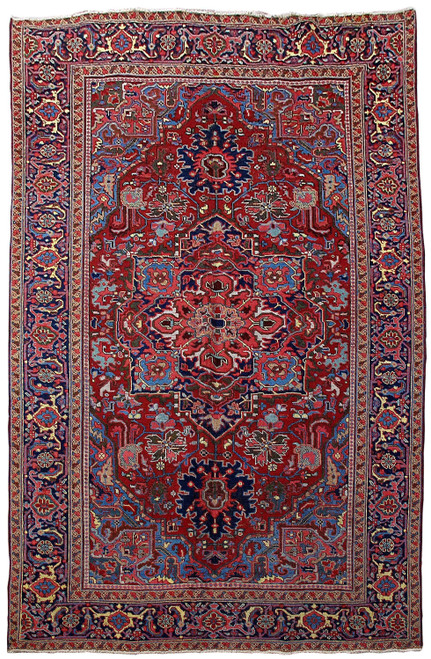
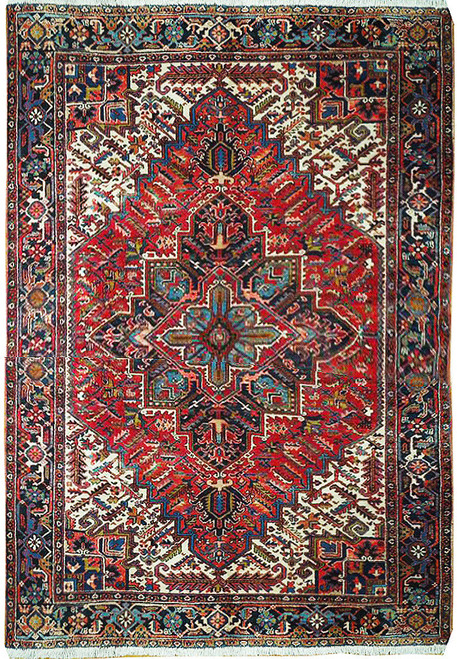
This is a full room size Persian Heriz at 10' x 13', hand-knotted in wool on a cotton foundation with a 3/8" pile that still stands firm and even across the whole field. The drawing is pure Heriz: one large stepped medallion anchored dead center, ivory spandrels cut into the 4 corners in hard angular steps, and a deep red field packed with palmettes, serrated leaves and small hooked vines. The wool has the slightly glossy, chalky-bright quality that these northwest villages are known for, and the reds read warm and saturated rather than flat. Condition is excellent with no repairs or wear visible in the photographs, and every rug ships with a certificate of authenticity. If you are shopping 10x13 Persian rugs for a living room or a dining table that seats 8, this is the size and the weave that has been doing that job for a century.
Design and Motifs
Everything here is drawn with straight lines and right angles, which is the signature of the weave. The central medallion is a stepped octagonal form on a near-black navy ground, built around a small 8 petal rosette with cruciform arms reaching out to 4 hooked pendants. Above and below it sit lance-shaped pendants that carry the eye the full length of the rug. The ivory spandrels are not smooth curves but jagged crenellated shapes, filled with scrolling vine and tiny latch-hook fragments, and they read almost like frost against the red. The open field between medallion and corners is worked with large angular palmettes, serrated sickle leaves, rosettes and small rectangular boteh-like devices, each one outlined so it separates cleanly from the ground. The main border runs a classic turtle palmette and vine on dark navy, flanked by narrow reciprocal guard stripes in red and ivory. It is a textbook example of why collectors seek out geometric Persian rugs for rooms with contemporary furniture.
A Deep Red Field with Navy and Ivory Contrast
The field is a rich madder red that shifts between brick and a cooler rose depending on where the light falls, with subtle horizontal variation through the weave that tells you the dye lots were natural and hand mixed. Against that, the medallion ground and the main border are a navy so deep it reads black at a glance and only opens up to blue in raking light. The ivory is the third structural color, used in the corner spandrels, the outline of the medallion and the thin guard stripes, and it is what keeps a heavily patterned rug from going dense. Inside the motifs the palette widens: soft sky blue, olive and mustard green, terracotta, a dusty rose and small touches of pale cream on individual leaf tips and rosette centers. The overall effect in a room is warm and grounding, and the red and navy combination sits comfortably with leather, walnut, brass and darker woods.
Heriz: The Villages East of Tabriz
Heriz is a cluster of weaving villages in northwest Persia, east of Tabriz on the slopes below Mount Sabalan. Two things made the name famous. The first is the water, which is rich in minerals and gives the local sheep a wool with unusually high lanolin content, so the pile wears slowly and takes dye with real depth. The second is the drawing style: these are village weavers working from memory and from a small cartoon rather than a full court design, so the curved line of a city workshop becomes a bold angular line instead, and the design gains power from that. Knot counts in Heriz village work generally sit under 200 KPSI, which is exactly right for this kind of scale. The weave is meant to be walked on, and rugs of this construction routinely stay in families for generations. The back of this piece, shown against a ruler, is tight and regular with clean rows and no slippage, which is the mark of a well-made loom job.
10' x 13' Persian Heriz Rug | Red Field, Navy Stepped Medallion | Village Woven Wool
Ask about this rug
This piece is the only one of it, so the things worth knowing about it are particular to it. If you want to talk through the size, the colour in your own light, or the weave, speak to someone here first.