Watch the film
| Size in ft: | Width: 10' x Length: 14' |
| Size in Inch: | Width: 120" x Length: 168" |
| Size in meters: | Length: 4.27 x Width: 3.05 m |
| Colors: | Red, Blue, Ivory, Banana |
| Shape: | Rectangular |
| Woven: | 100% Hand-knotted | Handmade |
| Foundation: | Cotton |
| Pile: | |
| Age: | 1980's | Approx. 40 years old |
| Design: | Esfahan | Central Floral Medallion | Arabesque Spandrels |
| Origin: | Persian Esfahan | Made in Persia |
| Condition: | Excellent | Full even pile |
10' x 14' Persian Esfahan Najafabad Rug | Red Field Floral Medallion | 1980s Wool Pile
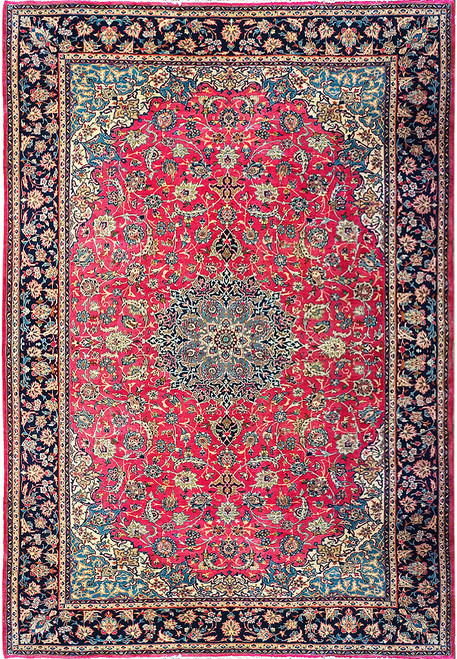
A full room size piece in the classic central Persian formula: a deep red field, a sky blue and ivory star medallion, banana gold corner spandrels and a navy main border. This Persian Esfahan rug was woven in the 1980s with a hand-spun wool pile on a cotton foundation, and the pile is still full and even from edge to edge with its original kelim ends and tight side cords intact. At 10' x 14' it sits in the most useful range of 10x14 Persian rugs, large enough to float a full seating group or an extended dining table on the field rather than the border. Every rug we ship travels with a certificate of authenticity recording origin, materials and age.
Please Note About the Photographs:
The overhead studio frame was shot under cool light and reads a brighter, cleaner red, while the floor and detail photos were taken in warm indoor light and read deeper and richer. Both are the same rug. The field in person sits between the two, a true tomato red with soft natural variation from the hand-dyed wool, and every rug is professionally steamed and pressed before it leaves our warehouse.
Design and Motifs
The drawing follows the Esfahan medallion and corner layout. At the center sits a 16 point star medallion outlined in navy, filled with a sky blue ground that carries an 8 petal gold rosette at its heart, ringed by small red and ivory flowerheads on hair thin tendrils. Ivory arabesque leaves radiate out of the medallion like a sunburst and dissolve into the field, so the medallion reads as part of the vine system rather than a shape dropped on top of it. The red field is drawn with a continuous scrolling vine that carries lotus palmettes, serrated sickle leaves, tulip buds and ragged ivory blossoms, all mirrored across both axes. The 4 corners are filled with banana gold spandrels holding burgundy and blue palmette cartouches, and the main navy border runs a stately alternation of ivory and gold palmettes linked by curling vines, fenced by light blue and ivory guard stripes that repeat a small reciprocal flower. The red outer edge finishes the frame.
A Study in Red, Navy and Banana Gold
The field is a warm madder red with the gentle tonal movement that only hand-dyed wool gives, slightly lighter where the light crosses the pile and deeper in the shadow of the knot. Against it the border runs a near black navy, which is what makes the design read clearly from across a room. The third major color is banana, a pale buttery gold that fills the spandrels and much of the border ornament and keeps the palette from going heavy. Inside the medallion the blue switches register entirely, from navy outline to a soft powder sky blue ground, and that same light blue is picked up again in the guard stripes and in scattered field blossoms, which ties the center to the frame. Smaller quantities of ivory, sage olive, camel, burgundy and a pale rose peach appear in the flowerheads and leaf tips, giving close range detail without disturbing the red, navy and gold structure.
Najafabad and the Esfahan Weaving Tradition
Najafabad is a weaving town a short drive west of Esfahan in central Persia, and it works from the same cartoons and the same design vocabulary that made the Esfahan workshops famous from the Safavid era onward. The difference is scale and purpose: where the city ateliers concentrate on small, extremely fine wool and silk pieces, Najafabad looms were built to produce room size and oversize rugs like this one in durable all wool pile on a cotton foundation, keeping the curved line and the flowing vine of the Esfahan school while making a floor covering meant to be used. You can see that intent in the weave on the reverse, a firm, regular knot that holds the fine arabesque drawing cleanly, and in the pile itself, a springy local wool with the quiet sheen that comes from good fleece and good washing. Four decades on, the colors have settled into each other and the rug has the character of a genuine 1980s Persian piece rather than anything freshly made to look old.
10' x 14' Esfahan Najafabad Rug | Red Field Floral Medallion | 1980s Wool Pile
Ask about this rug
This piece is the only one of it, so the things worth knowing about it are particular to it. If you want to talk through the size, the colour in your own light, or the weave, speak to someone here first.