Watch the film
| Size in ft: | Width: 9'11" x Length: 15'11" |
| Size in Inch: | Width: 119" x Length: 191" |
| Size in meters: | Length: 4.85 x Width: 3.02 m |
| Colors: | Red, Ivory, Blue, Green |
| Shape: | Rectangular |
| Woven: | 100% Hand-knotted | Handmade |
| Foundation: | Cotton |
| Pile: | |
| Design: | Esfahan | Star Medallion | All-over Floral Vinery |
| Origin: | Persian Najafabad | Made in Persia |
| Condition: | Excellent |
9'11" x 15'11" Persian Najafabad Rug | Esfahan Floral Medallion | Oversize Wool Pile
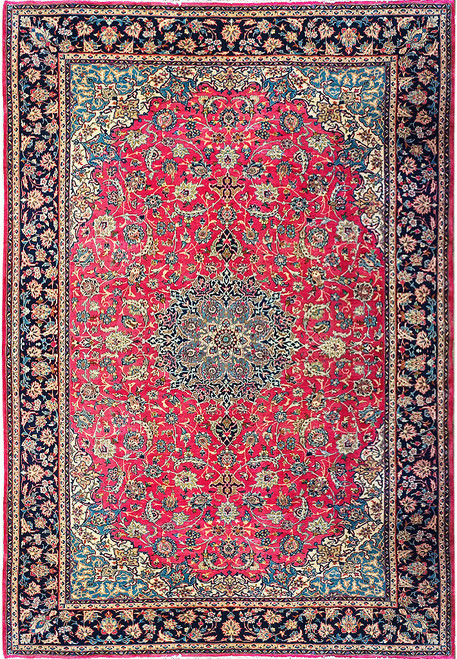
This is a big, serious room rug: 9'11" x 15'11" of hand-knotted wool from Najafabad, the weaving town on the western edge of the Isfahan plain, drawn in the classic Esfahan manner with a star medallion floating on a deep red field of curling vines. The pile is a full 3/8", the handle is firm over a cotton foundation, and the wool has the quiet sheen that comes from good highland fleece rather than from any finishing treatment. At this footprint it belongs in the group of oversize Persian rugs that can carry a full seating arrangement or a 12 seat dining table without the furniture crowding the border. Every rug we sell ships with a certificate of authenticity confirming origin, materials and hand-knotted construction.
Please Note About the Photographs:
The full overhead photograph was taken under cool studio light and reads greener and brighter than the rug does in person. The close-up photographs of the medallion, the border and the corner are the accurate reference for color: a true red field, ivory and navy drawing, and soft blue guard bands.
Design and Motifs
The center holds a pointed star medallion built from interlocking navy and ivory cartouches around a small sky blue core, with a single rosette at the exact middle and paired tulip and boteh forms stepping outward along each of the points. Above and below it, narrow navy pendants reach into the field. The field itself is not empty ground waiting for a medallion; it is a complete all-over composition of thin scrolling vines that link palmettes, split leaves, eight petal rosettes and small blossoms, repeated in mirror image on either side of the long axis so the drawing stays balanced across the full 15'11". Ivory spandrels close the 4 corners with their own vinework, and the frame runs to 5 bands: a wide main border of alternating palmettes and serrated leaves on dark navy, flanked by ivory and light blue guard stripes carrying a running vine. This curvilinear, garden-derived vocabulary is the signature of the Esfahan school, and you can read more about its history in our guide to Isfahan rugs.
A Red Field With Ivory, Blue and Green Drawing
The field red is a warm madder tone that leans slightly rose in daylight and deepens toward brick under lamplight, and because the vinework is drawn so finely the ground reads as a living surface rather than a flat block of color. Against it the palette is disciplined: ivory and pale cream for the outlines, leaves and spandrels, a mid navy for the medallion frame and the main border ground, and two distinct blues that do most of the lifting, a clear sky blue in the medallion core and inner guard band and a duller teal blue through the field blossoms. Olive and moss green appear in the leaf forms and in scattered stems, with small touches of soft brown and rose pink in the border flowers. The corner photograph shows the border ground reading almost aubergine where the navy meets red, a shift that comes from natural abrash in the dye lots and is exactly what you want to see in a hand-dyed Persian weave.
Najafabad and the Isfahan Weaving Tradition
Najafabad sits about 20 miles west of Isfahan and has woven to Isfahan cartoons for generations, taking the city's curvilinear drawing and putting it on a sturdier, more practical weave built for large rooms. The city ateliers chase extreme fineness on silk warps; Najafabad workshops chase durability and scale, using a cotton foundation, a heavier wool pile and a tighter beat-down than most village production, which is why oversize pieces from this town survive decades of real household traffic with the design still crisp. You can see the evidence in the close-up of the pile: even knot rows, clean color breaks along the vine outlines, and no blurring where one shade meets the next at 15'11" of length. The selvages are firm, the fringe is the original cotton warp, and the rug lies flat and square.
9'11" x 15'11" Persian Najafabad Rug | Esfahan Floral Medallion | Oversize Wool Pile
Ask about this rug
This piece is the only one of it, so the things worth knowing about it are particular to it. If you want to talk through the size, the colour in your own light, or the weave, speak to someone here first.