Watch the film
| Size in ft: | Width: 10' x Length: 14' |
| Size in Inch: | Width: 120" x Length: 168" |
| Size in meters: | Length: 4.27 x Width: 3.05 m |
| Colors: | Navy Blue, Ivory, Gold, Rust, Brown, Sky Blue |
| Shape: | Rectangular |
| Woven: | 100% Hand-knotted | Handmade |
| Foundation: | Cotton |
| Pile: | |
| Age: | 1980s |
| Design: | Esfahan | Central Medallion | All-Over Floral |
| Origin: | Persian Isfahan | Made in Persia |
| Condition: | Excellent | Perfect |
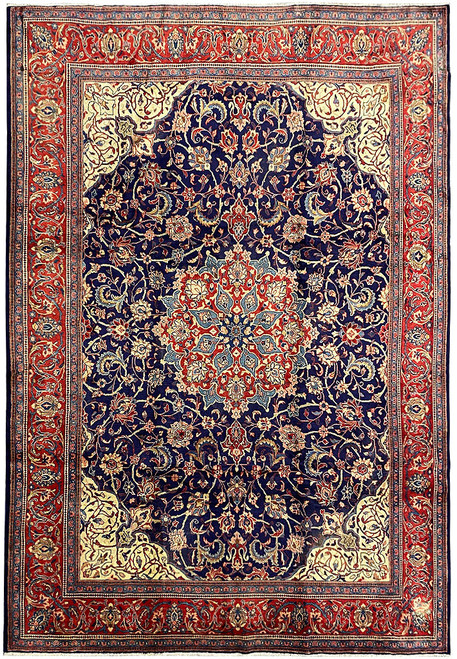
10' x 14' Persian Isfahan Rug | Navy Blue Floral Medallion | 1980s Fine Wool in Excellent Condition
This is a full room size 10' x 14' piece woven in the 1980s in the tradition of Persian Isfahan rugs, hand-knotted in wool on a cotton foundation. The pile still stands upright and even across the whole field, the ends and sides are original, and the colors have the settled depth that only 40 years of natural mellowing produces. Handling it, the first thing you notice is how tightly the drawing holds together at this scale: nothing in the vine work drifts or loses its line, even in the far corners. It ships with a certificate of authenticity, and the size makes it one of the more usable formats in our stock of 10x14 Persian rugs.
Please Note About the Photographs:
A few of the floor photographs show soft shadow lines across the field. Those are fold marks from rolled and palleted storage, not wear, not fading and not damage. They relax out once the rug is laid flat, and every rug leaves us professionally steamed and pressed before shipping.
Design and Motifs
The layout is the classic Isfahan formula, drawn with unusual patience. A layered central medallion sits dead center, built outward from an 8 petal rosette into a sage and gold core, then a ring of sky blue palmettes, then a scalloped outer contour that throws long pendants north and south. Ivory spandrels fill all 4 corners with curling arabesque, each closing on a small lobed cartouche. Between medallion and border the field is not left quiet: it carries a dense all-over lattice of Shah Abbasi palmettes, rosettes, serrated leaves and thin scrolling vines that mirror perfectly across both axes. The border system runs 7 bands deep, with a broad navy main border of alternating palmettes and leafy rosettes flanked by ivory and sky blue guard stripes and a fine reciprocal outer stripe. The curvilinear drawing is what marks the work as Isfahan: every stem bends on a true curve instead of stepping, which is only possible at a high knot count.
A Deep Navy Field Lit with Gold and Ivory
The ground is a deep midnight navy, closer to indigo than to royal blue, and it reads almost black in low light before opening up under a lamp. Against it the weaver placed warm honey gold, antique ivory and cream, burnt rust and a soft cinnamon brown, with cool sky blue used sparingly on the inner medallion petals and the guard stripes for contrast. Small touches of olive green and a chalk white appear inside the flower heads, and the outlining is done in a near black so each motif stays crisp instead of blurring into the field. The medallion itself is the lightest area of the rug, a sage and pale gold pool that pulls the eye straight to center. If your room is anchored in navy blue and blues, this piece sets a formal tone without going dark, because the ivory borders frame all 4 sides in light.
Isfahan Weaving and Workshop Quality
Isfahan sits in central Persia and has been a court weaving center since the Safavid workshops of the 16th century. Its reputation rests on drawing rather than on decoration alone: the flowing vine, the true curve, the precise repeat, all of which collapse unless the knot count supports them. This piece was woven on a cotton foundation with a close, even wool pile, and the back shows straight regular knot rows with no pulling at the selvedges, the sign of a disciplined loom rather than village work. Wool pile over cotton warp is also the combination that makes a rug of this size practical, because it takes daily traffic and vacuuming for decades. For anyone weighing the age of a piece, our guide on how to date an Oriental rug explains the wear, dye and construction clues that place this one in the 1980s.
10' x 14' Persian Isfahan Rug | Navy Blue Floral Medallion | 1980s Fine Wool in Excellent Condition
Ask about this rug
This piece is the only one of it, so the things worth knowing about it are particular to it. If you want to talk through the size, the colour in your own light, or the weave, speak to someone here first.