| Size in ft: | Width: 11'10" x Length: 17'3" |
| Size in Inch: | Width: 142" x Length: 207" |
| Size in meters: | Length: 5.26 x Width: 3.61 m |
| Colors: | Red, Emerald Green, Ivory, Gold, Light Blue, Rose |
| Shape: | Rectangular |
| Woven: | 100% Hand-knotted | Handmade |
| Foundation: | Cotton |
| Pile: | |
| Design: | All-Over Floral | Palmette and Vine | Emerald Green Border |
| Origin: | Persian Tabriz | Made in Persia |
| Condition: | Excellent | Full even pile |
11'10" x 17'3" Persian Tabriz Rug | Red All-Over Palmette Field | Emerald Green Border
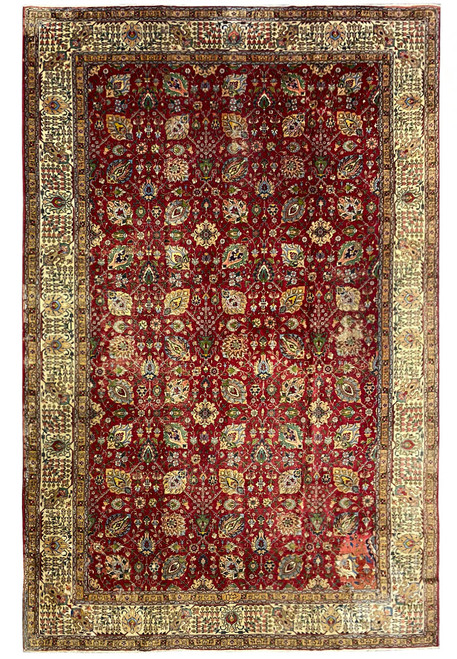
This is a proper room-filling Tabriz: 11'10" x 17'3" of hand-knotted wool on a cotton foundation, drawn as a continuous red floral field and closed by a deep emerald green border. Pieces at this scale were woven for large reception rooms, and they are the part of the market where supply is thinnest, which is why serious buyers of oversize Persian rugs tend to move quickly when a clean one appears. The pile is full and even across the whole surface, the sides and ends are intact, and the back reads tight and regular with no repairs visible in the photographs. Every rug we sell ships with a certificate of authenticity confirming origin, materials and hand-knotted construction.
Design and Motifs
There is no central medallion here. Instead the weaver ran an all-over floral design from end to end, built on a lattice of thin curving vines that link large fan-shaped palmettes, round rosettes, serrated leaves and small budding sprays. The drawing is mirrored on both halves of the field, so the eye keeps finding matched pairs of blossoms set at the same interval down the length. Look closely and the individual flower heads are shaded differently from one another, some ivory and gold, some navy, some pale blue, some rose, which keeps 17 feet of repeating pattern from ever reading mechanically. The main border carries a procession of large blossoms and curled leaves against green, and it is flanked on both sides by ivory guard stripes of small linked rosettes, then finer outer stripes. Each of the 4 corners is resolved cleanly, with the border pattern turning the angle instead of being cut off, which is the mark of a drawn cartoon rather than an improvised village weave.
The Red and Emerald Green Color Story
The field is a true warm red, closer to a clear brick and madder tone than to burgundy, and it holds its intensity from selvage to selvage without abrash banding. Against it the vinework is drawn in soft gold and straw, so the pattern reads as a warm gold tracery rather than a hard outline. The flower heads bring in the secondary palette: ivory, mustard and saffron gold, slate and cornflower blue, dusty rose, a moss green in the leaves, and dark navy at the center of the largest palmettes for contrast. The main border is a deep emerald that photographs almost teal under showroom light, and it is the single strongest design decision in this rug, because green against red is a much rarer and more confident pairing than the usual navy border. Between the green and the red sit ivory guard borders that act as a bright frame and keep the two saturated tones from fighting. The overall effect in a room is rich and formal, but the ivory and gold lift it so it never goes dark.
Tabriz Weaving and Workshop Quality
Tabriz sits in northwest Persia and has been the organizing center of Persian workshop weaving for centuries, the place where full-size paper cartoons, trained designers and disciplined city weavers turned floral drawing into a repeatable craft. Fineness there is measured in Raj, the count of knots across a gereh of about 2.75 in, with 40 Raj regarded as commercial, 50 as fine and 60 Raj and above as collector work. No Raj count was recorded for this piece, so we will not quote one, but the evidence is in the weave itself: the back shows small, square, tightly packed knots on a cotton warp, the curved vines hold their line without stepping, and the palmette outlines stay crisp at full size, all of which takes a knot count well above village work. The wool has the slight sheen typical of good Azerbaijani fleece and has taken a light polish from use, which is exactly what you want in a rug of this age and scale. Woven flat, laid out and left alone, a Tabriz of this construction is a floor covering you pass down rather than replace.
11'10" x 17'3" Persian Tabriz Rug | Red All-Over Palmette Field | Emerald Green Border
Ask about this rug
This piece is the only one of it, so the things worth knowing about it are particular to it. If you want to talk through the size, the colour in your own light, or the weave, speak to someone here first.