Watch the film
| Size in ft: | Width: 11'4" x Length: 16' |
| Size in Inch: | Width: 136" x Length: 192" |
| Size in meters: | Length: 4.88 x Width: 3.45 m |
| Colors: | Red, Blue, Turquoise, Ivory, Pink, Gold, Green |
| Shape: | Rectangular |
| Woven: | 100% Hand-knotted | Handmade |
| Foundation: | Cotton |
| Pile: | |
| Age: | 1970's | Vintage |
| Design: | Persian Lavar | Central Medallion | Allover Floral Field |
| Origin: | Persian Kerman | Made in Persia |
| Condition: | Excellent | Even pile throughout |
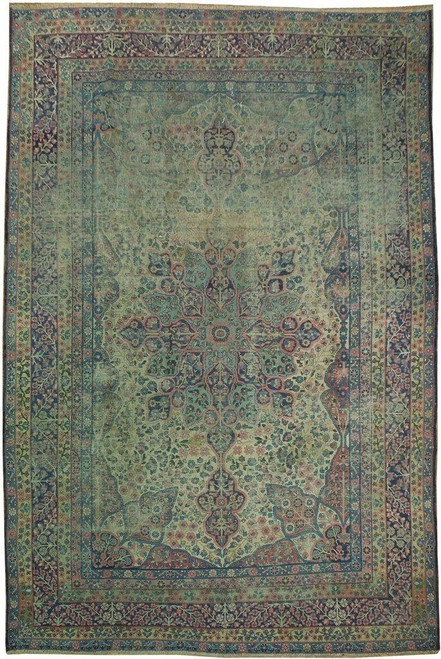
11'4" x 16' Persian Kerman Lavar Rug | Raspberry Red Field, Navy Floral Border | 1970s
This is a full palace piece from the 1970s, 11'4" x 16' of hand-knotted wool on a cotton foundation, woven in the Lavar manner of southeast Persia. The scale is the first thing you notice and the drawing is the second: a raspberry red field carrying an unbroken allover floral lattice, an elongated navy and turquoise medallion at center, and a deep indigo main border that frames all 4 sides without a single lazy repeat. The pile is even from end to end, the wool still has its natural sheen, and the sides and ends are sound. Among oversize Persian rugs this is the size that actually finishes a 12 by 18 room, and it ships with a certificate of authenticity documenting origin, materials and age.
Please Note About the Photographs:
The first catalog image renders the field a deeper, cooler red than it reads in person. The floor photographs taken in our warehouse are the truer reference: the ground is a warm raspberry crimson with a pink cast in daylight. Every rug is professionally steamed and pressed before it leaves us.
Design and Motifs
The center holds a stepped, many lobed medallion built in layers: a soft pink core with an 8 petal rosette at its heart, a navy surround, and turquoise cartouche panels set at the diagonals, with pendants running out along the long axis. Around it the field is filled corner to corner with detached floral sprays, curling palmettes, lotus heads and thin vine work, each blossom drawn separately rather than stamped from one repeat, which is the hallmark of Lavar drawing. Ivory and turquoise spandrels close off the 4 corners with dense leaf and blossom scroll. The main border runs a classic rosette and vine cadence on indigo, flanked by turquoise and ivory guard stripes carrying small pink blossoms and green leaves, so the eye steps through 5 distinct bands before it reaches the field.
The Raspberry Red and Indigo Palette
The field reads as a warm raspberry crimson, a shade cooler and more saturated than the brick reds of northwest Persia, and it carries a gentle abrash that moves across the width in the daylight shots. Against it the main border is a near black indigo, deep enough to make the field glow by contrast. The secondary palette is what gives this piece its lift: sky and teal turquoise in the medallion panels, corner spandrels and guard stripes, buttery ivory in the vine outlines and spandrel grounds, rose and salmon pink in the blossoms, ochre gold in the leaf tips and cartouche outlines, and a cool sage green through the stems. Nothing is muddy and nothing shouts. Red and blue carry the room while the pinks and turquoises do the detail work up close.
Kerman Weaving and the Lavar Tradition
Kerman sits in the southeast of Persia and has been a workshop city, not a village weaving area, for centuries. Its looms are known for curvilinear drawing, finely spun wool and painterly floral work, with the term Lavar (from the town of Ravar to the north) reserved for the more finely drawn, more carefully colored end of Kerman production. This piece shows that hand in the way the vines meet the medallion and in how cleanly the border corners resolve rather than being cut off mid motif. The weave is firm on a cotton foundation with a clipped, level pile that keeps the detail crisp, and the 1970s date puts it in a period when good Kerman wool and skilled workshop weavers were still readily available. If you want to understand how weavers, tags and construction place a piece in time, our guide on how to date an Oriental rug walks through the same evidence we used here.
11'4" x 16' Persian Kerman Lavar Rug | Raspberry Red Field, Navy Floral Border | 1970s
Ask about this rug
This piece is the only one of it, so the things worth knowing about it are particular to it. If you want to talk through the size, the colour in your own light, or the weave, speak to someone here first.