Watch the film
| Size in ft: | Width: 11' x Length: 15'9" |
| Size in Inch: | Width: 132" x Length: 189" |
| Size in meters: | Length: 4.80 x Width: 3.35 m |
| Colors: | Red, Ivory, Blue |
| Shape: | Rectangular |
| Woven: | 100% Hand-knotted | Handmade |
| Foundation: | Cotton |
| Pile: | |
| Age: | 1970's | Semi-antique |
| Design: | Tabriz | Central medallion | All over floral field |
| Origin: | Persian Tabriz | Made in Persia |
| Condition: | Excellent |
11' x 15'9" Persian Tabriz Rug | Red Field Floral Medallion | 1970s Oversize Wool
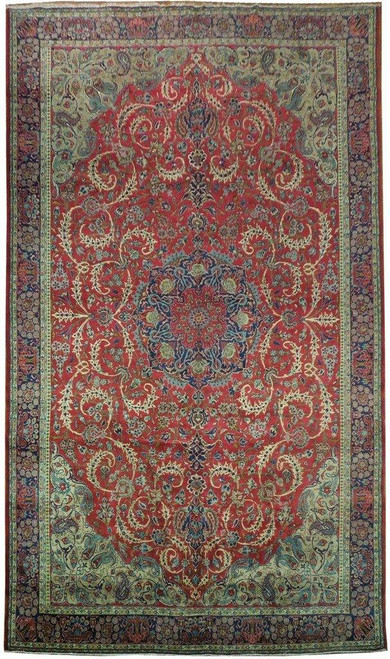
This is a 1970s Persian Tabriz in true room-filling scale, 11' x 15'9" of hand-knotted wool on a cotton foundation, and it has come through five decades with its pile still full and its colors still deep. The drawing is classic Tabriz workshop work: a dark lobed medallion floating on a red field that is completely filled with curved vine and blossom, framed by an ivory main border and two sky blue guard bands. Rooms of this footprint rarely get a rug woven with this much detail, which is what makes a piece in the 11 by 16 range worth holding out for. Every rug we ship carries a certificate of authenticity confirming origin, materials and hand-knotted construction, so what is described here is what arrives at your door. If you are comparing pieces in this footprint, our full run of oversize Persian rugs is the place to start.
Design and Motifs
The center holds a pointed, lobed medallion in near-black navy, filled with ivory and rose palmettes and finished top and bottom with slender pendants that reach out into the field. Around it the red ground is worked edge to edge with a curvilinear vine system: split arabesque leaves, 8 petal rosettes, feathered saz leaves and cypress-like buds, all drawn with the flowing line that separates a Tabriz cartoon from village work. The 4 corner spandrels are rendered in soft blue rather than ivory, an unusual and very handsome choice that makes the corners read as their own panels. Framing everything is a wide ivory border of turning vine and paired blossoms, set between a red rosette band and sky blue guard stripes with a fine sawtooth minor stripe at the outer edge. The close photographs show how controlled the outlining is, with black and ivory contour lines holding each flower apart from the red behind it.
A Deep Red Field With Ivory and Two Blues
The field is a warm true red, closer to cherry than to brick, and it stays even across the whole 15'9" length with only the gentle tonal shift that natural dye lots give an old rug. Against it the palette runs cool: a powdery sky blue in the spandrels, the guard bands and the leafwork, and a much darker inky navy reserved for the medallion, the pendants and the outlines. Ivory does the lifting, as a clean unshaded ground in the main border and as highlight petals scattered through the field, and it keeps the red from ever feeling heavy. Smaller accents of apricot, terracotta, olive green, soft rose and a dusty brown appear in the individual blossoms, and those warm notes are what make the rug work with wood floors and leather as easily as with cream upholstery. The wool has a low sheen that shifts with the light, reading brighter from one end and richer from the other.
Tabriz Weaving in Northwest Persia
Tabriz sits in Azerbaijan province in the northwest of Persia and has been the country's most organized weaving city for centuries, the place where the master designer, the cartoon and the workshop loom came together. Fineness there is counted in Raj, knots per gereh across the width, and Tabriz weavers built their reputation on holding a curved line at high knot counts in sizes most looms cannot handle. That workshop discipline is visible here in the symmetry of the medallion, the way the border pattern turns cleanly at all 4 corners and the consistency of the field drawing over nearly 16 feet. The foundation is cotton, the pile is good northwest Persian wool clipped at a medium height, and the back shown in the photographs is tight and regular with straight, even rows. A rug built this way in the 1970s has already proven it can take traffic, and it has decades of service left in it.
11' x 15'9" Persian Tabriz Rug | Red Field Floral Medallion | 1970s Oversize Wool
Ask about this rug
This piece is the only one of it, so the things worth knowing about it are particular to it. If you want to talk through the size, the colour in your own light, or the weave, speak to someone here first.