Watch the film
| Size in ft: | Width: 11' x Length: 16'4" |
| Size in Inch: | Width: 132" x Length: 196" |
| Size in meters: | Length: 4.98 x Width: 3.35 m |
| Colors: | Brick, Black, Blue, Ivory |
| Shape: | Rectangular |
| Woven: | 100% Hand-knotted | Handmade |
| Foundation: | Cotton |
| Pile: | |
| Age: | Semi-Antique |
| Design: | Bakhtiar | Central Medallion | Floral Field |
| Origin: | Persian Bakhtiar | Made in Persia |
| Condition: | Excellent | Full even pile |
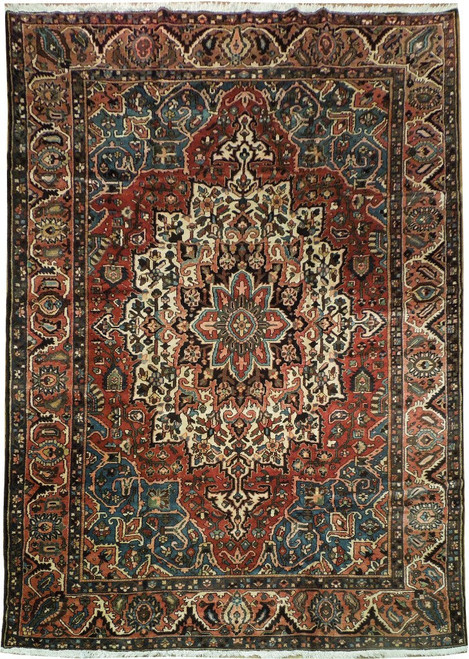
11' x 16'4" Persian Bakhtiar Rug | Brick Field with Black and Ivory Medallion | Semi-Antique Oversize
This is a big, honest village piece: a semi-antique Persian Bakhtiar measuring 11' x 16'4", hand-knotted in wool on a cotton foundation and still carrying a full, even pile after decades of quiet life. The drawing is confident rather than fussy, with a black and ivory medallion anchored dead center in a brick red field of flowering vines, and navy corner spandrels that square the composition off at all 4 corners. At this scale it belongs in a great room, a long formal living room or a large dining room where the table can sit entirely on the wool, and it sits comfortably among the oversize Persian rugs we import directly. Every rug we sell ships with a certificate of authenticity.
Please Note About the Photographs:
The field reads as a deep brick red in the direct overhead and close-up photographs and as a lighter rose brick in the showroom floor shots taken under warm overhead light. That difference is camera and lighting, not 2 different dyes. The true tone sits between the two, a warm brick red that shifts slightly with the nap direction as you walk around the rug.
Design and Motifs
The center holds a large lobed medallion built in layers: a near black ground traced with bright blue outlines, filled with 8 broad palmettes and rosettes, and opening at its core to a red cartouche with an 8 petal ivory and gold rosette. A wide ivory halo of scrolling vine wraps that medallion and softens the contrast, and slender pendant finials run north and south into the field, each one tipped with a small blue blossom. Around all of it the field is packed with serrated leaves, curling vine and detached flower heads drawn in the semi-geometric Bakhtiar manner, where curves are suggested with straight steps rather than true arcs. The navy spandrels in the corners repeat the same flowers on a dark ground. The main border carries large palmettes and rosettes on a brick ground between narrow ivory vine guards, and the outermost minor band is the small sawtooth stripe visible in the corner close-up.
Brick, Indigo and Ivory: How the Color Works
The field is a warm brick red with a faint terracotta cast, the kind of red that has mellowed rather than faded, and it abrades gently between light and dark passes as the wool catches the light. Against it, the medallion ground is a very dark blue reading almost black, lifted by a clear mid blue outline that flickers through the lobes. Ivory does the heavy lifting: the halo around the medallion, the vine guards and dozens of small blossoms all sit in a soft undyed cream that has warmed toward gold in places. Supporting colors are easy to spot in the close-ups, including salmon pink, sage and teal green, mustard gold, chocolate brown and a deep wine red inside the flower heads. The navy corner spandrels and navy accents in the border pull the blue of the medallion out to the edges so the whole rug reads as a balanced red, blue and ivory palette rather than a red rug with blue trim.
Bakhtiar Weaving and the Quality of This Piece
Bakhtiar rugs come from the Chahar Mahal villages of west central Persia, the settled weaving country of the Bakhtiari tribes on the eastern flank of the Zagros. The wool there is long stapled and springy, the weavers work on a cotton foundation at a firm village knot count, and the result is a rug built for daily traffic rather than for a display wall. You can see that in the reverse photograph: a clear, legible knot grid with the design reading crisply from the back, and thick selvedges holding the sides. The pile still stands well, the fringes are intact and the colors are even end to end. If you want to understand where a piece like this sits on the timeline, our guide on how to date an Oriental rug walks through the same clues we used, from dye behavior to the drawing of the border. This is a room-defining Bakhtiar at a size that is genuinely hard to find in this condition.
11' x 16'4" Persian Bakhtiar Rug | Brick Field with Black and Ivory Medallion | Semi-Antique Oversize
Ask about this rug
This piece is the only one of it, so the things worth knowing about it are particular to it. If you want to talk through the size, the colour in your own light, or the weave, speak to someone here first.