


Watch the film
One of one
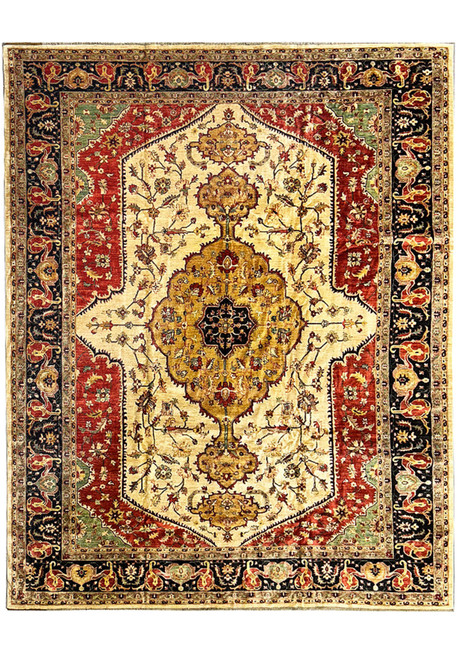
12 x 16 Oriental Ziglar Rug
- SKU
- F-6487
- ORIGIN
- European Rugs
- DESIGN
- French & Aubusson Rugs
- SIZES
- 12x16
- SHAPES
- Rectangular Rugs
| Size in ft: | Width: 12' x Length: 16' |
| Size in Inch: | Width: 144" x Length: 192" |
| Size in meters: | Length: 4.88 x Width: 3.66 m |
| Colors: | Ivory, Periwinkle Blue, Burgundy, Green, Lavender, Apricot |
| Shape: | Rectangular |
| Woven: | 100% Hand-knotted | Handmade |
| Foundation: | Cotton |
| Pile: | |
| Age: | 1950's | Mid-century |
| Design: | French Floral | Arched Vine Lattice Panels | All Over |
| Origin: | French |
| Condition: | Excellent | Full even pile |
12' x 16' French Rug | Ivory Floral Panel Field | 1950s Hand-Knotted Wool
A 1950s French floral piece at true room scale, this 12' x 16' rug is hand-knotted in wool on a cotton foundation and drawn in the formal French garden manner: upright flowering plants set one to a compartment across a soft ivory ground, framed by a periwinkle blue border of alternating cartouches and rosette medallions. The pile is full and even with no bald areas, the selvedges and ends are sound, and the folded corners in the detail photos show a tight, regular back. Pieces of this footprint usually carry a freight surcharge somewhere else; here it ships free, and it sits naturally in the group of oversize 12x16 rugs that anchor a great room or a long dining table. Every rug we sell ships with a certificate of authenticity.
Design and Motifs
The field is a true all over floral design with no central medallion, built from 5 vertical columns of slender blue stems that arch into ogee panels. Each panel holds a single flowering plant: lilies, tulips, carnations, a many petalled garden rose, some rising from a small tufted base and others leaning across the compartment on a curved stem. Rows are separated by chains of small burgundy 8 petal rosettes with pale ice blue centers, a device repeated along the inner guard stripe so the whole layout reads as one continuous trellis. The main border alternates lobed blue cartouches, each centered on a green and apricot rosette, with ivory panels of scattered blossom and serrated leaves, and the 4 corners are resolved cleanly rather than cut off, which is the mark of a properly drawn cartoon. A narrow rosette chain and a fine vine stripe finish the outer edge.
A Quiet Ivory Ground With Periwinkle and Burgundy
The ground is a warm ivory that reads closer to cream or light champagne in daylight, and it carries the entire composition without ever going stark white. Against it the palette is deliberately soft: a dusty periwinkle blue for the lattice stems, the main border and the cartouches, deep burgundy used almost entirely as outline and in the small rosettes, and a pair of greens, one sage and one deeper olive, for the leaves and stalks. The blossoms bring in mauve and lavender, pale apricot, muted gold and a chalky ice blue, with the occasional orange marigold as a spark. Because the strong burgundy appears only in thin lines and tiny flower heads, the overall effect is light and airy rather than formal, and the rug works with painted furniture, pale oak and stone floors as easily as it does with darker antiques.
French Tradition and the Quality of the Weave
French floor coverings of this type descend from the court manufactories that gave Europe the Savonnerie knotted pile and the Aubusson flatweave, and from the 18th century onward the house style was a garden rendered as architecture: compartments, trellises, rosette chains and single specimen flowers instead of the endless vine of the East. This 1950s example is hand-knotted with a wool pile, not woven flat and not tufted, and the folded views show a dense, straight back with the pile packed tightly enough to hold single knot outlines around every petal and leaf. That fineness is what keeps a plant with 7 or 8 separate colors legible at 12 feet across. Buyers often ask where a piece like this sits next to the weaving traditions of the East, and our guide on the difference between Persian and Oriental rug categories is the clearest explanation we have written.
12 x 16 Oriental Ziglar Rug
Ask about this rug
This piece is the only one of it, so the things worth knowing about it are particular to it. If you want to talk through the size, the colour in your own light, or the weave, speak to someone here first.
Related rugs
-

12 x 14'5 Oriental Ziglar Rug
$6,600.00 -
12 x 15 Ziglar Oriental Rug
$14,280.00 -

12 x 16'3 Oriental Ziglar Rug
$10,560.00 -

12 x 16 Oriental Heriz Rug
$4,790.00