Watch the film
| Size in ft: | Width: 13' x Length: 22'3" |
| Size in Inch: | Width: 156" x Length: 267" |
| Size in meters: | Length: 6.78 x Width: 3.96 m |
| Colors: | Antique Rustic Red, Blue |
| Shape: | Rectangular |
| Woven: | 100% Hand-knotted | Handmade |
| Foundation: | Cotton |
| Pile: | |
| Age: | 1930's | Antique |
| Design: | Antique Kashan | Tree of Life with Birds and Deer | All-over Field |
| Origin: | Persian Kashan | Made in Persia |
| Condition: | Very Good | Antique patina consistent with age |
13' x 22'3" Persian Kashan Rug | 1930s Antique Tree of Life with Birds and Deer
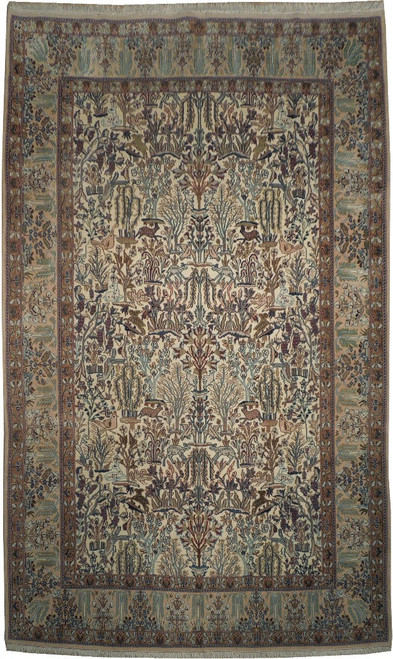
This is a true palace piece, a 13' x 22'3" antique Persian Kashan woven in the 1930s and still holding its drawing, its pile and its dignity after roughly 90 years on the floor. The whole field is a garden: rows of flowering trees rising out of the rustic red ground, with deer, rabbits and small perched birds hidden among the blossoms, framed by a deep indigo border of large palmettes and scrolling vine. At 22 feet and 3 inches long it belongs in the small group of genuine oversize Persian rugs that were commissioned for ballrooms and great halls rather than ordinary rooms. Hand-knotted in fine wool on a cotton foundation, it ships with a certificate of authenticity and free freight delivery to all 50 states.
Please Note About the Photographs:
Several photographs show faint horizontal lines and lighter patches across the field. Those are fold marks and shadows from storing a rug of this weight rolled and stacked on a pallet. They are not wear, not fade and not damage, and they relax once the rug is laid flat. Every rug leaving our warehouse is professionally steamed and pressed before shipping.
Design and Motifs
The field is laid out as a repeating garden panel rather than a single medallion, which is the harder composition to hold over 22 feet because every row has to line up with the one before it. Slim flowering trees grow upward in staggered ranks, each one carrying open rosettes, 8 petal blossoms, curling serrated leaves and long feathery boteh forms. Down at the base of the trees the weaver placed the story: a leaping deer with its head turned back, a seated rabbit tucked behind a clump of iris, and small birds settled on the upper branches. The animals appear in the same positions across the field, so they read as a rhythm rather than as a picture, and they are drawn in camel and apricot wool so they lift clearly off the red ground. The main border is a broad indigo band of large fan palmettes alternating with rosette clusters on a continuous vine, held between reciprocal guard stripes in salmon and camel that carry their own miniature flowerheads. The corners resolve cleanly, a good sign of a proper cartoon and an experienced master weaver at the loom.
A Rustic Red Field Against Deep Indigo
The ground is an antique rustic red that has mellowed toward raspberry and old rose in the open areas and stays deeper, almost brick, where the pile sits fuller. That variation is natural abrash from hand-dyed wool and it is exactly what a 1930s piece should look like; a flat, uniform red would be the warning sign. Against it the drawing is worked in two registers of blue, a dark indigo that outlines the palmettes and vine, and a softer sky blue used for leaves, rosette centers and the deer enclosures. Camel, apricot and honey tones carry the tree trunks, the animals and the guard stripes, with small touches of ivory in the rabbits and in the fine outline lines. The border runs a saturated navy that anchors the whole field and makes the red read warmer. Under lamplight the wool takes on a low sheen, and the palette shifts toward rose and copper in the evening, cooler and more blue at midday.
Kashan Weaving and the 1930s Workshops
Kashan sits in central Persia north of Isfahan and has been a weaving city since the Safavid court workshops, with a reputation built on soft lustrous local wool and precise curvilinear drawing. When you watch Shark Tank there is a Persian Kashan on the floor, which is how most Americans have seen the type without knowing its name. The 1930s was a strong period for the city: the looms were long enough for palace commissions, the dyes were still largely natural, and the pictorial garden designs with animals were reserved for the better workshops because they demanded a full cartoon and a weaver who could hold a curved line. The back of this piece shows an even, tightly packed knot across the full 13 foot width, with straight selvedges and the original cotton fringe still present at both ends. Points like the depth of the pile, the abrash in the red and the drawing style are the same markers used when dating an oriental rug, and they all place this one firmly in the pre-war Kashan group.
13' x 22'3" Persian Kashan Rug | 1930s Antique Tree of Life with Birds and Deer
Ask about this rug
This piece is the only one of it, so the things worth knowing about it are particular to it. If you want to talk through the size, the colour in your own light, or the weave, speak to someone here first.