Watch the film
| Size in ft: | Width: 3'3" x Length: 13'3" |
| Size in Inch: | Width: 39" x Length: 159" |
| Size in meters: | Length: 4.04 x Width: 0.99 m |
| Colors: | Dark Brown, Ivory, Rust, Rose Pink, Black, Blue, Burgundy |
| Shape: | Runner |
| Woven: | 100% Hand-knotted | Handmade |
| Foundation: | Cotton |
| Pile: | Wool and Silk |
| Age: | 2000s | Never used |
| Design: | Mahi | Herati Fish Pattern | 4 Lobed Medallions |
| Origin: | Persian Tabriz | Made in Persia |
| Condition: | Perfect | Never used |
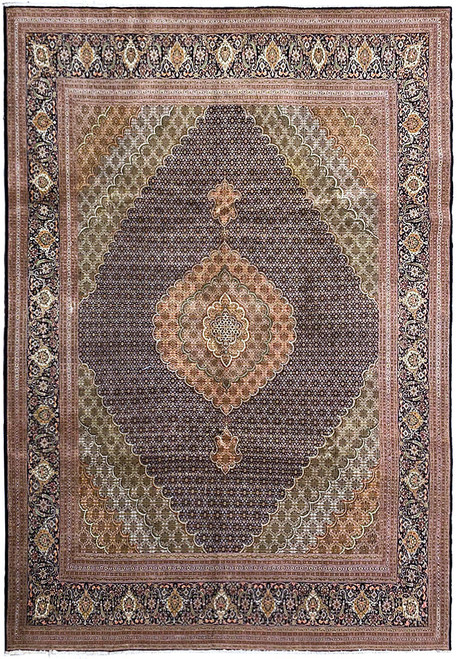
3'3" x 13'3" Persian Tabriz Runner Rug | Mahi Herati Design | Wool & Silk, Never Used
This is a full 13'3" of Mahi weaving, the design Tabriz is best known for, worked at a scale most runners never attempt. The rug was woven in the 2000s and has never been on a floor: the pile stands tall and even from end to end, the fringe is untouched, and the selvedges are tight and square. Wool and silk share the pile, so the small floral heads catch light while the ground stays matte, and the whole 39" width stays flexible enough to lie flat against a baseboard. At this length it is a natural hallway runner, though it works equally well down a long galley kitchen or a stair landing corridor. Every rug we ship carries a certificate of authenticity confirming origin, materials and hand-knotted construction.
Design and Motifs
The field is a continuous Mahi, or herati, lattice: diamond frames each holding a rosette, with four curved lanceolate leaves turned outward at the corners. Those leaves are the fish that give the pattern its name, and here they are drawn small and repeated relentlessly, which is exactly how a good Tabriz workshop shows off its knot count. Running down the center are 4 lobed medallions, each with an ivory outline, a rust and salmon interior of layered petals, and a small pendant at either end that reaches into the field. The main border carries alternating rosettes and dark cartouche-style palmettes linked by a thin vine, framed on both sides by narrow guard stripes of tiny star flowers. The corners resolve cleanly, with the border drawing turning the angle without breaking the repeat, a detail that separates workshop weaving from village work.
Color Story: Brown Tracery on Ivory, Framed in Rose
Up close the ground is ivory, but the herati tracery is drawn so densely in dark brown and black that from standing height the field reads as a warm, tweedy brown, which is why dark brown is listed as the dominant color. Inside that tracery the weavers dropped in pinpoints of sky blue, soft green, orange, burgundy and deep navy, so the surface has real chromatic life when you crouch down to it. The medallions shift the temperature: rust, terracotta and apricot cores ringed in ivory, with small burgundy and green florets inside. The main border is the surprise, a clear rose pink that is softer and more decorative than the usual Tabriz red, holding orange and ivory palmettes with black-ground cartouches at intervals. It is a palette that sits comfortably with warm oak, walnut and painted trim rather than fighting them.
Tabriz Weaving and the Mahi Tradition
Tabriz sits in northwest Persia and has been a commercial weaving capital for centuries, with workshops that measure their own fineness in Raj, the number of knots per gereh across the width. The Mahi pattern is the house specialty there, and it is an honest test of a workshop: the herati repeat only holds its shape if the knots are small and the drawing is disciplined, otherwise the fish leaves blur into the lattice. On this runner the repeat stays crisp across all 13'3", including through the medallion junctions where the field pattern has to bend around the ivory outlines. The cotton foundation is tightly packed, the back is even and legible motif for motif, and the wool is springy with a quiet silk sheen in the floral accents. A never-used piece at this length is uncommon, since most long Tabriz runners were bought for corridors and put straight to work.
3'3" x 13'3" Persian Tabriz Runner Rug | Mahi Herati Design | Wool & Silk, Never Used
Ask about this rug
This piece is the only one of it, so the things worth knowing about it are particular to it. If you want to talk through the size, the colour in your own light, or the weave, speak to someone here first.