Watch the film
| Size in ft: | Width: 3'4" x Length: 4'7" |
| Size in Inch: | Width: 40" x Length: 55" |
| Size in meters: | Length: 1.40 x Width: 1.02 m |
| Colors: | Beige, Blue, Pink |
| Shape: | Rectangular |
| Woven: | 100% Hand-knotted | Handmade |
| Foundation: | Cotton |
| Pile: | |
| Age: | Circa 1910s | Antique |
| Design: | Farahan Sarouk | Lobed Floral Medallion | Navy Spandrels |
| Origin: | Persian Farahan Sarouk | Made in Persia |
| Condition: | Excellent |
3'4" x 4'7" Antique Persian Farahan Sarouk Rug | Ivory Field & Rose Medallion | 1910s
This is a genuine turn of the century piece, a small antique Persian Farahan Sarouk rug woven around the 1910s and measuring 3'4" x 4'7". Everything about it reads early: the soft cotton foundation, the tight village knotting, the dry mineral pinks and the deep indigo that has aged to near black. The wool has the glassy, slightly waxy handle that only old hand-spun fleece develops after a century of use and careful washing, and the pile is even from end to end with the gentle patina collectors look for. At this scale it works as a bedside rug, a reading chair rug or a piece to hang and frame, and it is one of the easiest ways to bring a real pre-1920 Persian weaving into a room. A certificate of authenticity is included with every rug we ship.
Please Note About the Photographs:
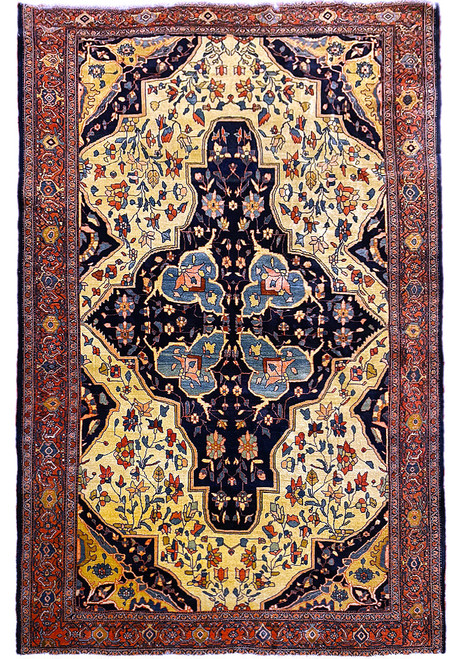
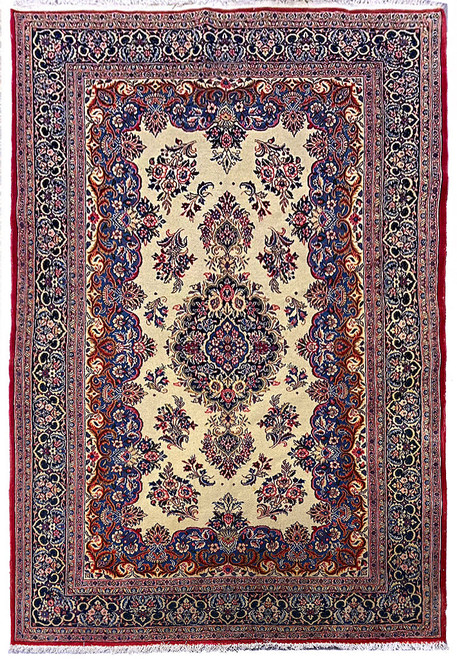
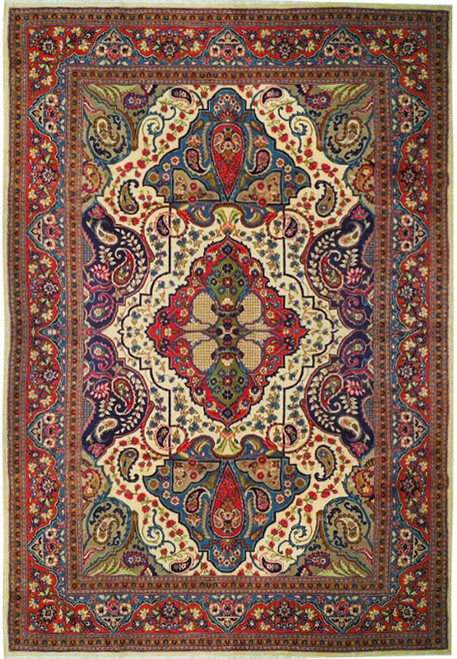
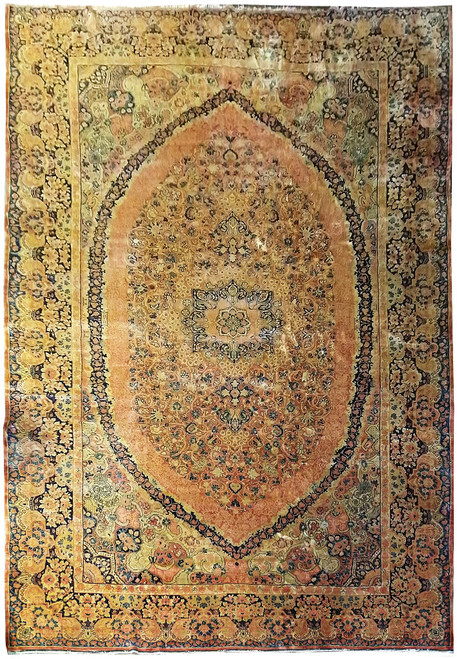
The first studio photograph was taken under bright white lighting and renders the rug lighter and cooler than it is in person. The floor and close-up photographs are the accurate reference: the field is a warm ivory to camel, the medallion a deeper salmon rose, and the main border a dark indigo that reads almost black in normal room light.
Design and Motifs
The drawing is classic Farahan Sarouk: a single large lobed medallion set on an open ivory field, outlined twice in a fine blue line and anchored top and bottom by a small pendant cartouche. Inside the medallion, paired serrated leaves and stylized vases of blossom mirror each other across a small pale lozenge at the exact center, with scattered 4 petal and 8 petal flowerheads filling the rose ground. The field around the medallion is not crowded; it carries loose flowering sprays and single blossoms that give the composition air. Deep navy spandrels fill all 4 corners with curling vine and large open flowers, and the main border repeats an alternating rhythm of octagonal rosettes and blue palmette blossoms on a soft rose ground, framed by narrow vine guard stripes. It is a formal court style layout drawn with village directness, which is exactly why these pieces have never gone out of fashion.
A Closer Look at the Colors
The palette is built on three voices. The field is a warm ivory and beige that shades toward pale camel where the old wool has mellowed, and it carries the whole design without ever feeling stark. The medallion is a dusty salmon rose, a dry pink with a terracotta undertone that deepens slightly toward the outline and softens toward the center lozenge. Against those two, the indigo of the spandrels and the main field ground reads almost black at a distance, then opens up in daylight into a true dark blue. Through the border and the flowerheads run clear mid blues, a muted sage and olive green, pale straw yellow and small touches of apricot, all of them natural dye tones that have aged together rather than fading unevenly. Blue, pink and beige in this proportion sit comfortably with oak floors, painted furniture and both warm and cool wall colors.
Origin and Weaving Quality
The Farahan district lies in west central Persia, north of Arak, and its weavers supplied some of the most admired small rugs of the late 19th and early 20th centuries. Farahan Sarouk describes the marriage of that district's fine, flat, tightly packed weave with the Sarouk medallion vocabulary, and it is the reason these rugs feel thinner and more precise in the hand than later commercial pieces. The back of this rug shows the story clearly: crisp knot definition, a cotton warp and weft, straight sides and original woven ends with modest fringe, all consistent with the age given. Structure, dye behavior and drawing are the three things a specialist reads when judging a piece like this, and if you want to understand the method yourself, our guide on how to date an oriental rug walks through the same checks we used here.
3'4" x 4'7" Antique Persian Farahan Sarouk Rug | Ivory Field & Rose Medallion | 1910s
Ask about this rug
This piece is the only one of it, so the things worth knowing about it are particular to it. If you want to talk through the size, the colour in your own light, or the weave, speak to someone here first.