Watch the film
| Size in ft: | Width: 4'10" x Length: 6' |
| Size in Inch: | Width: 58" x Length: 72" |
| Size in meters: | Length: 1.83 x Width: 1.47 m |
| Colors: | Burgundy, Blue |
| Shape: | Rectangular |
| Woven: | Hand-Knotted |
| Pile: | Finest Wool |
| Origin: | Persia |
| Design: | Kashan Poem Writing |
| Age: | 1900's |
| Condition: | Excellent |
4'10" x 6' Persian Kashan Rug | Poem Border, Vase & Love Birds | Antique 1900s Silky Wool
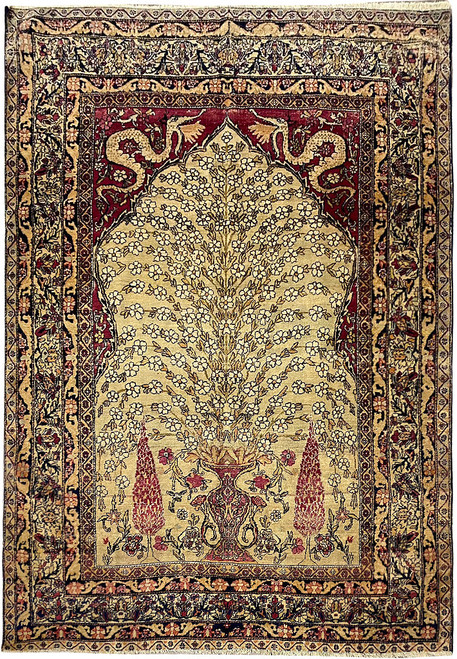
This is a piece that was drawn to be read as much as walked on. Woven in the 1900s, the 4'10" x 6' format holds a complete architectural scene: an arch, two blue columns, a great footed vase of flowers, and a wide burgundy border filled with Persian poetry in navy calligraphy. The wool has the low, liquid sheen that collectors look for in antique Persian Kashan rugs, and the pile is still full and even across the field, with original ends and sides. It ships with a certificate of authenticity documenting origin, age, materials and construction.
Please Note About the Photographs:
The field reads brighter and more crimson in the full flat-lay photograph than it does in person. The close-up images taken in natural light are the truer reading: a deep wine burgundy that shifts toward raspberry where the silky wool catches the light. That shift is the natural luster of the pile, not a colour change or fading.
Design and Motifs
The field is laid out as a niche. Two narrow indigo columns, filled with a rippling wave stripe and capped with gold capitals, rise on either side and support a shallow arch crowned by a hanging lamp. Between them a large navy vase with ribbed handles holds a spray of blossoms that climbs the full height of the field: 8 petal rosettes, palmettes, carnations, feathered saz leaves and a central blue cartouche on the stem. Two birds face each other near the top of the spray, one ivory and one blue, the detail that gives this rug its love bird name. Smaller vases and a single boteh sit in the lower corners. The main border is the reason to own it: broad burgundy panels carrying lines of Persian verse in navy calligraphy, each cartouche separated and framed by saffron gold guard stripes of linked rosettes. Writing borders of this quality were workshop commissions, drawn by a designer who could set script and floral work in the same rhythm.
A Burgundy Field Lit by Indigo and Saffron
The ground is a saturated wine burgundy that lifts to raspberry red along the crest of the pile, so the field changes tone as you move around it. Against that ground the palette is built almost entirely on blue: near-black navy for the calligraphy, the vase body and the outlines, a mid indigo for the columns and larger blossoms, and a soft powder sky blue for the smaller flower heads and bird. The saffron gold guard stripes are the only warm break, and they run as a bright frame on all 4 sides, repeated in the column capitals and in the base of the great vase. Ivory appears in the fringe and in scattered petals, coral pink flickers through the border rosettes, and olive green runs through the leaves and stems. Orange is used sparingly, a few flower centers and one accent on the vase, which keeps the whole reading cool and jewel-like rather than hot.
Kashan, the City and the Weave
Kashan sits in central Persia, north of Isfahan, and has been a court weaving town since the Safavid period. Its reputation rests on soft, lustrous local wool and on drawing done at a knot count fine enough to carry curved line, which is exactly what a script border demands. Kashan is also the rug most Americans have seen without knowing the name: when you watch Shark Tank there is a Persian Kashan on the floor. The back of this piece, visible in the last photographs, shows the tight regular knotting and cotton foundation of a city workshop rather than village work, and the ends and selvedges are still original, one of the first things to check when you date an antique Oriental rug. A century of use has taken nothing off the pile depth, which is unusual for a poem rug of this age.
4'10" x 6' Persian Kashan Rug | Poem Border, Vase & Love Birds | Antique 1900s Silky Wool
Ask about this rug
This piece is the only one of it, so the things worth knowing about it are particular to it. If you want to talk through the size, the colour in your own light, or the weave, speak to someone here first.