Watch the film
| Size in ft: | Width: 4'3" x Length: 6' |
| Size in Inch: | Width: 51" x Length: 72" |
| Size in meters: | Length: 1.83 x Width: 1.30 m |
| Colors: | Beige, Blue, Rust, Olive Green |
| Shape: | Rectangular |
| Woven: | Hand-Knotted |
| Pile: | 1/4 Wool Thin Side |
| Origin: | Persia |
| Design: | Prayer Tehran |
| Age: | 1900's |
| Condition: | Excellent |
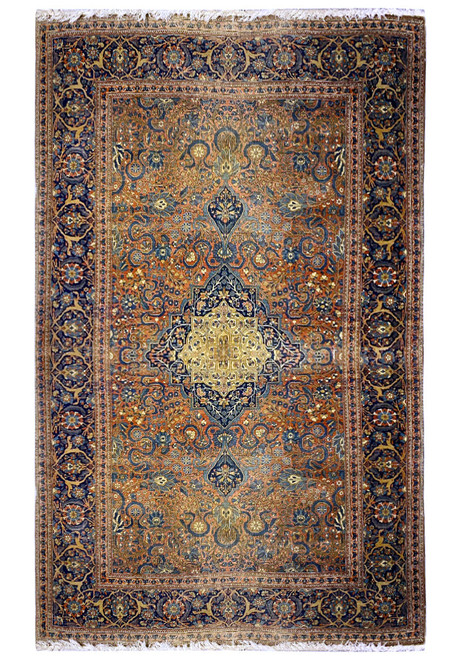
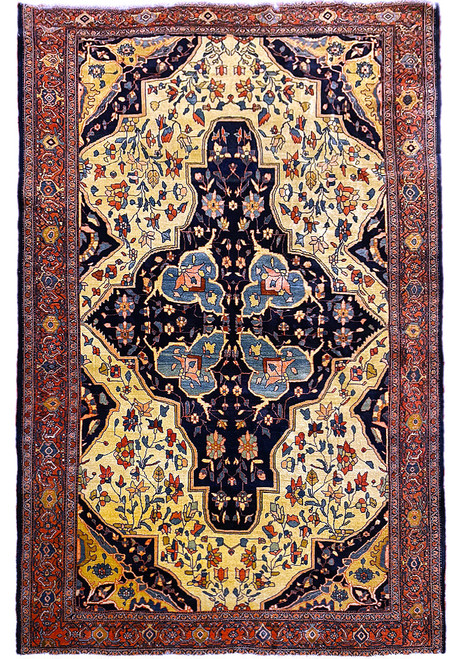
4'3" x 6' Antique Persian Tehran Prayer Rug | Vase, Dragons & Tree of Life | Circa 1900s
Antique Tehran rugs are the rarest thing in the Persian city weaving world, and this 4'3" x 6' prayer piece from the 1900s is a textbook example of why collectors chase them. A single flowering tree rises out of a footed vase and fills the whole beige field with small white blossoms, framed by a mihrab arch whose deep red spandrels hold a pair of confronted dragons. It is drawn with the delicacy of a miniature painting rather than a floor covering, and at this 4 x 6 Persian rug scale it works equally well on the floor of a study or mounted on a wall. Hand-knotted in wool on a cotton foundation, the pile sits low and silky after more than a century, which is exactly what you want to see on a piece of this age. Every rug ships with a certificate of authenticity, and if you want to understand how pieces like this are placed in time, our guide on how to date an oriental rug walks through the same clues we used here.
Please Note About the Photographs:
Several images are macro close-ups taken under strong light, which exaggerates the low, silky pile and the soft color shifts of the natural dyes. Those tonal variations are abrash, a natural feature of hand-dyed antique wool, not fade or damage. The fringes are intact at both ends as shown, and the rug is professionally steamed and pressed before it ships.
Design and Motifs
The composition is a directional prayer design. An arched mihrab opens over the field, and inside it a slender vase with scrolling handles supports a tree that branches into hundreds of 5 petal white blossoms on fine stems, each outlined in dark indigo so the flowers read crisply against the pale ground. Two tall cypress cones in rose madder flank the vase at the base, with single roses, poppies and pomegranate blossoms scattered around them on curling leafy stems. The spandrels above the arch are the most unusual element: against a deep red ground, 2 long-bodied dragons face one another across the apex, their scrolling tails turning into vine work, a Safavid-era motif that almost never survives into small city prayer pieces. The border system is generous for the size, with a wide navy main band of palmettes and flowering vines, an amber floral minor band on either side, and slim reciprocal guard stripes of rosettes running the full 4 corners.
Color Palette
The field is a warm beige that moves between straw, camel and pale olive green as the light crosses it, and that olive undertone gives the blossoms their soft ivory glow rather than a stark white. Against it, the flower heads are ivory with small rust and apricot centers, the leaves a muted sage and tobacco. The arch spandrels are a deep oxidized red, almost claret where the dye has settled, and the same rose madder returns in the 2 cypress trees and the body of the vase, shifting from raspberry at the top to a dusty rose at the base. The borders carry the cool weight: a near-black indigo blue main band with amber, salmon and coral flowers drawn across it, tied back to the field by the golden guard stripes. Blue, rust, olive green and beige is a restrained antique palette that sits easily with walnut furniture, parquet and cream plaster walls.
Tehran Weaving and Origin
Tehran produced hand-knotted rugs for only a short window, and the output was tiny compared with the great commercial centers of Persia, which is why genuine antique Tehran pieces surface so rarely on the market. The workshops there wove for a court and merchant clientele in the capital, taking their drawing from classical Persian painting and manuscript illumination rather than from village pattern books. You can see that training in this rug: the blossom stems are curved freehand, no 2 flower heads are quite identical, and the dragons are outlined with the confidence of a designer used to working on paper. The weave is a fine, tight city knot on a cotton foundation, close enough in the back to hold detail at the scale of a single blossom, and the wool has taken on the low sheen that only a century of use gives. For a collector looking for a small, framed-quality antique with real scarcity behind it, a signed-quality Tehran prayer rug of this age is about as uncommon as Persian city weaving gets.
4'3" x 6' Antique Persian Tehran Prayer Rug | Vase, Dragons & Tree of Life | Circa 1900s
Ask about this rug
This piece is the only one of it, so the things worth knowing about it are particular to it. If you want to talk through the size, the colour in your own light, or the weave, speak to someone here first.