Watch the film
| Size in ft: | Width: 4'3" x Length: 7'1" |
| Size in Inch: | Width: 51" x Length: 85" |
| Size in meters: | Length: 2.16 x Width: 1.30 m |
| Colors: | Rust, Blue, Olive, Ivory, Gold |
| Shape: | Rectangular |
| Woven: | 100% Hand-knotted | Handmade |
| Foundation: | Cotton |
| Pile: | |
| Age: | 1900's | Antique |
| Design: | Haj Jalili Tabriz | Lobed medallion with pendants | All over floral field |
| Origin: | Persian Tabriz | Made in Persia |
| Condition: | Excellent | Antique |
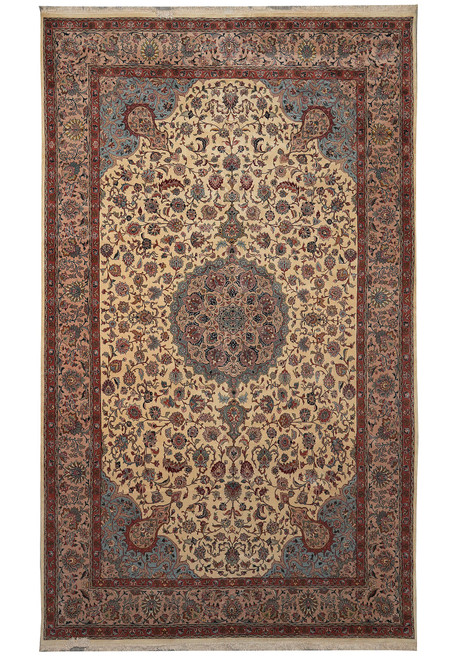
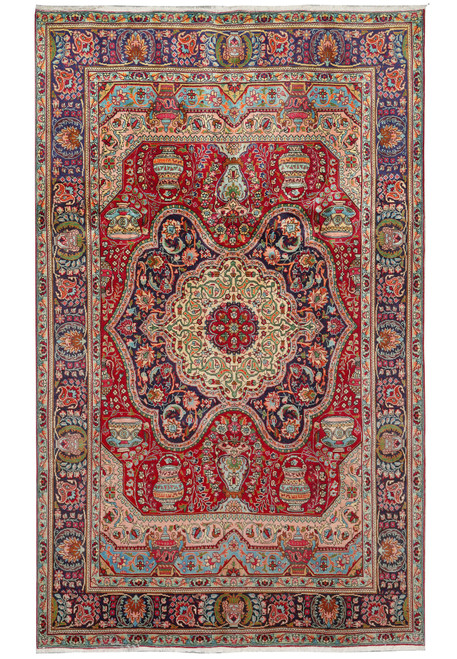
4'3" x 7'1" Antique Persian Tabriz Rug | Haj Jalili Design | Rust & Navy Floral Medallion | 1900s
This 4'3" x 7'1" antique Persian rug was woven in the early 1900s and is drawn in the Haj Jalili manner, the exacting Tabriz workshop style that collectors hunt for: miniature scale drawing, a copper to rust field, and a deliberately short pile that lets every knot show. The wool stands at about 1/4 inch, which is how these pieces were finished when new rather than a sign of hard use, and it is the reason the vine work still reads sharply more than a century on. At 51 inches by 85 inches it is a true estate piece, one of a kind, and it ships with a certificate of authenticity.
Please Note About the Photographs:
Several of these images were shot at an angle under studio lighting, so the far end of the field reads paler and cooler in those frames than it does in the flat overhead photo. The warm rust and indigo seen in the overhead and close-up shots are the true tones. The gentle shifts of tone across the field are abrash, the natural variation of hand-dyed wool that antique Persian weavings are prized for.
Design and Motifs
The center holds an 8 point ivory and gold medallion filled with tiny mirrored blossoms and lattice work, set inside a deep indigo surround of curling leaves and white tendrils. Slender pendants run off the top and bottom into the field, each ending in a lobed cartouche of blue and cream flower heads. Around them the field is packed edge to edge with a curvilinear all over pattern: scrolling vines, split palmettes, rosettes, small star flowers and paired serrated leaves, none of it repeating lazily, all of it drawn at a scale that only a fine weave allows. The wide main border carries alternating rosette cartouches and floral bouquets joined by a gold arabesque, framed by narrow guard stripes of blossom meander and a tiny reciprocal zigzag along the outer edge. Both corners of the border turn cleanly, the mark of a cartoon worked out before the first knot was tied.
Rust, Indigo and Olive: The Color Story
The field is a warm rust that moves between terracotta, salmon and a softer apricot as the light crosses it, the kind of depth only slow madder dyeing and a hundred years of settling produce. Against it the borders are a saturated indigo navy, dark enough to throw the gold arabesque forward and to make the pale flower heads glow. Between those two poles sit the supporting tones: a dusty mid blue in the leaves and vine work, olive and old gold in the stems and cartouche grounds, and small hits of ivory and cream in the blossoms that keep the dense drawing legible. The medallion is the lightest note in the rug, a buttery ivory gold that pulls the eye straight to the center. Nothing here is harsh or synthetic; the whole palette is mellow, warm and easy to live with next to walnut, brass and unbleached linen.
Tabriz Weaving and the Haj Jalili Name
Tabriz sits in northwest Persia and has been the country's commercial weaving capital for centuries, working to the Raj system, where fineness is counted across the width of the rug. Haj Jalili worked out of Marand, a weaving town roughly 40 miles northwest of Tabriz that weaves in the Tabriz tradition and to Tabriz standards, and whose output has always been sold within the Tabriz group. His name survives because of what he demanded of his weavers: very short pile over a tight cotton foundation, copper and rust grounds, and drawing fine enough that the design holds together at a scale most workshops would not attempt. This piece shows all of it, from the pin sharp guard stripes to the clean corner resolutions visible in the close-up photographs. If you want to understand the tell tale signs of age in a weaving like this one, from the low even pile to the mellowed dye tones, our guide on how to date an oriental rug walks through exactly what to look for.
4'3" x 7'1" Antique Persian Tabriz Rug | Haj Jalili Design | Rust & Navy Floral Medallion | 1900s
Ask about this rug
This piece is the only one of it, so the things worth knowing about it are particular to it. If you want to talk through the size, the colour in your own light, or the weave, speak to someone here first.