Watch the film
| Size in ft: | Width: 7'10" x Length: 9'10" |
| Size in Inch: | Width: 94" x Length: 118" |
| Size in meters: | Length: 3.00 x Width: 2.39 m |
| Colors: | Beige, Tan, Brown, Rust, Olive Green, Cream |
| Shape: | Rectangular |
| Woven: | 100% Hand-knotted | Handmade |
| Foundation: | Cotton |
| Pile: | |
| Age: | New | Never used |
| Design: | Haj Jalili | Central Medallion | Floral Spandrels |
| Origin: | Agra | Made in India |
| Condition: | Perfect | Never used |
7'10" x 9'10" Agra Rug | Haj Jalili Medallion Design | Natural Wool, New & Never Used
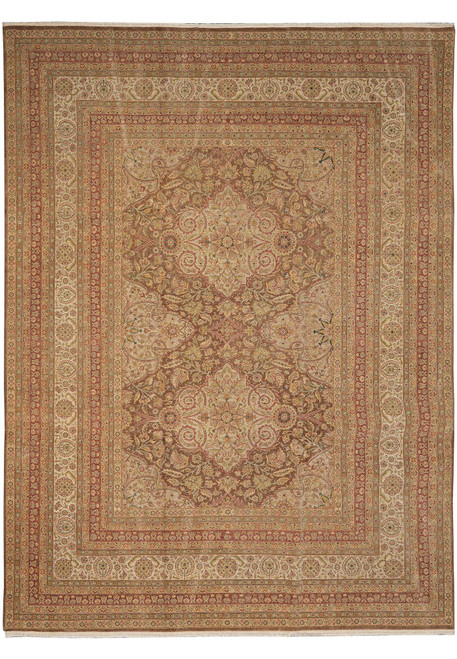
This is a hand-knotted Agra rug measuring 7'10" x 9'10", woven in India in natural wool on a cotton foundation and drawn after the celebrated Haj Jalili medallion layout. It has never been on a floor: the pile is full, the ends and sides are original and tight, and the wool still carries the dry silky handle of a rug straight off the loom. At 94" x 118" it falls squarely into the most useful room size there is, and buyers shopping 8x10 hand-knotted rugs will find this one unusually quiet in color for a formal medallion design. Every rug we ship travels with a certificate of authenticity confirming the weave, the materials and the country of origin.
Please Note About the Photographs:
The first catalogue photograph was shot under cooler studio light and reads greener and flatter than the rug actually is. The floor photographs and the close-ups show the true tone: a warm beige and tan field with brown, rust and olive drawing. Please judge the color from the floor shots and the detail images.
Design and Motifs
The layout is a classic Haj Jalili composition: a single elongated 8 sided medallion outlined in dark brown and rust, filled with a small vase and leaf spray, and flanked by two pointed pendants. Around it the weaver has drawn a wide open ground of thin scrolling vine, small rosettes, serrated leaves and delicate floral sprays rather than a crowded all over field, which is exactly what gives this drawing its calm. All 4 corners carry large spandrels with stepped outlines, cypress forms and architectural columns that echo the medallion instead of competing with it. The border system runs 5 bands deep: a main band of alternating palmettes and vine, framed by narrow reciprocal guard stripes and outer bands of small stars and stylized blossoms. The curved line work is what to look at closely in the medallion photograph, since a flowing arabesque this smooth only holds together at a genuinely fine knot count.
A Warm Beige and Tan Palette with Rust and Olive Drawing
The field is a soft wheat beige that shifts toward cream near the medallion and toward warm tan under the spandrels, with the natural abrash of hand-spun wool visible as gentle horizontal banding across the open ground. The medallion outline is a deep chestnut brown broken by rust and terracotta, and the pendants repeat the same pairing. Scattered through the vine work are olive and sage greens, a soft coral pink in the rosettes, a muted blue-grey in the smaller blossoms and occasional charcoal accents that give the drawing its definition. The wide border sits a shade darker than the field in tan and light olive, so the rug reads as one continuous warm neutral from across a room and only reveals its color range up close. This is a low contrast rug: it will sit under oak, walnut, cream upholstery and stone without fighting anything in the room.
Agra Weaving and the Haj Jalili Drawing
Agra in northern India has been a weaving center since the Mughal court workshops of the 16th and 17th centuries, and the city's modern looms remain among the best in the world for large hand-knotted work. India is where most of the world's good contemporary hand-knotted weaving is now done, and this piece shows why: even selvedges, a flat lie straight off the loom, dense natural wool and drawing that stays disciplined through every curve. The Haj Jalili name refers to the 19th century master weaver of Marand whose medallion compositions are still copied by the finest workshops, and this is an honest Indian interpretation of that drawing rather than a Persian piece. If you are weighing where a rug like this sits against Persian production, our guide to the Oriental rug category explains the difference in plain terms.
7'10" x 9'10" Agra Rug | Haj Jalili Medallion Design | Natural Wool, New & Never Used
Ask about this rug
This piece is the only one of it, so the things worth knowing about it are particular to it. If you want to talk through the size, the colour in your own light, or the weave, speak to someone here first.