Watch the film
| Size in ft: | Width: 4'11" x Length: 13'7" |
| Size in Inch: | Width: 59" x Length: 163" |
| Size in meters: | Length: 4.14 x Width: 1.50 m |
| Colors: | Red, Dark Slate Blue |
| Shape: | Runner |
| Woven: | 100% Hand-knotted | Handmade |
| Foundation: | Cotton |
| Pile: | 3/8" Wool |
| Design: | Hamedan | Stepped pole medallion | All-over floral field |
| Origin: | Persian Hamedan | Made in Persia |
| Condition: | Excellent |
4'11" x 13'7" Persian Hamedan Runner Rug | Red & Navy Pole Medallion | Village Wool
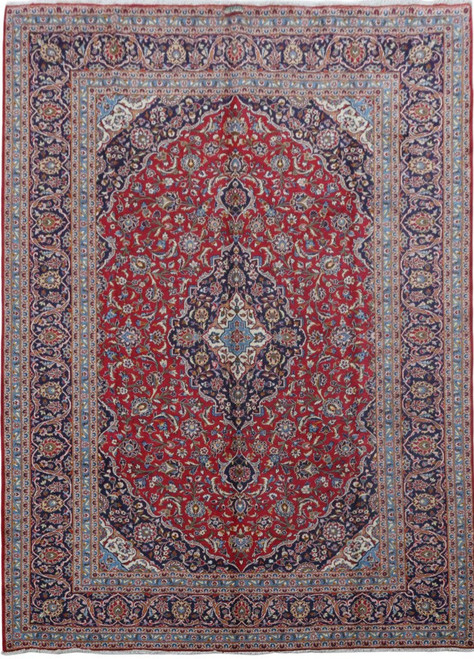
This is a full 13'7" of hand-knotted village weaving, and at 4'11" across it is considerably wider than the usual 2 ft 6 in corridor piece, which puts it in the gallery runner class rather than the narrow strip class. The field reads as a single continuous red panel carrying a chain of linked pole medallions, framed by a dark slate blue main border that holds the whole length together visually. The wool is the thick, springy Hamedan fleece that takes color deeply and wears for generations, set on a cotton foundation with a 3/8" pile that still stands full and even end to end. In a broad entry or a double-width corridor it does what few wide hallway runner rugs manage, covering the walking line without leaving awkward bare floor at the sides. It ships with a certificate of authenticity confirming the origin, materials and hand-knotted construction.
Please Note About the Photographs:
The soft line visible along one side in the first photograph is a fold mark from rolled storage, not wear, fade or damage. Marks like this relax on their own once the rug is laid flat, and every rug leaves us professionally steamed and pressed before shipping.
Design and Motifs
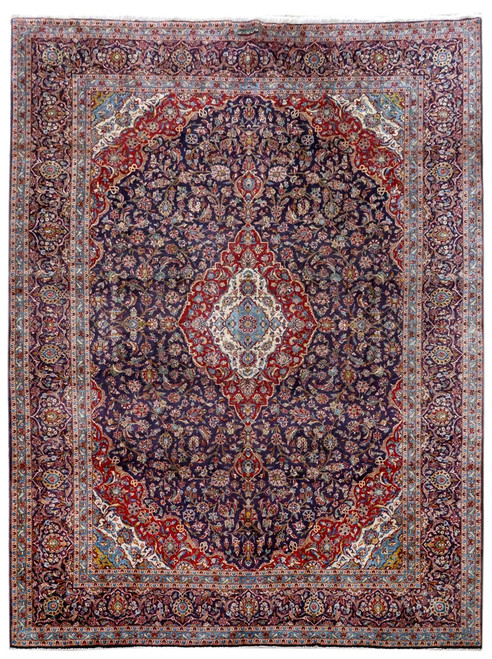
The drawing is the classic Hamedan village formula worked at length. An elongated hexagonal field runs nearly the full 13'7", closed at both ends by stepped navy spandrels filled with curling vine, and inside it three large stepped medallions sit in a pole arrangement down the center line. Each medallion is a navy ground crowded with 8 petal rosettes, tulip heads and paired serrated leaves, and the red ground between them repeats the same vocabulary at smaller scale: little boteh, rows of stacked squares, star rosettes and angular blossom clusters set on thin stems. Nothing is drawn with a curved compass line here. Every arc is built out of short steps, which is exactly what you want to see in genuine village work and what separates it from a city workshop copy. The main border carries a repeating rosette and leaf meander, flanked on both sides by a narrow reciprocal zigzag guard stripe that gives the long sides a crisp edge, and the end panels finish with upright flowering plants rather than a plain cut-off.
A Deep Red Field Against Dark Slate Blue
The palette is built on 2 strong tones with a handful of small lifts. The field is a deep madder red, saturated rather than orange, and it shifts slightly in tone along the length as the light moves across the pile, which is normal in hand-spun wool and gives the surface its depth. Against it the dark slate blue reads almost black in shadow and opens into a clear ink blue where the light catches the border and the medallion grounds, so the design changes weight depending on where you stand. Inside the navy shapes the weaver lit everything up with salmon pink and soft rose on the rosette petals, with small touches of ivory and pale tan on individual flower heads and on a few of the border leaves. Those lighter notes are used sparingly, which is why the rug stays quiet overall instead of looking busy. The ivory-toned fringe at both ends is the only bright break in an otherwise deeply colored piece.
Hamedan: Weaving in Western Persia
Hamedan sits in western Persia at the foot of the Zagros range, on the site of the ancient capital of Ecbatana, and it is the commercial hub for several hundred surrounding weaving villages. Rugs from the region are tied with the symmetrical Turkish knot on a cotton warp, usually single-wefted, which produces a flat, tightly compacted back and a rug that lies down obediently and takes traffic without complaint. The wool is the real asset: highland fleece with a high lanolin content that stays resilient underfoot and holds dye beautifully, which is why old Hamedan pieces so often keep their color long after finer city rugs have gone pale. Knot count here is not the point and never was. What you are buying is honest loom work at a useful running length, drawn from memory rather than from a cartoon, with the small asymmetries in the medallion spacing that prove a person and not a machine set the pattern.
4'11" x 13'7" Persian Hamedan Runner Rug | Red & Navy Pole Medallion | Village Wool
Ask about this rug
This piece is the only one of it, so the things worth knowing about it are particular to it. If you want to talk through the size, the colour in your own light, or the weave, speak to someone here first.