| Size in ft: | Width: 6'5" x Length: 9'1" |
| Size in Inch: | Width: 77" x Length: 109" |
| Size in meters: | Length: 2.77 x Width: 1.96 m |
| Colors: | Ivory, Teal Green, Blue |
| Shape: | Rectangular |
| Woven: | 100% Hand-knotted | Handmade |
| Foundation: | Cotton |
| Pile: | Wool & Silk |
| KPSI: | 60 Raj | Approx. 400 |
| Age: | 2000s | Never used |
| Signature: | Yes | Small woven cartouche in 2 upper corners |
| Design: | Tabriz Floral Medallion | All-over vine field | Corner spandrels |
| Origin: | Persian Tabriz | Made in Persia |
| Condition: | Perfect | Never used |
6'5" x 9'1" Persian Tabriz Rug | Ivory & Teal Floral Medallion | Wool & Silk, 400 KPSI, Signed
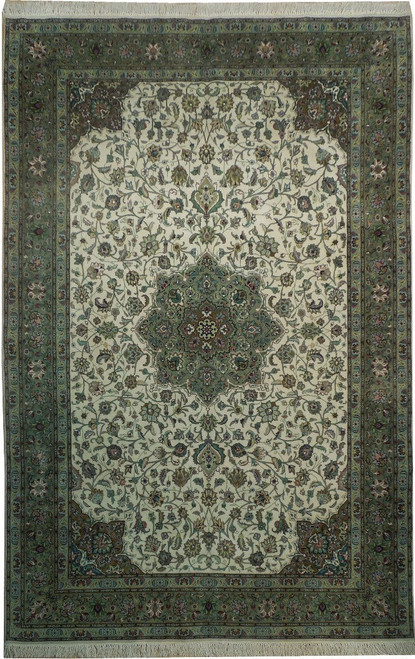
This is a workshop Tabriz woven at 60 Raj, roughly 400 knots per square inch, in wool with silk worked into the highlights, and it has never been on a floor. Held at an angle the silk lifts out of the pile in thin bright lines along the vine stems and inside the petal lobes, which is exactly where a good Tabriz workshop spends its silk. Two small cartouches carry a woven name in the upper corners, the mark of a named weaver rather than an anonymous commercial run. At 6'5" x 9'1" it sits in the most useful of all 6x9 Persian rugs proportions, and it ships with a certificate of authenticity documenting origin, materials and knot count.
Design and Motifs
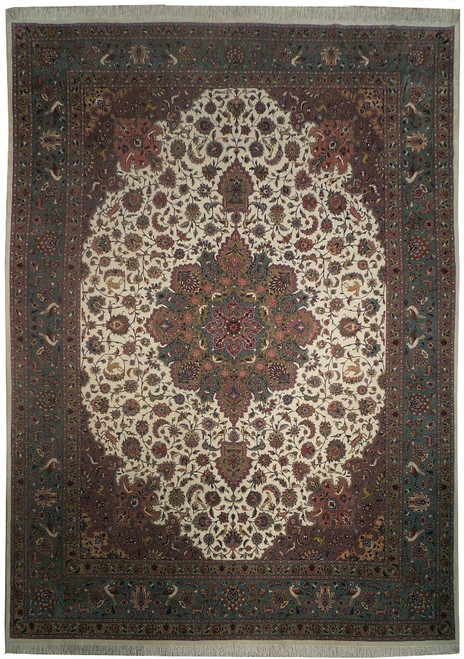
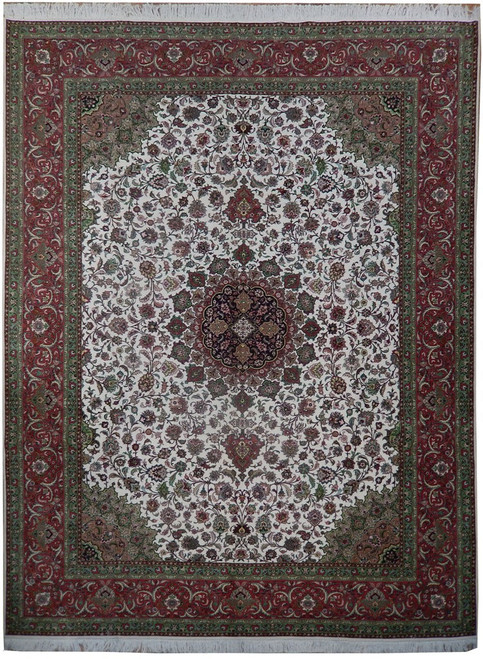
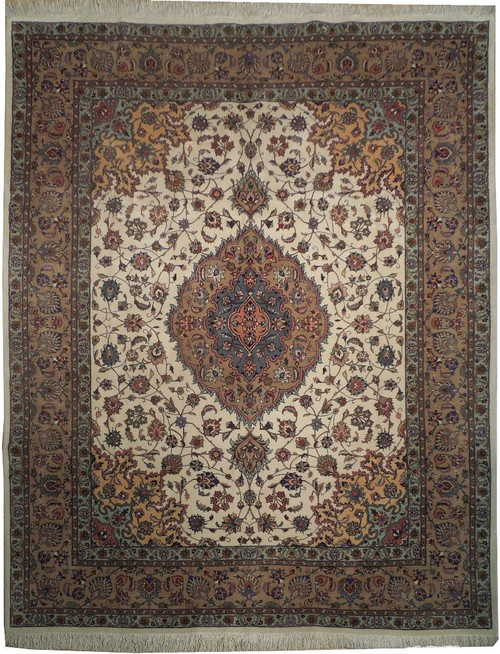
The center holds a layered 8 petal rosette medallion built in 3 rings: a small rose colored core with a tiny lattice panel at its heart, a ring of deep brown cartouche shaped lobes, then a ring of green and camel petals outlined in pale piping. Above and below the medallion the drawing extends into a cusped pendant rather than a plain finial, and all 4 corners carry stepped camel spandrels filled with dark palmettes and curling saz leaves. The ivory field between them is never left open: it runs a continuous all-over vine of palmettes, rosettes, carnations and split leaves, drawn in the curvilinear Tabriz manner where every stem actually resolves into a flower instead of trailing off. The main border repeats a large brown palmette alternating with paired rosettes on a teal ground, flanked by camel guard stripes of small 4 petal flowers and a fine barber pole outer edge.
The Ivory, Teal Green and Blue Palette
The ground is a warm ivory, closer to unbleached cream than white, which keeps the rug from reading cold in daylight. Against it the main border is a muted teal green, a grey leaning sea green rather than an emerald, and that same green reappears inside the medallion petals so the border and center speak to each other across the field. Blue is used as an accent only: small cornflower and indigo blossoms scattered through the vine, thin blue outlines around the central rosette, and dark navy dots in the spandrel palmettes. Between them sit camel and soft caramel tones in the corners and guard stripes, plus faded rose, terracotta and brown flower heads that supply the warmth. The overall effect is subdued and slightly antiqued, a palette that works over pale oak and reads well in low evening light.
Tabriz Weaving in Northwest Persia
Tabriz in northwest Persia measures fineness by Raj, the number of knots across a gereh of about 2.75 inches. 40 Raj is ordinary commercial goods, 50 Raj is fine, and 60 Raj, where this rug sits, is around 400 knots per square inch and is the point at which a workshop can hold a true curved line: the vine here bends without stepping, and the petal outlines stay crisp at a quarter inch. The back photograph shows the evidence, with the ruler laid across a tight, even, cotton warped weave and no slack or waviness in the rows. Tabriz weavers work on a hook, which is how they keep this density consistent over 9 feet of length, and the signed corners tell you the piece came off a named loom rather than a village order.
6'5" x 9'1" Persian Tabriz Rug | Ivory & Teal Floral Medallion | Wool & Silk, 400 KPSI, Signed
Ask about this rug
This piece is the only one of it, so the things worth knowing about it are particular to it. If you want to talk through the size, the colour in your own light, or the weave, speak to someone here first.