Watch the film
| Size in ft: | Width: 7'11" x Length: 10'10" |
| Size in Inch: | Width: 95" x Length: 130" |
| Size in meters: | Length: 3.30 x Width: 2.41 m |
| Colors: | Pale Red, Ivory, Navy Blue, Charcoal Brown, Slate Blue, Rust |
| Shape: | Rectangular |
| Woven: | 100% Hand-knotted | Handmade |
| Foundation: | Cotton |
| Pile: | 3/8" Wool |
| Design: | Heriz | Stepped Geometric Medallion | Ivory Corner Spandrels |
| Origin: | Persian Heriz | Made in Persia |
| Condition: | Excellent | Even pile throughout |
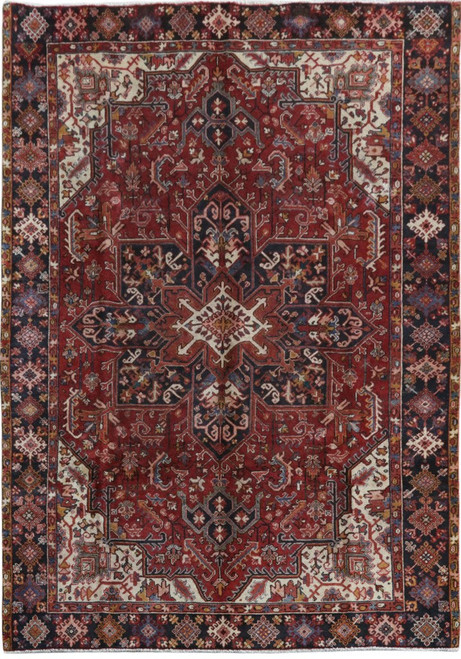
7'11" x 10'10" Persian Heriz Rug | Pale Red Geometric Medallion | Ivory Corner Spandrels
This is a hand-knotted Persian Heriz in the classic village format, a softened pale red field carrying one large stepped medallion, with generous ivory corners that open the drawing up and keep a room of this scale from feeling heavy. At 7'11" x 10'10" it sits squarely in the most useful of all room sizes, which is why buyers searching 8x11 Persian rugs keep coming back to Heriz first. The pile is a firm 3/8" wool on a cotton foundation, the handle is substantial in the hand, and the surface is even from selvage to selvage with no thin areas. Every rug we ship leaves Freeport with a certificate of authenticity recording the origin, materials and exact measurements of this specific piece.
Please Note About the Photographs:
The close-up photographs were taken under direct light and read brighter and warmer than the full overview shot, which flattens the red slightly. Both are the same rug. In normal daylight the field falls between the two, a soft brick red rather than a hot red. The final photograph shows the reverse of the rug next to a ruler so you can see the hand-knotted structure for yourself.
Design and Motifs
The centre is a broad 8 point stepped medallion built entirely from straight lines and angled steps, with an ivory core, a small square rosette at the exact middle, and hooked palmette arms firing out to the four sides in charcoal brown and dark navy. Above and below it sit two tall hexagonal cartouches filled with serrated leaf blades, the pendant arrangement that anchors the long axis of the field. The pale red ground between these elements is packed with angular vine scrolls, hooked leaves, small 8 petal rosettes and tiny paired birds and comb motifs, all drawn in the blocky village manner rather than a curved workshop line. The 4 corner spandrels are ivory and carry the same vocabulary in reverse, with stepped edges and dense floral filler, and they give the whole composition its lift. The main border is a dark ground running rosettes and paired vine hooks, framed by narrow reciprocal guard stripes. If you are shopping the broader family of geometric Persian rugs, this is the drawing that defines the type.
Color
The field is a pale brick red, a mellowed madder tone with a faint rose cast where the light catches the pile, and it shifts subtly from panel to panel the way naturally dyed village wool does. Against it, the ivory of the spandrels and the medallion core is a warm unbleached cream rather than a bright white, which is what keeps the contrast soft. The medallion arms and the two pendant cartouches are worked in a deep charcoal brown that reads almost black in shadow, outlined with clear mid blue that repeats through the leaf blades and the small rosettes. Slate and steel blues appear across the field filler, with occasional flashes of rust, camel and a muted aubergine in the smaller flowers. The border sits darkest of all, a near black brown ground carrying red, blue and ivory rosettes, so the pale interior is held inside a strong frame. Overall the palette is dusty and lived in rather than saturated, which is why it settles easily next to oak floors, walnut furniture, cream plaster walls and both warm and cool upholstery.
Origin and Weaving Quality
Heriz is a cluster of weaving villages east of Tabriz in northwest Persia, below the slopes of Mount Sabalan, and its reputation comes from two things: mineral-rich water and famously tough local wool that hardens the fibre and gives the pile its long working life. Weavers there draw from memory rather than from a full cartoon, which is why Heriz designs are angular, why the medallion arms step instead of curve, and why no two pieces of the same pattern are ever identical. Village weaving of this kind is normally coarser than city work, and that is exactly the point, since the heavier knot count and thick wool are what let a Heriz take decades of traffic in a main room. On this piece the knots are regular, the rows are straight, the selvages are intact and the back shows a clean, tight structure with no repair. Age is not documented for this rug, so we make no claim; if you want to understand how a piece like this is placed in time, our guide on how to date an Oriental rug walks through what dealers actually look at.
7'11" x 10'10" Persian Heriz Rug | Pale Red Geometric Medallion | Ivory Corner Spandrels
Ask about this rug
This piece is the only one of it, so the things worth knowing about it are particular to it. If you want to talk through the size, the colour in your own light, or the weave, speak to someone here first.