Watch the film
| Size in ft: | Width: 7' x Length: 10'6" |
| Size in Inch: | Width: 84" x Length: 126" |
| Size in meters: | Length: 3.20 x Width: 2.13 m |
| Colors: | Terra Cotta, Ivory |
| Shape: | Rectangular |
| Woven: | 100% Hand-knotted | Handmade |
| Foundation: | Cotton |
| Pile: | 3/8" Wool |
| Age: | 1990's |
| Design: | Soltanabad Mahal | All over floral |
| Origin: | Persian Mahal | Made in Persia |
| Condition: | Excellent |
7' x 10'6" Persian Soltanabad Mahal Rug | Terra Cotta All Over Floral | 1990s Village Weave
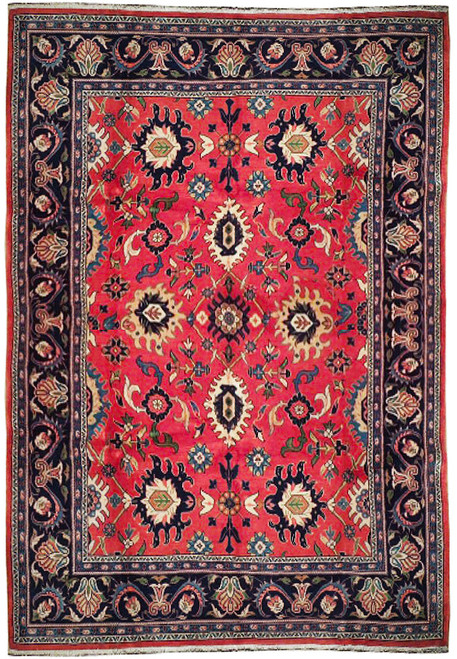
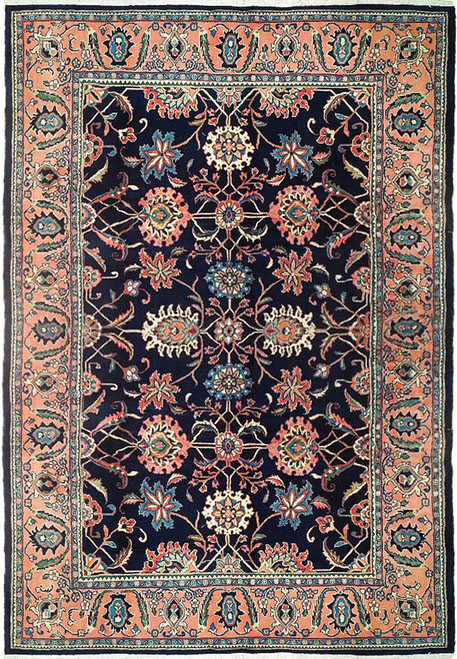
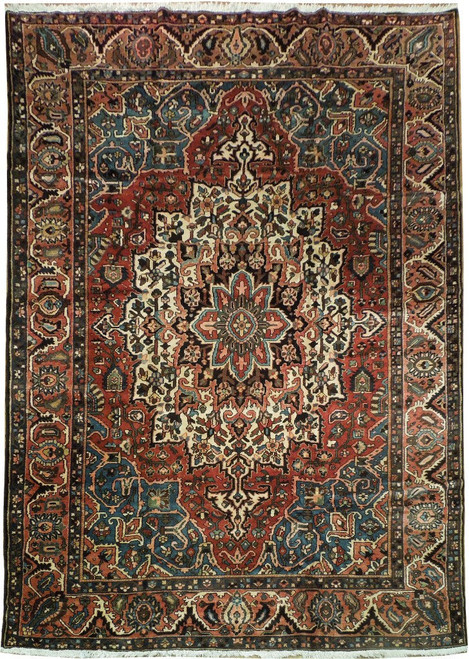
This is a 1990s Persian Soltanabad Mahal in the large scale floral manner that made the Soltanabad district famous, woven on a cotton foundation with a 3/8" wool pile that still stands evenly across the whole 7' x 10'6" surface. The field is a warm terra cotta, the border a broad ivory band, and the drawing is deliberately open, so the pattern breathes instead of crowding the eye. Condition is excellent, with clean selvages, original ends and no repairs visible in the photographs. It is a practical room-size piece for a seating group or a table setting of 6, and within our selection of 7x10 Persian rugs it stands out for the unusual chartreuse and sky blue accents in the flowers. Every rug leaves our Freeport showroom with a certificate of authenticity documenting origin, materials and hand-knotted construction.
Please Note About the Photographs:
The soft diagonal lines you can see in the terra cotta field are fold marks and shadows from storage on the pallet. They are not wear, not fade and not damage. They relax once the rug is laid flat, and every rug is professionally steamed and pressed before it ships.
Design and Motifs
The layout belongs to the family of all over Persian rug designs, built around a single ivory and sage rosette at the center rather than a heavy medallion. Four large serrated palmettes radiate from that rosette on sweeping cream vine arms that curl back on themselves like cloud bands. Between them sit big lotus blossoms with pale cream hearts and long chartreuse serrated leaves, each one repeated in mirror image at top and bottom, so the drawing reads the same from either end of the room. The 4 corners of the field carry 8 petal star rosettes with turquoise centers, a village touch that keeps the composition from looking like a city workshop piece. The main ivory border alternates navy palmette heads with gold diamond rosettes and small coral blossoms, flanked by narrow guard stripes of yellow-green scrolling vine and a thin twisted ribbon stripe, then finished with a slim terra cotta outer edge that ties the border back to the field.
Terra Cotta, Ivory and the Green Accents
The ground color is a true terra cotta, closer to fired clay and brick than to a cherry red, and the wool takes the light unevenly in the best way, so the field shifts between rust and soft apricot as you walk around it. Against that ground the weaver used a high-contrast palette: ivory and cream in the vines and blossom hearts, deep navy in the leaf tips and palmette centers, a bright chartreuse yellow-green through the serrated foliage, and cooling notes of sky blue and soft sage in the rosettes. Small touches of coral, mustard gold and pale peach appear in the border blossoms. The wide ivory main border lifts the whole thing and keeps the orange from dominating a room, which makes this an easy piece to place with cream walls, walnut furniture or navy upholstery. For buyers searching the warm end of the spectrum it sits naturally with our orange and rust Persian rugs.
Soltanabad, Mahal and the Weave of Central Persia
Soltanabad, now the city of Arak in central Persia, became the organizing center for hundreds of village looms in the late 19th century, when European firms commissioned the open, large-scale floral patterns that Western rooms wanted. Mahal is the grade name attached to that production: a village weave on a cotton foundation, knotted with the strong local highland wool and finished with a medium pile rather than a tight, thin one. The result is a rug meant to be used. At 3/8" the pile here is substantial, the knotting is regular enough to hold the curved vine work and the fine border blossoms cleanly, and the back shows even rows with no pulling or crowding. Compared with the glossy city weaves of Isfahan or Nain, a Mahal like this is honest floor furniture: softer drawing, bolder scale, and wool that takes decades of traffic without thinning. The measuring ruler in the final photograph documents the hand-knotted structure at the border, exactly as it appears in the certificate of authenticity.
7' x 10'6" Persian Soltanabad Mahal Rug | Terra Cotta All Over Floral | 1990s Village Weave
Ask about this rug
This piece is the only one of it, so the things worth knowing about it are particular to it. If you want to talk through the size, the colour in your own light, or the weave, speak to someone here first.