Watch the film
| Size in ft: | Width: 7' x Length: 11' |
| Size in Inch: | Width: 84" x Length: 132" |
| Size in meters: | Length: 3.35 x Width: 2.13 m |
| Colors: | Ivory, Coral Red, Blue, Green |
| Shape: | Rectangular |
| Woven: | 100% Hand-knotted | Handmade |
| Foundation: | Cotton |
| Pile: | |
| Age: | 1980's | Approx. 40 years old |
| Design: | Tabriz | Central Medallion | All-Over Floral Vine Field |
| Origin: | Persian Tabriz | Made in Persia |
| Condition: | Perfect | No visible wear |
7' x 11' Persian Tabriz Rug | Ivory Field, Coral Red Border | 1980's, Perfect Condition
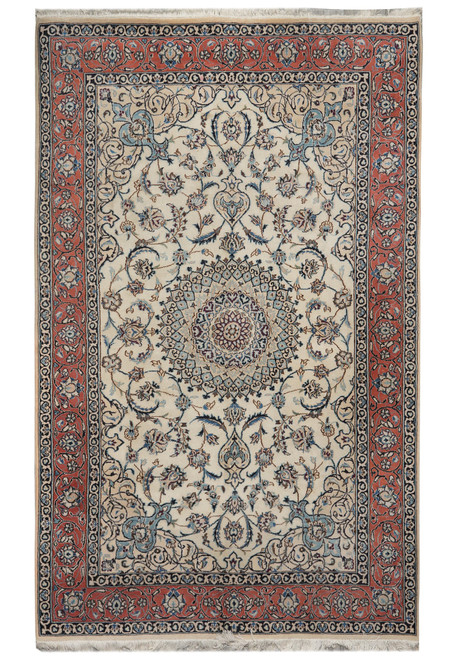
This 7' x 11' Persian Tabriz rug came off the loom in the 1980's and has reached us with the pile standing full, the fringe intact and the ivory ground still clean and light. Everything about the drawing is workshop work rather than village work: a lobed medallion sits dead center, the floral vine of the field runs out evenly to all 4 corners, and a wide coral red main border pulls the whole composition closed. The foundation is cotton, the pile is wool, and the knot count is fine enough to hold the curved line and the small blossom heads without the pattern going blocky. Every rug we sell ships with a certificate of authenticity, and if you want to see how a date like the 1980's is actually established, our guide on how to date an Oriental rug sets out the evidence a dealer reads in the back, the dyes and the selvedge.
Design and Motifs
The medallion is built in layers. At its heart is a small ivory and pink rosette, ringed by a cream petal wreath, set inside a deep indigo cusped star, which in turn sits on a coral red lobed frame edged with serrated leaves and palmettes. Slender pendants reach from the top and bottom of the medallion into the field and finish in a lotus bloom, a device that gives the 11' length a clear axis when you stand at either end. The field itself is a true all-over floral: thin arabesque vines coil in mirrored pairs, carrying palmettes, split saz leaves, carnations, tulips and paisley-shaped boteh leaves, with tiny 8 petal rosettes filling the gaps so the ivory never reads empty. Coral red spandrels at the 4 corners repeat the medallion vocabulary in miniature. The border system runs 5 bands deep: a wide coral red main border of alternating palmette and vase-like floral sprays, flanked by narrow indigo and ivory guard stripes carrying rosette and vine chains, so the eye steps in gradually instead of hitting the field all at once.
A Color Palette Built on Ivory and Coral Red
The ground is a warm ivory with a faint cream cast rather than a cold white, which is what makes this one of the easier ivory and beige Persian rugs to live with in a room of mixed woods and upholstery. Against it the main border reads coral red, closer to terracotta and brick than to a hot crimson, and that same red returns in the medallion frame and the corner spandrels to tie the layout together. The blues do the structural work: a deep indigo outlines the medallion core, the guard stripes and the leaf drawing, while a lighter sky blue and powder blue appear in the larger palmettes and curling leaves and keep the field from going flat. Green runs through the foliage in sage and olive tones, with a few deeper bottle green leaf tips in the medallion. Scattered across all of it are the accent notes that give the weaving its liveliness: rose pink, soft peach, old gold, chocolate brown and small points of near-black. The result is a polychrome field that still reads calm from standing height, because the ivory holds roughly two thirds of the surface.
Tabriz, the Workshop City of Northwest Persia
Tabriz sits in the northwest of Persia and has been the commercial and technical center of Persian weaving for centuries, the city where a designer draws the cartoon and a master weaver executes it knot by knot. Fineness in Tabriz is measured in Raj, the number of knots per gereh of about 2.75 in across the width: 40 Raj is commercial grade, 50 Raj is genuinely fine, and 60 Raj and above is collector territory. This piece belongs to the solid workshop range, dense enough to render the thin arabesque stems and the small rosette heads cleanly, which is the test that separates Tabriz drawing from coarser interpretations of the same layout. Tabriz weavers work with a metal hook and tend to clip the pile fairly low, and the low clip is why the pattern here stays crisp after 40 years of life. The cotton foundation keeps the rug flat and dimensionally stable at 7 ft by 11 ft, and the wool has the tight, slightly lustrous surface that good northwest Persian fleece develops as it is walked on.
7' x 11' Persian Tabriz Rug | Ivory Field, Coral Red Border | 1980's, Perfect Condition
Ask about this rug
This piece is the only one of it, so the things worth knowing about it are particular to it. If you want to talk through the size, the colour in your own light, or the weave, speak to someone here first.