Watch the film
| Size in ft: | Width: 7' x Length: 19' |
| Size in Inch: | Width: 84" x Length: 228" |
| Size in meters: | Length: 5.79 x Width: 2.13 m |
| Colors: | Midnight Blue, Beige, Olive, Rust |
| Shape: | Runner |
| Woven: | 100% Hand-knotted | Handmade |
| Foundation: | Cotton |
| Pile: | |
| Age: | 1900's | Antique |
| Design: | Herati | Mahi Fish Pattern | All-over Field |
| Origin: | Persian Mahal | Made in Persia |
| Condition: | Excellent |
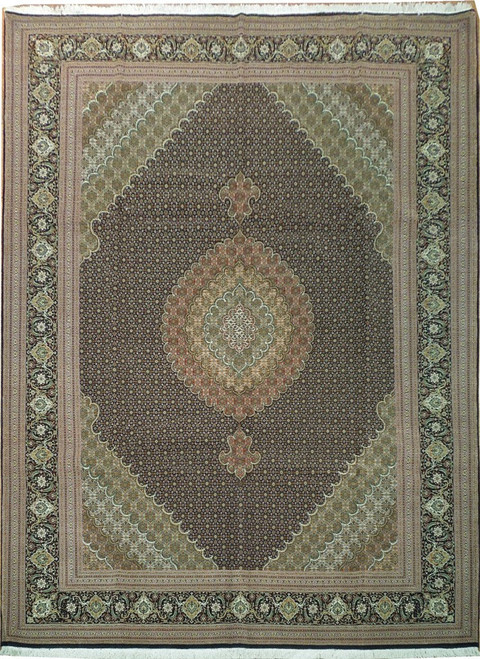
7' x 19' Persian Mahal Runner Rug | Antique Herati Fish Pattern | Midnight Blue Gallery Length
A 7 ft wide piece that runs 19 ft long is not a size any weaver produced by accident. This antique Mahal was drawn for a specific hall, and pieces in this gallery format almost never survive in wearable condition, let alone in the state this one is in. The pile still stands upright across the whole length, the ends and sides are original, and the midnight blue ground has held its depth for more than a century. The 7' x 19' scale suits a long entry hall, a wide corridor, a library aisle or a narrow reception room where a standard rectangle would leave the floor awkwardly cut in half. Every rug leaves us with a certificate of authenticity recording origin, age, materials and knotting, so you have documentation for insurance or appraisal from day one.
Please Note About the Photographs:
The full-length overhead photograph was shot under bright studio light and reads warmer and lighter than the rug actually is. The close-up and angled images are the accurate ones: the ground is a deep midnight blue, closer to indigo than to mid-blue. Please judge the color from the detail shots.
Design and Motifs
The field carries a classic Herati, the pattern also called mahi, or fish. A fine diamond lattice runs edge to edge across all 19 ft, each diamond holding a central rosette and framed on 4 sides by curved lanceolate leaves, the sickle shapes that gave the pattern its fish name. Within that framework the weaver alternated palmettes, 8 petal rosettes, small cruciform blossoms and tiny paired leaf sprays, so the repeat never reads as mechanical when you walk its length. There is no medallion and no interruption, which is exactly what makes this all-over Herati design work in a long hall: the eye is drawn down the run rather than pulled to a center. The border system is unusually generous for a village piece, with a broad beige main band of rosettes and serrated vine flanked by narrow reciprocal guard stripes and a further floral stripe on a dark ground, then an outer meander that squares off cleanly at all 4 corners.
A Midnight Blue Field With Rust, Beige and Olive
The ground is a saturated midnight blue that reads almost black in low light and opens into indigo when the sun crosses it, with a gentle abrash banding visible in the close-ups where dye lots met on the loom. Against it the lattice and vinework are drawn in a gold-olive that has mellowed into old brass, while the rosettes and palmettes carry rust, brick and a soft salmon pink that must once have been a stronger madder. Beige and ecru do the structural work, outlining the leaves and filling the main border so the whole length keeps its brightness. Small touches of wine red, dark brown and cream punctuate the flower centers, and the combination of deep blue with warm earth tones means the rug sits comfortably with oak floors, brass hardware, leather and antique walnut without fighting any of them.
Mahal Weaving From the Arak Region of Persia
Mahal rugs come from the villages around Arak in west-central Persia, the district historically traded as Sultanabad, and they were woven in large formats for grand houses at home and abroad from the late 19th century onward. The weave here is a firm village knot on a cotton foundation, heavier and more robust than a city workshop product, with thick, lanolin-rich wool that has taken on a low sheen with age. The back shown in the detail photographs is even and legible, the knot rows regular over the full 19 ft, and the selvages and fringes are as the weavers finished them. That combination of handspun wool, natural dyes and a dense beat-down is why a piece from the 1900's still walks well today, and it is also the evidence a specialist uses to date an antique rug by weave and palette rather than by a label.
7' x 19' Persian Mahal Runner Rug | Antique Herati Fish Pattern | Midnight Blue Gallery Length
Ask about this rug
This piece is the only one of it, so the things worth knowing about it are particular to it. If you want to talk through the size, the colour in your own light, or the weave, speak to someone here first.