Watch the film
| Size in ft: | Width: 3'8" x Length: 17'5" |
| Size in Inch: | Width: 44" x Length: 209" |
| Size in meters: | Length: 5.31 x Width: 1.12 m |
| Colors: | Navy Blue, Red |
| Shape: | Runner |
| Woven: | 100% Hand-knotted | Handmade |
| Foundation: | Cotton |
| Pile: | |
| Design: | All-Over Herati | Fish Pattern | Multiple Guard Borders |
| Origin: | |
| Condition: | Excellent |
3'8" x 17'5" Persian Runner Rug | All-Over Herati Fish Pattern | Red & Navy Wool
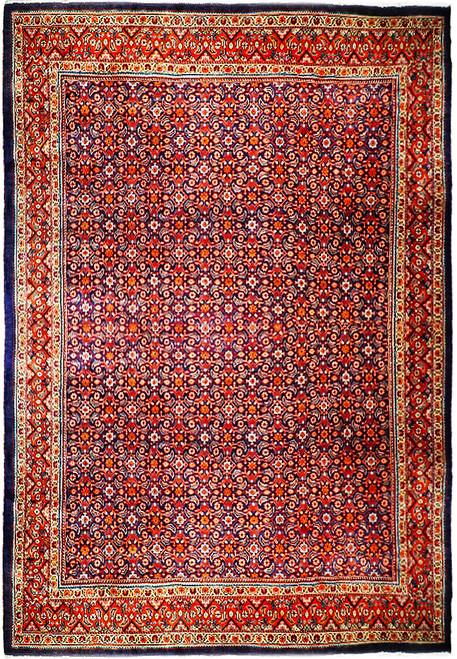
Runners this long are not easy to find. At 3'8" x 17'5" this hand-knotted Persian runner covers a full 17 foot corridor in one continuous piece, with no seams, no joins and no need to butt two shorter pieces together and live with the mismatch. The weave is village work in the truest sense: a cotton foundation, a 3/8" wool pile that has been walked on just enough to gain a low sheen, and an all-over Herati design that repeats without a single break from one end to the other. Weight, handle and pile depth are all consistent along the length, the selvages are intact and the ends are secure, which is why the condition reads Excellent. Every rug we ship carries our certificate of authenticity confirming it is genuinely hand-knotted in Persia. For a long entry, a gallery wall or a stair landing, this is the sort of hallway runner rug that solves the room in one purchase.
Please Note About the Photographs:
One of the close-up photographs was taken under bright direct light and reads lighter and more orange than the rug actually is. The full-length images are the accurate reference: the field is a deep red with natural burgundy shading, framed by a near-black navy border. The soft tonal bands you can see in the close-up are abrash, the natural variation of hand-dyed wool, not fade, wear or damage.
Design and Motifs
The field carries the Herati pattern, also called mahi or the fish pattern, one of the oldest and most enduring repeats in Persian weaving. Each unit is built from a small rosette set inside a diamond, with 4 curved lanceolate leaves turning outward at the corners, the leaves that gave the pattern its fish name. Those units lock together into a continuous lattice that runs the full 209" of the length, so the eye never finds a stopping point and the runner reads as one flowing surface rather than a series of repeated panels. There is no central medallion, which is exactly right for a narrow format where a medallion would be cropped by furniture and traffic. The border system is a wide navy main band of connected turtle palmettes and hooked vine, flanked on both sides by narrow guard stripes of ivory reciprocal diamonds that outline the whole runner like piping. Small ivory and gold flowerheads are scattered through the lattice at regular intervals, and it is these tiny light accents that keep the dark field from going flat under low lighting.
A Deep Red Field Framed in Navy Blue
The palette is disciplined and built on 2 anchors. The ground is a deep madder red that shifts between brick, wine and a darker burgundy as the natural abrash bands move along the length, the signature of hand-dyed yarn taken from different dye lots. Over that ground the lattice is drawn in an ink-dark navy blue that photographs almost black in shadow and resolves into true indigo in daylight. The main border is worked in the same deep navy so the red field sits inside a dark frame, a contrast that makes the runner read as crisp and defined from across a long hall. Highlights are ivory, cream and a soft apricot gold, placed in the rosette centers, the fish leaves and the reciprocal guard stripes, and they are used sparingly enough to act as punctuation rather than pattern. Touches of faded terracotta and a muted teal appear in the palmettes of the outer border. Together the red and navy scheme is forgiving of foot traffic, works with dark hardwood and warm wall colors, and needs no rotation to keep looking even.
Persian Village Weaving and Runner Construction
Long runners like this one come out of the village workshops of Persia, where a narrow loom is warped once and a weaver works a single piece over many months rather than turning out several small rugs. The construction here is classic: a cotton warp and weft for dimensional stability, a hand-spun wool pile knotted row by row and beaten down firmly, and selvages wrapped in wool along both long edges to protect the sides where a runner takes the most abuse. Wool of this type, greasy with lanolin and spun by hand, is what gives the surface its slight luster and its resistance to crushing underfoot. Holding a 44" width true over 209" of length is the hard part of weaving a runner, and the edges on this piece track straight with only the gentle waver that tells you a human being, not a machine, set every knot. The pile still stands at 3/8", the ends are firm and the pattern registers cleanly from the first row to the last.
3'8" x 17'5" Persian Runner Rug | All-Over Herati Fish Pattern | Red & Navy Wool
Ask about this rug
This piece is the only one of it, so the things worth knowing about it are particular to it. If you want to talk through the size, the colour in your own light, or the weave, speak to someone here first.