Watch the film
| Size in ft: | Width: 2'11" x Length: 16'10" |
| Size in Inch: | Width: 35" x Length: 202" |
| Size in meters: | Length: 5.13 x Width: 0.89 m |
| Colors: | Red Orange, Black, Ivory, Soft Blue, Apricot |
| Shape: | Runner |
| Woven: | 100% Hand-knotted | Handmade |
| Foundation: | Cotton |
| Pile: | |
| Design: | Hamadan | All-Over Lattice | No Medallion |
| Origin: | Persian Hamedan | Made in Persia |
| Condition: | Excellent |
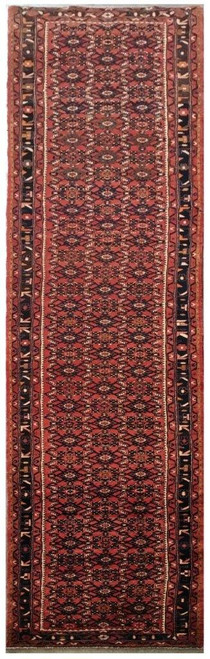
2'11" x 16'10" Persian Hamedan Runner Rug | All-Over Herati Lattice | Red Orange & Black Wool
Runners this long do not come along often. At 2'11" x 16'10" this hand-knotted Persian Hamedan runs just under 17 feet, the length you need for a full hallway or a long upstairs landing where most runners stop 4 or 5 feet short. The pile is 3/8" wool on a cotton foundation, dense underfoot and still standing evenly along the whole length, and the condition is excellent with the original fringe and both ends intact. The field is an unbroken all-over lattice in black over a red orange ground, with no medallion to interrupt the run, which is exactly why it reads so calmly in a narrow space. It ships with a certificate of authenticity documenting origin, materials and hand-knotted construction.
Please Note About the Photographs:
The first full-length photograph was taken under cooler light and reads darker than the rug actually is. The close-up images show the truer tone: a warm brick red orange field with black lattice work. Lighting, not dye variation, accounts for the difference between the photographs.
Design and Motifs
The field is drawn as a continuous diagonal trellis in black, each compartment holding a small boxed rosette flanked by hooked leaf forms and tiny serrated diamonds, a village reading of the classic Herati or fish pattern reduced to straight lines and angles. The repeat runs the full 16'10" without a medallion, a break or a panel, so the eye travels the length of the rug rather than stopping in the middle. Guard stripes do the framing: a narrow ivory zigzag ribbon on each side of the field, then a main border of alternating rosettes and 8 petal florettes set on a dark ground, then a reciprocal black vine on the red outer band. Because the pattern was carried from memory rather than a cartoon, the compartments shift slightly in width from one end to the other and a few rosettes are drawn a little larger than their neighbors, the small irregularities that separate a hand-knotted village runner from a machine product.
Color: Red Orange, Black and the Accents Between Them
The ground is a warm red orange, closer to brick and terracotta than to a cool Kashan crimson, and it lightens and deepens slightly along the length as the wool takes the dye differently from one batch to the next. Over it the lattice is a deep black that in some light reads as the darkest navy, and the same dark tone fills the main border so the field appears to float between two black bands. The accents are what keep it from going flat: clean undyed ivory in the zigzag ribbons and in the small hooked leaves, soft apricot and pale salmon in the border florettes, a scattering of teal and slate blue rosette centers, and a few touches of warm brown and copper in the outer vine. Nothing is bright or synthetic in feeling, and the overall impression is a warm red orange and black runner with ivory punctuation, a palette that sits easily on oak, walnut and dark stained floors.
Hamedan: Western Persia and the Village Runner Tradition
Hamedan sits in the Zagros foothills of western Persia and gives its name to the output of hundreds of surrounding villages, which is why Persian Hamedan rugs cover such a wide range of drawing while sharing one structure. The weave here is the single-weft village construction the district is known for: a symmetrical knot tied on a cotton warp, one shoot of weft between rows, and heavy local wool that gives a thick, slightly stiff handle and wears for generations rather than years. The pile wool from this region is high in lanolin, which is why a Hamedan keeps its sheen under traffic and why the region's long narrow looms, set up in village houses, have produced the best Persian runners for over a century. A piece at this length was woven on a loom dressed specifically for it, not cut down from a larger rug, and the even borders at both ends confirm it.
2'11" x 16'10" Persian Hamedan Runner Rug | All-Over Herati Lattice | Red Orange & Black Wool
Ask about this rug
This piece is the only one of it, so the things worth knowing about it are particular to it. If you want to talk through the size, the colour in your own light, or the weave, speak to someone here first.