Watch the film
| Size in ft: | Width: 8'1" x Length: 10' |
| Size in Inch: | Width: 97" x Length: 120" |
| Size in meters: | Length: 3.05 x Width: 2.46 m |
| Colors: | Brown Is The Main Color, Ivory, Olive, Rust |
| Shape: | Rectangular |
| Woven: | Hand-Knotted |
| Pile: | Wool And Silk |
| Origin: | India |
| Design: | Mahi Tabriz |
| Age: | New |
| Condition: | Perfect |
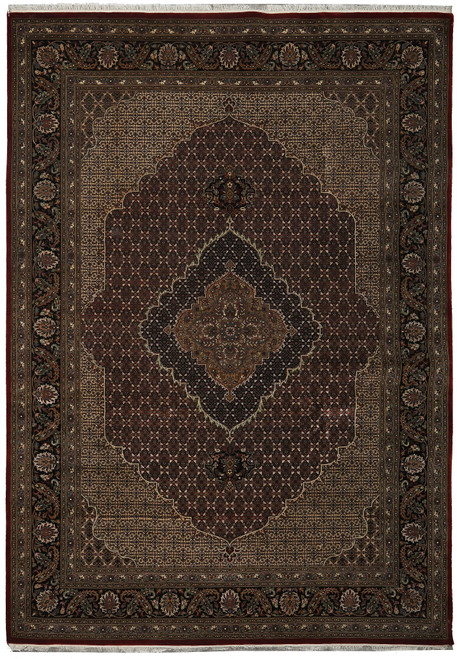
8'1" x 10' Indian Area Rug | Mahi Tabriz Design | Wool and Silk | Brand New
This is a brand new, hand-knotted Oriental rug woven in India in the classic Mahi Tabriz design, with a wool and silk pile on a cotton foundation. The proportions are the workhorse room size, and a true 8x10 area rug like this one covers a seating group or sits under a 6 to 8 seat table without crowding the walls. What separates it from the mass market version of this pattern is the knot count and the drawing: the herati lattice stays crisp across the full 10' length, the silk highlights catch light along the outlines, and the pile has been sheared low and even so nothing blurs. The rug has never been on a floor, the fringe is hand-tied and untrimmed, and it ships with a certificate of authenticity confirming that it is entirely handmade.
Please Note About the Photographs:
Several of the floor photographs show pale, cloudy patches across the brown field. That is pile-direction sheen from the silk highlights reflecting the studio lights, not fade, not wear and not damage. Walk around the rug and those areas darken again. Every rug leaves us professionally steamed and pressed.
Design and Motifs
Mahi means fish, and the name comes from the herati unit repeated across the field: a small rosette inside a diamond, flanked by 4 curved lanceolate leaves that old weavers read as fish circling a pond. Here that unit tiles the entire brown ground in tight diagonal rows, giving the surface a woven-textile density rather than an open floral look. At the center sits a lobed ivory medallion with a dark navy core, and inside that core a 4 petal rosette in rust and soft blue-green. Matching pendants finish the medallion at top and bottom, and quarter medallions anchor all 4 corners of the field, each one repeating the ivory ground so the eye reads a clean diamond across the rug. A narrow scalloped outline traces a second, larger diamond around the medallion, an old cartoon trick that keeps a very busy field organized. The main border runs ivory with turning palmettes, serrated leaves and curling vines, framed by olive guard bands of small reciprocal florets and a plain dark brown outer edge.
A Chocolate Brown Field With Ivory, Olive and Rust
Brown is the main color and it is a deep chocolate, closer to espresso than to tan, warmed by the rust and camel outlines of the herati lattice so the field reads rich rather than flat or dark. Scattered through that ground are thousands of tiny ivory florets that act like pinpricks of light and keep the pattern legible from standing height. The medallion and corner spandrels switch to a soft ivory, almost oatmeal, which lifts the center of the rug, and the black-navy medallion core gives the composition its one point of real contrast. Inside it the rust petals carry small touches of sage, slate blue, cream and deep red. The main border is the lightest element in the rug, an ivory ground with olive, brick and dusty blue vinework, bounded by olive-gold guard stripes. Because the pile is wool and silk, the silk passes sit on the outlines and the rosette centers, so the palette shifts as you cross the room: warm and grounded from one end, noticeably brighter and more golden from the other. Practically, this brown field is forgiving with dark wood, leather and stone.
Made in India: Where This Weave Comes From
India is where most of the world's good contemporary hand-knotted work is now made, and this rug is a fair example of why. The Mahi cartoon belongs to the Tabriz weaving tradition, but the Indian workshops that took it up weave it on a cotton warp and weft with a fine, tightly packed knot, then clip the pile low so the miniature herati repeat holds its shape. Look at the back in the fold photograph: the knot rows are even, the pattern is legible from the reverse, and the selvedge is wrapped by hand in matching brown wool. The fringe is the actual warp of the rug, hand-tied rather than sewn on, which is the simplest way to confirm a genuine hand-knotted piece. Wool at this grade takes dye cleanly and wears for decades under real household traffic, and the silk is used sparingly, as highlight rather than as the body of the pile, which is the correct way to build a rug meant to be walked on.
8'1" x 10' Indian Area Rug | Mahi Tabriz Design | Wool and Silk | Brand New
Ask about this rug
This piece is the only one of it, so the things worth knowing about it are particular to it. If you want to talk through the size, the colour in your own light, or the weave, speak to someone here first.