Watch the film
| Size in ft: | Width: 8'2" x Length: 10'2" |
| Size in Inch: | Width: 98" x Length: 122" |
| Size in meters: | Length: 3.10 x Width: 2.49 m |
| Colors: | Black, Brown, Rust, Olive, Ivory |
| Shape: | Rectangular |
| Woven: | 100% Hand-knotted | Handmade |
| Foundation: | Cotton |
| Pile: | Wool and Silk |
| Age: | New | Current production |
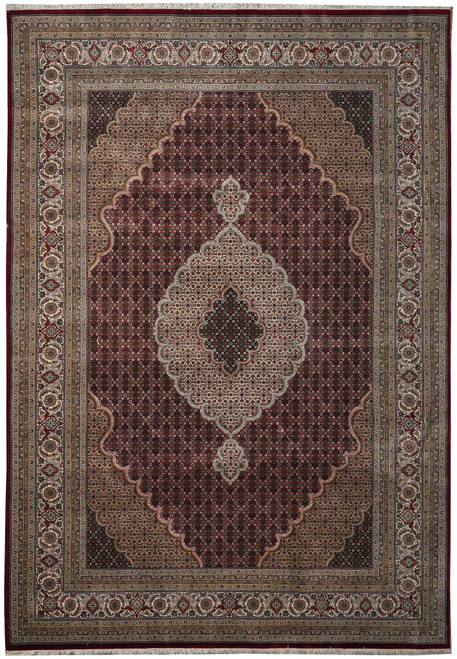
| Design: | Tabriz Mahi | Herati fish lattice | Central medallion with 4 corner spandrels |
| Origin: | Made in India |
| Condition: | Perfect | Never used |
8'2" x 10'2" Wool and Silk Oriental Rug | Tabriz Mahi Fish Design | Brand New, Made in India
The Mahi drawing is the hardest classical pattern to weave well, because the whole field is built from thousands of tiny repeating units and any drift in the knot count shows immediately. This 8'2" x 10'2" hand-knotted rug holds that lattice dead straight from selvage to selvage, with silk worked into the ivory and camel outlines so the small motifs lift off a near black ground. It is brand new, never walked on, with a thick even pile, hand-tied cotton fringe at both ends and no restoration of any kind. Every rug we sell ships with a certificate of authenticity confirming it is genuinely hand-knotted.
Please Note About the Photographs:
The silk highlights in this rug reflect light, so the field photographs warmer and lighter in the first overhead image and deeper and darker in the angled floor shots. That shift is sheen, not fading, staining or wear. Viewed from the pile direction the ground reads as a deep earthy black throughout.
Design and Motifs
Mahi means fish, and the name comes from the pairs of curved lancet leaves that flank every small rosette in the field, read for generations as fish circling a pond. Here the entire ground is a diamond lattice of those units, each compartment carrying a rosette, a hooked leaf pair and a minute ivory floret, repeated many thousands of times across the rug. A pointed lobed medallion sits at the center, its ivory ground filled with an even finer scale lattice and framed by a scalloped ivory outline, with a rosewood inner cartouche holding an 8 petal rosette and 4 curling palmettes. Slender pendants rise from the top and bottom of the medallion, and the 4 corner spandrels repeat the same ivory scalloping against the field. The main border runs a black ground with alternating large palmettes and serrated acanthus leaves joined by a continuous vine, flanked inside and out by narrow guard stripes of small figural and floral cartouches that keep the frame from looking heavy.
A Palette of Black, Camel, Rust and Olive
The dominant reading is an earthy black, used both for the inner medallion field and for the main border, which gives the rug real weight in a room with pale walls or light wood floors. Against that black the lattice is drawn in camel, warm tan and soft brick rust, with ivory dots that scatter across the surface like tiny lights, plus quiet touches of olive, slate blue and deep burgundy inside the rosettes. The outer field surrounding the medallion shifts to a lighter camel brown, so the rug reads as two tonal zones rather than one flat ground. The ivory medallion and spandrels supply the brightest notes, the rosewood center pulls a muted rose and terracotta into the middle, and one guard border carries a pale sage green that cools the whole scheme. Because the highlight yarns are silk against a wool ground, the palette changes as you walk around the rug: camel turns to gold in raking light, black deepens to charcoal, and the whole field gains a low sheen.
Woven in India in the Tabriz Mahi Tradition
This piece was hand-knotted in India, where the best contemporary workshops now produce some of the finest hand-knotted work being made anywhere, with disciplined graph reading, dense knotting and careful yarn selection. The Mahi layout demands that discipline: at this scale the weaver has to keep a repeating micro pattern true across 98 inches of width without the rows wandering, and the crisp unbroken diamonds in the field photographs are the proof. The pile is wool with silk highlights on a cotton foundation, clipped low so the drawing stays legible, and the handle is firm rather than floppy, the sign of tight packing at the beat-down. If you are comparing this style against city weavings from other countries, our guide on the difference between an Oriental rug and its regional cousins is worth reading before you decide, and the full wool and silk rugs selection shows how differently that fiber blend behaves in other designs.
8'2" x 10'2" Wool and Silk Oriental Rug | Tabriz Mahi Fish Design | Brand New, Made in India
Ask about this rug
This piece is the only one of it, so the things worth knowing about it are particular to it. If you want to talk through the size, the colour in your own light, or the weave, speak to someone here first.