Watch the film
| Size in ft: | Width: 8'4" x Length: 10'2" |
| Size in Inch: | Width: 100" x Length: 122" |
| Size in meters: | Length: 3.10 x Width: 2.54 m |
| Colors: | Ivory, Brown, Rust, Sage |
| Shape: | Rectangular |
| Woven: | 100% Hand-knotted | Handmade |
| Foundation: | Cotton |
| Pile: | Wool and Silk |
| Age: | New | Never used |
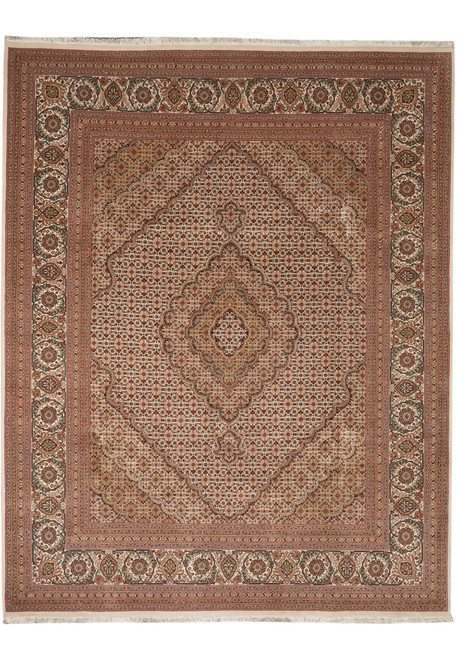
| Design: | Mahi Tabriz | Herati fish pattern | Scalloped medallion with 2 pendants |
| Origin: | Made in India |
| Condition: | Perfect | Never used |
8'4" x 10'2" Wool and Silk Oriental Rug | Mahi Tabriz Fish Design | Brand New, Made in India
This is a brand new, never used hand-knotted rug in the Mahi Tabriz drawing, woven with a fine wool pile carrying silk highlights on a cotton foundation. It measures 8'4" x 10'2", which places it squarely in the 8x10 range that anchors most seating groups without crowding the walls. The weave is tight and even, the pile is low and crisp so the tiny motifs read clearly, and the silk catches light along the medallion outlines and the scrolling border vines. Every rug we sell ships with a certificate of authenticity confirming that it is genuine, hand-knotted and exactly as described.
Design and Motifs
Mahi means fish, and the name refers to the small curved leaves that flank each rosette inside the diamond lattice, a drawing also known as the herati pattern. Here that lattice runs edge to edge across the field in miniature, thousands of repeats, each diamond outlined in rust with a rosette at the center and four leaves turning around it. Over that ground sits a scalloped diamond medallion in a darker tone, echoed by 2 slender pendants above and below and by lightly drawn corner spandrels that let the field breathe. The border system is deep: a wide ivory main band of palmettes, rosettes and split-leaf scrollwork, framed by paired guard stripes of running vine, small checkerboard cartouches and delicate barber-pole outlines. Look at the close-up photos and you can see how steadily the lattice holds its line through 4 corners, which is the real test of this design.
A Study in Ivory, Brown, Rust and Sage
The field reads ivory from a standing height, an unbleached cream that warms toward oatmeal under lamplight. Inside the medallion and across the outer field the ground shifts to a soft coffee brown that photographs closer to tobacco and camel in the detail shots. Rust carries the drawing: it outlines the diamonds, fills the border palmettes and supplies the only true bursts of saturated color. Sage green does the quiet work, edging the medallion scallops, the guard stripes and the leaf tips, and it is the color that keeps the palette from turning orange. Scattered through the lattice are pinpoints of deep indigo, charcoal and clean white rosette centers, tiny enough that they register as sparkle rather than as color blocks. The overall effect is an earth tone rug, restrained and easy to live with, that sits comfortably on oak flooring and beside cream upholstery as shown in the room photograph.
Made in India, Woven to the Tabriz Mahi Standard
India is where most of the world's best contemporary hand-knotted work is now made, and we say that with no hedging. The weaving centers of northern India have spent decades mastering the fine city drawings, and the Mahi Tabriz pattern is one they execute at a very high level: the knot count here is dense enough to hold a lattice motif that measures well under an inch, and the wool is spun fine and clipped low so nothing blurs. Silk is used sparingly, exactly where it belongs, along the medallion outlines and the scrolling vines, giving the surface a shift of luster as you walk around it. If you are weighing how this compares to other hand-knotted work, our guide to what separates a Persian rug from a broader Oriental rug explains the terminology honestly. The back, visible in the folded photograph, shows a clean, regular knot grid on a cotton foundation with hand-tied ivory fringe at both ends.
8'4" x 10'2" Wool and Silk Oriental Rug | Mahi Tabriz Fish Design | Brand New, Made in India
Ask about this rug
This piece is the only one of it, so the things worth knowing about it are particular to it. If you want to talk through the size, the colour in your own light, or the weave, speak to someone here first.