Watch the film
| Size in ft: | Width: 8' x Length: 10'3" |
| Size in Inch: | Width: 96" x Length: 123" |
| Size in meters: | Length: 3.12 x Width: 2.44 m |
| Colors: | Black, Brown, Sage Green, Ivory, Rust |
| Shape: | Rectangular |
| Woven: | 100% Hand-knotted | Handmade |
| Foundation: | 100% Cotton |
| Pile: | Wool and Silk |
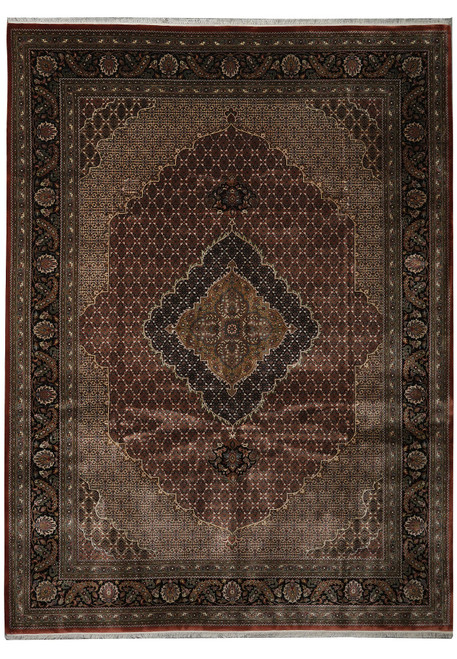
| Design: | Mahi Tabriz | Fish Pattern | All-over lattice with central medallion |
| Origin: | Made in India |
| Condition: | Perfect | Excellent |
8' x 10'3" Oriental Wool and Silk Rug | Mahi Tabriz Fish Design | Made in India
This 8' x 10'3" piece is a fine contemporary Oriental rug, hand-knotted in India in wool with silk drawn through the medallion outlines and the finer details. It is a true room-size rug that covers a standard 8x10 floor plan with a little extra length, and it reads as dark, dense and formal from across the room, then opens into thousands of tiny motifs when you stand over it. The pile is low and tightly packed, the handle is firm, and the white cotton fringe is clean and even at both ends. Condition is perfect. Every rug we ship carries a certificate of authenticity confirming that it is hand-knotted, along with its size, materials and origin. If you are shopping the 8x10 rug size and want something darker than the usual red and ivory traditional, this is the one to look at closely.
Design and Motifs
The drawing is the classic Mahi, or fish, pattern: a diagonal lattice covering the entire field, with each small compartment holding a curled leaf pair and a tiny rosette, the stylized fish that gives the design its name. At the center sits a lobed, almost cloud-band medallion with a soft light ground, and inside it a second smaller cartouche filled with its own miniature lattice, so the eye keeps stepping inward. Slender pendants rise and fall from the top and bottom of the medallion, and the 4 corners are filled with large scalloped spandrels that repeat the same lattice in reverse coloring, which is what creates the cut-out silhouette across the field. The main border carries a procession of palmettes, split leaves and open rosettes linked by a thin vine, framed on both sides by narrow guard stripes of running zigzag and small florets. Everything is curvilinear and precisely repeated, with no drifting lines, the mark of a rug woven from a full cartoon rather than from memory.
Color Palette
The field ground is black, but it is not a flat black: the lattice is knotted in warm brown and mahogany, so the surface actually reads as a deep brown-black shot through with copper where the light catches the silk. Each lattice node is picked out in ivory, which is what gives the field its fine frosted sparkle in the close-up views. The central medallion and the corner spandrels shift the palette to pale sand and ivory with soft taupe, outlined in a light silvery line that separates them cleanly from the dark field. The main border returns to black and is filled with sage green and olive leafwork, ivory palmettes, slate blue rosette centers and clear accents of rust and brick red, the only genuinely warm color notes in the rug. Narrow guard bands in beige and pale green cool the whole frame down. Against light oak or walnut flooring the rug grounds a room without pulling color from the walls, and it sits comfortably with charcoal, cream, brass and olive furnishings.
Origin and Weaving Quality
This rug was made in India, which is where most of the world's best contemporary hand-knotted weaving is now done, and workshops there produce Mahi Tabriz designs at a level of fineness that would be difficult to find elsewhere at this price. The weave is worth examining in the photograph with the ruler laid across the border: the knot rows are extremely close and perfectly straight, the cotton foundation is taut, and the pile has been shorn low so the drawing stays sharp instead of blurring. Wool carries the field and border, while silk is used selectively on the medallion outline, the pendants and some of the small floral detail, which is why those elements change tone as you walk around the rug. The result is a piece that belongs with the better hand-knotted Oriental rugs we carry: dense enough for daily traffic in a living or dining room, and finely enough drawn to reward a close look for decades.
8' x 10'3" Oriental Wool and Silk Rug | Mahi Tabriz Fish Design | Made in India
Ask about this rug
This piece is the only one of it, so the things worth knowing about it are particular to it. If you want to talk through the size, the colour in your own light, or the weave, speak to someone here first.