Watch the film
| Size in ft: | Width: 8'2" x Length: 10'8" |
| Size in Inch: | Width: 98" x Length: 128" |
| Size in meters: | Length: 3.25 x Width: 2.49 m |
| Colors: | Coral, Blue, Green |
| Shape: | Rectangular |
| Woven: | 100% Hand-knotted | Handmade |
| Foundation: | Cotton |
| Pile: | 3/8" | Wool |
| Design: | Heriz | All-over diamond lattice | Small central medallion |
| Origin: | Persian Heriz | Made in Persia |
| Condition: | Excellent |
8'2" x 10'8" Persian Heriz Rug | Coral Field All-Over Lattice | Small Geometric Medallion
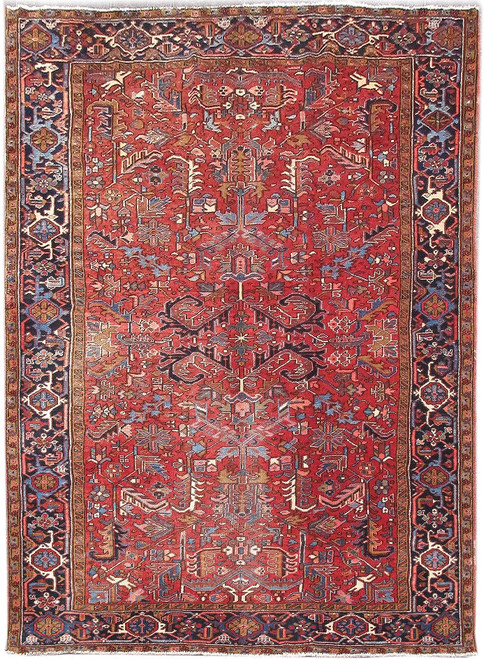
This 8'2" x 10'8" Persian Heriz is the quieter, more graphic side of Heriz weaving: instead of one huge star medallion filling the field, the weaver drew a dense diamond lattice across the entire coral ground and set a small ivory and olive medallion at the center of it. The pile is wool at 3/8", knotted on a cotton foundation, with a flat even surface and the gentle abrash you only get from hand-dyed village yarn. At just over 8 by 10 and a half feet it covers a standard seating group or a 6 to 8 seat table, which puts it right in the middle of the most useful range of 8x11 Persian rugs. Every rug we sell ships with a certificate of authenticity confirming it is hand-knotted and Persian in origin.
Please Note About the Photographs:
The first image is a flat studio photograph and the coral field reads a shade lighter and pinker there than it does in the showroom floor shots, which were taken under warm overhead lighting. The true color sits between the two, a soft brick coral with natural variation through the ground. Nothing in these photos is wear, fade or damage, and the rug is professionally steamed and pressed before it ships.
Design and Motifs
The field is built from a continuous navy lattice of small linked diamonds that runs corner to corner without interruption, a drawing pattern that belongs firmly to the family of geometric Persian rugs. Floating on top of that grid are dozens of individually drawn motifs: serrated leaves, small hooked animal forms, stepped double-headed figures, and little flowering shrubs in ivory, olive, rust and pale blue, each one slightly different from its neighbor because the weaver worked them from memory rather than a cartoon. At the center sits a compact lozenge medallion in ivory and sage with a blue starburst core, anchored above and below by matching pendants, and the same stepped vocabulary repeats at a larger scale in the 4 corners. The main border is a deep indigo band carrying alternating octagonal rosettes and angular palmettes in gold, ivory and coral, framed by narrow ivory and gold guard stripes with a running vine. Straight lines, hard angles and no curves anywhere: this is village drawing at its most confident.
Coral, Indigo and Green in the Palette
Coral is the color that carries this rug. The ground is a warm brick coral that shifts between salmon and terracotta as the light moves across the pile, with soft horizontal abrash bands where one dye lot gave way to the next. Against it, the lattice and outlining are a dark indigo blue that reads almost black in the border and brightens to a clear mid-blue where it crosses the open field. The green is the surprise: a dry sage and olive used for leaf forms, for the ground of the central medallion, and in flecks through the border rosettes, cool enough to keep the coral from going sweet. Ivory does the lifting, outlining the medallion, picking out the small hooked motifs and running through the guard stripes so the pattern stays legible from across a room. Secondary notes of camel gold, rust brown and a faded rose appear in the border cartouches. The overall effect is warm and lived-in rather than bright, a palette that settles easily over wood floors, sisal or a stone hearth.
Heriz: Weaving in the Villages Below Mount Sabalan
Heriz is a cluster of weaving villages east of Tabriz in northwest Persia, sitting in the foothills below Mount Sabalan. The mineral-rich water there is credited with the famously tough, high-lanolin wool that comes off local flocks, and that wool is the whole reason Heriz rugs have the reputation they do: the fiber resists crushing, takes dye deeply and burnishes rather than dulls with foot traffic. Weavers in these villages work on sturdy cotton warps with angular, straight-line drawing, because the knot count of village work is generally under 200 knots per square inch and curved lines simply do not resolve at that scale. What looks like simplification is actually a design tradition built around its own materials, and it is why a Heriz reads so clearly from a distance. The back of this piece, shown against a 12 inch ruler, has the even, firm handle of good village weaving, with straight sides and original ivory fringe at both ends. It is a rug built to be walked on for another lifetime.
8'2" x 10'8" Persian Heriz Rug | Coral Field All-Over Lattice | Small Geometric Medallion
Ask about this rug
This piece is the only one of it, so the things worth knowing about it are particular to it. If you want to talk through the size, the colour in your own light, or the weave, speak to someone here first.