Watch the film
| Size in ft: | Width: 7'9" x Length: 10'8" |
| Size in Inch: | Width: 93" x Length: 128" |
| Size in meters: | Length: 3.25 x Width: 2.36 m |
| Colors: | Rustic Red, Blue, Green |
| Shape: | Rectangular |
| Woven: | Hand-Knotted |
| Pile: | Wool |
| Origin: | Persia |
| Design: | Heriz |
| Age: | 1970's |
| Condition: | Excellent |
7'9" x 10'8" Persian Heriz Rug | Rustic Red Geometric Medallion | Vintage 1970s
This is a 1970s Persian Heriz, hand-knotted in wool on a cotton foundation and measuring 7'9" x 10'8". It has been on a floor before and it shows in the best way: the pile has settled into that low, even, slightly glossy surface that only real use gives a village rug, with no repairs, no bald spots and full, straight sides. The drawing is pure Heriz, a big stepped medallion anchoring a rustic red field, and the scale sits squarely in the most useful range of 8 x 11 Persian rugs, large enough to carry a full seating group without swallowing a room. Every rug we sell ships with a certificate of authenticity confirming origin, materials and hand-knotted construction.
Please Note About the Photographs:
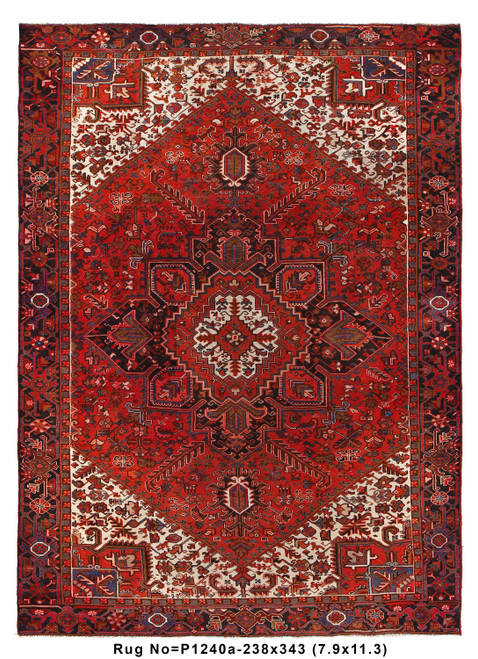
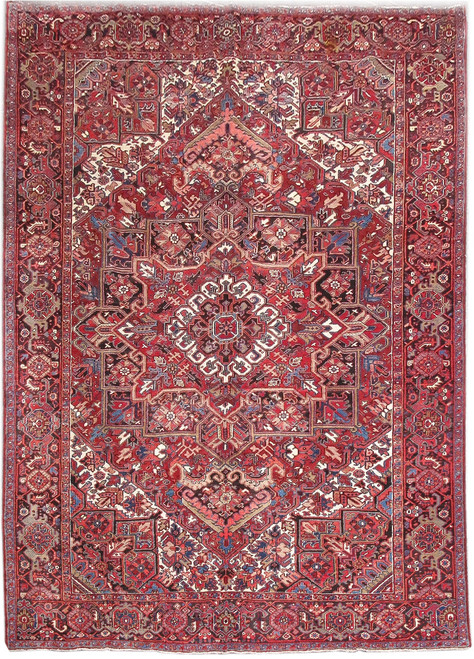
The overhead studio photograph reads deeper and cooler than the showroom floor shots taken under warm light. The true field color sits between the two. The soft tonal shifts you can see moving across the red are abrash, the natural variation between hand-dyed wool batches, and the gentle sheen in places is patina from careful use. Neither is fading, wear or damage. Every rug is professionally cleaned, steamed and pressed before it ships.
Design and Motifs
The center holds a stepped, many-lobed medallion outlined first in light blue and then in saffron, with a small turquoise rosette at its exact heart and 4 leafy cartouches set around it. Above and below the medallion sit dark pendant palmettes with pale green centers, and the 4 corners are filled with large ivory spandrels drawn in angular vine, hooked leaves and stiff little blossoms. Every curve here is built from straight lines and right angles, which is the signature of Heriz work and the reason these rugs read as bold from across a room and endlessly detailed up close. Look into the field and you find birds, tiny trees, rosettes and scattered boteh worked in green, gold and teal, the kind of small improvisations a village weaver adds from memory. The main border carries alternating palmettes and hooked rosettes on near-black ground, framed by narrow vine guard stripes. If you like geometric Persian rugs, this is the archetype of the category.
A Rustic Red Field With Navy, Green and Ivory
The field is a rustic red that shifts between brick and a warm terracotta depending on the light, broken by softer rose and salmon passages where the dye lot changed on the loom. Against it the medallion and the main border read as a deep inky navy, close to black in shadow and clearly blue where light hits the pile directly. The 4 corner spandrels are ivory, almost bone, and they are what keeps the whole rug from going heavy. Inside the drawing there is far more color than a first glance suggests: bottle green and sage in the leafwork, a clear turquoise at the medallion center and in small paired birds, mustard and saffron gold tracing the medallion outlines and the border cartouches, plus flecks of pink, cream and light blue. It is a warm, saturated, forgiving palette that sits well with wood floors, leather, brass and both dark and painted furniture.
Heriz Weaving and 1970s Village Quality
Heriz is a group of villages east of Tabriz, on the slopes below Mount Sabalan in northwest Persia. The water there is mineral rich and the local sheep grow famously tough, springy wool, which is why Heriz rugs outlast almost everything else on a busy floor. Weavers work from memory and a grid rather than a fully drawn cartoon, so the medallion is never perfectly symmetrical and the two ends of the field rarely match exactly, which is precisely what separates a real village rug from a factory copy. Knot count here is typical village work, chunky and honest, with a heavy wool pile on a cotton foundation and a weave you can read plainly on the back. Roughly 50 years of settled use has done this one nothing but favors: the wool has burnished, the reds have mellowed, and the structure is still tight. If you want to understand how weavers, dyes and wear help place a piece in time, our guide to how to date an Oriental rug covers the same signals we used on this 7'9" x 10'8" Heriz.
7'9" x 10'8" Persian Heriz Rug | Rustic Red Geometric Medallion | Vintage 1970s
Ask about this rug
This piece is the only one of it, so the things worth knowing about it are particular to it. If you want to talk through the size, the colour in your own light, or the weave, speak to someone here first.