Watch the film
| Size in ft: | Width: 10'8" x Length: 14'4" |
| Size in Inch: | Width: 128" x Length: 172" |
| Size in meters: | Length: 4.37 x Width: 3.25 m |
| Colors: | Antique Red, Navy Blue, Olive Green, Ivory |
| Shape: | Rectangular |
| Woven: | 100% Hand-knotted | Handmade |
| Foundation: | Cotton |
| Pile: | |
| Design: | Heriz | Stepped Geometric Medallion | Ivory Corner Spandrels |
| Origin: | Persian Heriz | Made in Persia |
| Condition: | Excellent | Full even pile throughout |
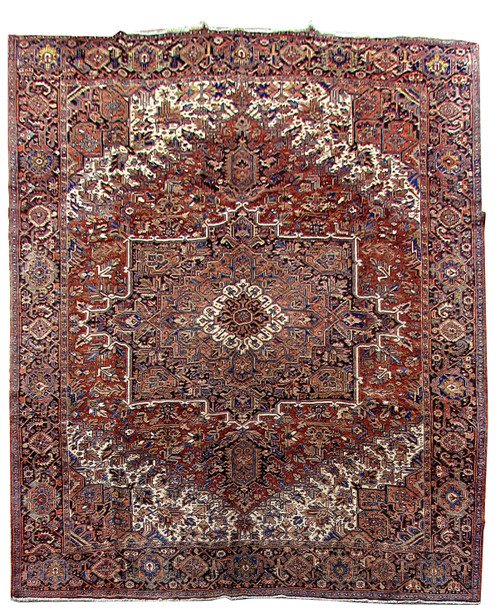
10'8" x 14'4" Persian Heriz Rug | Stepped Geometric Medallion | Antique Red and Ivory
At 10'8" x 14'4" this is a genuine room-size Heriz, big enough to carry a full sofa group with all four legs on the pile instead of floating around the edges, which is exactly why 10x14 Persian rugs in this family are so hard to find in honest condition. The field is a deep antique red carrying a single stepped medallion, with broad ivory corner spandrels that open the drawing up and keep a rug of this scale from reading heavy. It is hand-knotted on a cotton foundation with a dense wool pile, the pile stands full and even from end to end, and the wool has the dry, slightly glassy feel that highland Heriz fleece develops with age. Every rug we sell ships with a certificate of authenticity.
Design and Motifs
The center holds a small ivory cartouche inside a navy cruciform core, which sits inside a rose and navy medallion with 4 stepped arms and a serrated outline picked out in ivory. Above and below, long navy pendants reach into the field and end in hooked palmette finials. Flanking the medallion are 4 large hexagonal panels in rose and ivory, each filled with its own miniature rosette and angular vine, a device that gives the design depth without adding curves. The red ground between them is filled with hooked leaves, angular blossoms and stiff little vine arms, all drawn on the diagonal in the straight-line vocabulary that defines geometric Persian rugs from this district. The ivory spandrels repeat the same motifs in negative, and the main border runs a navy ground with alternating rosettes and serrated leaves, framed by narrow guard stripes in olive and ivory.
Color and Palette
The field is an antique red that shifts as you walk the rug, from a warm brick tone under the medallion to a softer rose toward the ends, the natural abrash you get from small dye lots worked across a wide loom. Against that, the navy of the border, the medallion core and the outlining reads almost black in low light and resolves into a true deep blue when sun hits it, and that contrast is what carries the drawing across nearly 14 and a half feet. Ivory does the lifting in the 4 corners, in the serrated outlines and in the fine guard stripes, keeping the whole surface legible rather than muddy. Olive green runs through the vine work and the inner stripe, and the weavers have dropped in salmon, soft rose and a dusty sky blue as accents inside the sub-medallions and leaves. Anyone shopping the red and burgundy rugs range will find this one warm without being loud.
Heriz Origin and Weave
Heriz is a group of villages east of Tabriz in northwest Persia, spread below Mount Sabalan, and the reputation of the weave rests on two local facts: the mineral-rich water the flocks drink, which produces an unusually tough and lustrous fleece, and a village drafting tradition that translates court medallions into straight lines, stepped corners and angular leaves rather than flowing curves. The knotting here is what you want from the district, a firm hand-knotted weave on a stout cotton foundation with heavy wefts beaten down hard between rows, which is why a Heriz of this age still lies flat and still has full pile underfoot. Village work of this type is not a fine-knot exercise and never pretends to be; the value is in the wool, the dyes and the drawing, and in a structure built to take decades of traffic in a busy room.
10'8" x 14'4" Persian Heriz Rug | Stepped Geometric Medallion | Antique Red and Ivory
Ask about this rug
This piece is the only one of it, so the things worth knowing about it are particular to it. If you want to talk through the size, the colour in your own light, or the weave, speak to someone here first.