Watch the film
| Size in ft: | Width: 9'10" x Length: 13'2" |
| Size in Inch: | Width: 118" x Length: 158" |
| Size in meters: | Length: 4.01 x Width: 3.00 m |
| Colors: | Warm Antique Red, Black, Blue, Ivory, Olive |
| Shape: | Rectangular |
| Woven: | 100% Hand-knotted | Handmade |
| Foundation: | Cotton |
| Pile: | |
| Design: | Heriz | Stepped Geometric Medallion | Ivory Spandrels |
| Origin: | Persian Heriz | Made in Persia |
| Condition: | Excellent | Full even pile |
9'10" x 13'2" Persian Heriz Rug | Stepped Geometric Medallion | Warm Antique Red Field
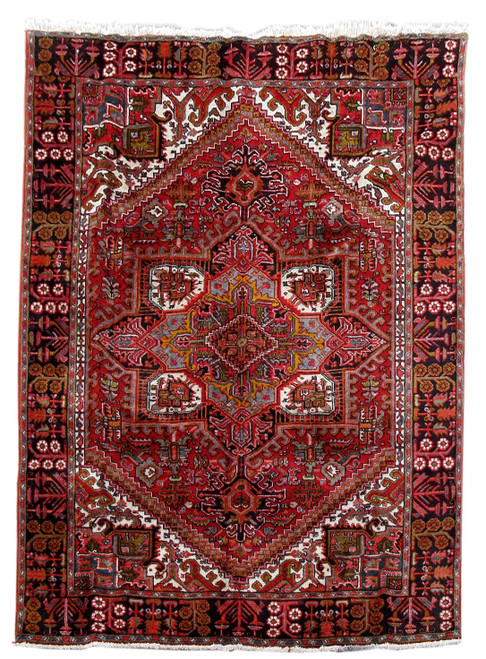
This is the Heriz that most people picture when they think of a Persian room size rug, and it is a strong example of the type: a warm antique red field, a big angular medallion drawn in ivory and indigo, and black cornerpieces that square off the composition. At 9'10" x 13'2" it covers a full seating group or a table for 8 without crowding the walls, which is exactly the proportion buyers look for in 10x13 Persian rugs. The pile is 3/8" hand-spun wool on a cotton foundation, still full and even across the whole surface, and the close-up of the back shows clean, tight rows of hand-tied knots with no machine regularity anywhere. Every rug we sell ships with a certificate of authenticity confirming it is hand-knotted in Persia.
Please Note About the Photographs:
The two close-up photographs were taken under direct light and read lighter and pinker than the rug actually is. The full overhead and angled shots are the accurate reference for color: a deep, warm antique red with black and indigo. The detail images are there to show the drawing and the pile, not the tone.
Design and Motifs
The center holds an 8 pointed stepped medallion outlined twice, first in blue and then in ivory, with a small hooked rosette at its heart and a pair of ivory anchor pendants running off the top and bottom axes. Around it the weaver has filled the field with serrated leaves, hooked palmettes, tiny boxed rosettes and squared off vine scrolls, all drawn in straight lines and 45 degree angles rather than curves, which is the signature of true village work among geometric Persian rugs. The 4 corner spandrels are ivory grounded and step inward in stages, each one carrying its own miniature medallion in red and blue. The wide black main border alternates 8 petal rosettes with large forked leaves, and it is framed on both sides by narrow guard stripes of running vine on ivory. Small asymmetries between the 4 corners, the mark of a rug drawn from memory rather than a full cartoon, give the piece its character.
Color: Antique Red, Indigo and Ivory
The field is a warm antique red that shifts between brick and a softer terracotta as the light moves across the pile, the natural result of hand-spun wool taking dye unevenly from fleece to fleece. Against it, the main border and the inner cornerpieces go almost black, a dense charcoal brown that pushes the red forward and gives the whole rug weight. Ivory does the structural work: it outlines the medallion, grounds the 4 spandrels and picks out the guard stripes, so the eye reads the layout instantly from across a room. Two blues appear, a clear mid blue used for the medallion outline and the small leaf tips, and a much darker indigo reserved for rosette centers and the boxed motifs. Olive and soft camel run through the leaves and vines, cooling the red and keeping the palette from turning monotone. It is a room anchoring color scheme that sits comfortably with dark wood, leather and warm neutral walls.
Heriz Weaving in Northwest Persia
Heriz is a cluster of villages in northwest Persia, east of Tabriz on the slopes below Mount Sabalan, and the wool from those flocks is famously tough. The local water is mineral rich, which is widely credited for the hard, glossy, almost waxy handle Heriz wool develops with age and for how well the dyes hold. Weavers there work on a village scale rather than in city workshops, drawing the design in straight lines and stepped angles that the loom and the memory can both hold, which is why a Heriz never tries for the curved vine of an Isfahan or a Nain. Knot counts in these villages typically run under 200 per square inch, and that is by design: a heavier knot and a thick 3/8" pile are what make a Heriz survive decades of heavy traffic. This one is a well drawn, well proportioned example of that tradition, with full pile, sound selvages and honest ends.
9'10" x 13'2" Persian Heriz Rug | Stepped Geometric Medallion | Warm Antique Red Field
Ask about this rug
This piece is the only one of it, so the things worth knowing about it are particular to it. If you want to talk through the size, the colour in your own light, or the weave, speak to someone here first.