Watch the film
| Size in ft: | Width: 6'10" x Length: 10'8" |
| Size in Inch: | Width: 82" x Length: 128" |
| Size in meters: | Length: 3.25 x Width: 2.08 m |
| Colors: | Red With Brown, Ivory, Black, Beige, Olive Green, And Hints Of Navy Blue. |
| Shape: | Rectangular |
| Woven: | Hand-Knotted |
| Pile: | Wool |
| Origin: | Persia |
| Design: | Heriz |
| Age: | 1970's |
| Condition: | Excellent |
6'10" x 10'8" Persian Heriz Rug | Geometric Medallion | 1970s Wool, Excellent Condition
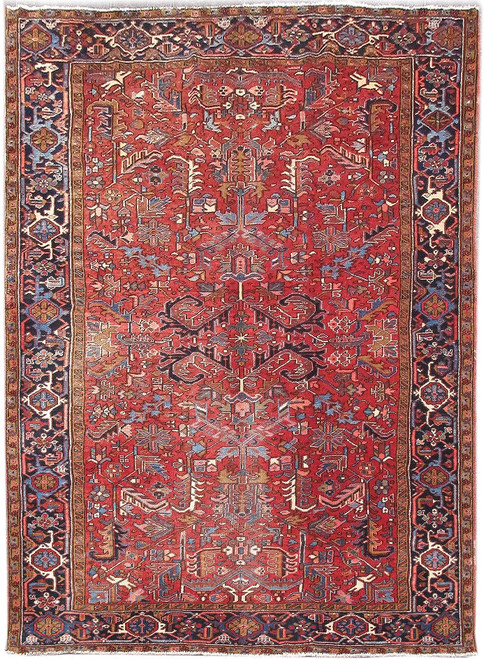
This is a village Heriz from the 1970s, hand-knotted in wool on a cotton foundation and still carrying a full, even pile after half a century. At 6'10" x 10'8" it sits in the most useful room size there is, wide enough to float a sofa and two chairs on and long enough to run under a dining table, which is why buyers searching 7x10 Persian rugs keep coming back to this format. The drawing is confident and entirely hand-held: a big stepped medallion anchored in the center, ivory spandrels that open the 4 corners, and a navy main border crowded with rosettes and hooked vines. Nothing about it is machine-perfect, and that is the point. Every Heriz we sell ships with a certificate of authenticity stating origin, age, materials and hand-knotted construction.
Please Note About the Photographs:
The first photograph was taken under different lighting and reads deeper, darker and browner than the rug does in person. The floor photographs and the close-ups show the truer reading: a clear brick red field with warm ivory corners. Please judge the color from those images, and ask us for a daylight video if you want a third look before you buy.
Design and Motifs
The center medallion is built as a stepped diamond with a lobed inner panel, its edges serrated into small hooks and outlined twice, first in ivory and then in deep brown, so the shape reads cleanly from across the room. Inside it sits a tiny 8 petal rosette on a dark cross-shaped cartouche, flanked by paired arrow-leaf panels and small boteh-like forms, with a pendant cresting off each end of the medallion like a crown. The red field around it is filled with angular serrated leaves, hooked vinework and stiff palmettes, all drawn with the straight lines and right-angle turns that define geometric Persian rugs from this district. The ivory spandrels in the 4 corners carry the same vocabulary at a larger scale, giving the eye somewhere to rest, and the navy main border alternates diamond rosettes with blocky hooked brackets between narrow barber-pole guard stripes.
Color: Brick Red, Ivory and Olive Green
The field is a true brick red that shifts toward cherry where the light hits the pile and toward a warm rust-brown where it lays the other way. The medallion is the surprise: it is not red at all but a muted slate and lavender-blue ground loaded with olive green and salmon panels, so the center of the rug reads cooler and softer than the field surrounding it. Ivory, closer to an aged cream than a bright white, does all the structural work in the spandrels, the outlines and the small floral sprays. Olive green appears in the leaf forms and the border brackets, beige fills the quieter ground areas, and black is used sparingly as an outlining color to keep the geometry sharp. Navy blue shows up in the main border and in scattered field details, cool enough to balance the warmth without turning the rug blue. Overall this is a warm, saturated, forgiving palette that sits comfortably on oak, walnut and stone floors alike.
Heriz: Village Weaving East of Tabriz
Heriz is a group of villages in northwest Persia, east of Tabriz in the foothills below Mount Sabalan. Two things made the district famous. The first is the water, which is mineral-rich and is credited with the unusually tough, slightly springy wool these flocks produce, wool that scours well, takes dye deeply and resists crushing under furniture for generations. The second is the drawing tradition: Heriz weavers work from memory and from village cartoons rather than from the fully detailed designs used in city ateliers, so every line is angular, every curve is stepped, and no 2 pieces are ever identical. Village Heriz weaving is typically a coarser, sturdier knot than workshop Tabriz work, usually under 200 knots per square inch, and that is exactly what makes it a floor rug you can actually live on. The 1970s date is consistent with the wool, the dye palette and the construction, and if you want to understand how that judgement is reached, read our guide on how to date an Oriental rug.
6'10" x 10'8" Persian Heriz Rug | Geometric Medallion | 1970s Wool, Excellent Condition
Ask about this rug
This piece is the only one of it, so the things worth knowing about it are particular to it. If you want to talk through the size, the colour in your own light, or the weave, speak to someone here first.