Watch the film
| Size in ft: | Width: 9' x Length: 12' |
| Size in Inch: | Width: 108" x Length: 144" |
| Size in meters: | Length: 3.66 x Width: 2.74 m |
| Colors: | Brown, Camel, Tan, Ivory, Chocolate |
| Shape: | Rectangular |
| Woven: | 100% Hand-knotted | Handmade |
| Foundation: | 100% Cotton Foundation |
| Pile: | 100% Wool |
| Age: | 1970's | Approx. 50 years old |
| Design: | Heriz | Stepped Geometric Medallion | Ivory Spandrels |
| Origin: | Persian Heriz | Made in Persia |
| Condition: | Excellent | Even pile throughout |
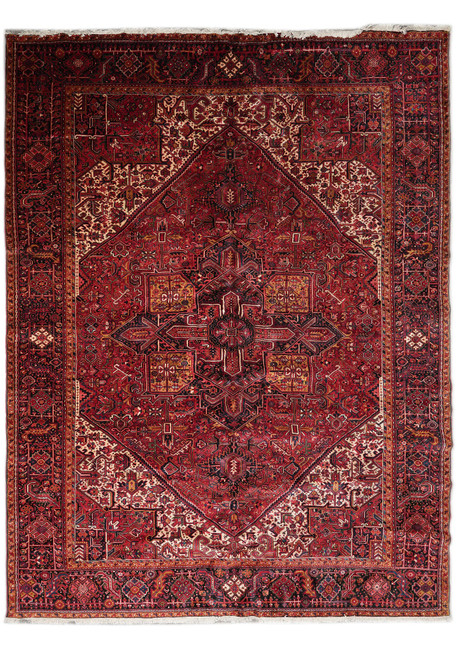
9' x 12' Persian Heriz Rug | Camel Brown Geometric Medallion | 1970s Vintage, Excellent Condition
This 9' x 12' Persian Heriz was knotted in the 1970s and has aged into exactly the palette collectors chase: a warm camel brown field with no bright color anywhere in it, the whole surface reading as one soft tonal wash from a few steps back. The pile is wool on a cotton foundation, cut low and even after 50 years of careful use, and the drawing is pure Heriz village work, angular, confident, laid out around a single stepped medallion. It is a true room size piece for a 9x12 space, and it ships with our certificate of authenticity documenting origin, age, materials and construction. If you want to understand how a piece like this is placed in time, our guide on how to date an Oriental rug walks through the same clues we used here, and you can compare it against our other 9x12 Persian rugs.
Please Note About the Photographs:
One image in this gallery is a digital room visualization included only to show how a 9' x 12' rug fills a seating area. The flat shots, the close-up details, the folded corner and the reverse side with the tape measure are all photographs of this exact rug, taken in our Freeport warehouse.
Design and Motifs
The layout is the classic Heriz formula drawn with unusual restraint. At the center sits a stepped diamond medallion outlined in dark chocolate, holding an 8 petal rosette and small hooked brackets, with a serrated leaf pendant reaching out to each side. That medallion floats inside a large octagonal frame, and the 4 corners are filled with ivory spandrels carrying angular palmettes, cypress forms and jagged vine work that meet the field along a sawtooth line. Between them the field is packed with stiff floral sprays, hooked rosettes and small birdlike leaf shapes, every curve broken into straight segments the way a village loom demands. The wide main border runs a stately procession of shield palmettes alternating with paired blossoms, flanked by narrow guard stripes of running vine. This is a textbook example of geometric Persian rug design, where the whole composition is built from angles rather than arcs.
A Camel, Tan and Ivory Brown Palette
Brown here means many browns. The open field is a warm camel that shifts toward dusty rose in raking light, and it is surrounded by a slightly deeper cocoa brown in the octagonal frame and again in the main border, so the eye reads depth without ever meeting contrast. The spandrels and many of the palmette outlines are a pale oatmeal ivory that lifts the corners and keeps the drawing legible. Detail work is picked out in the darkest tone in the rug, a near black chocolate used sparingly for medallion outlines, leaf tips and the fine hairlines of the guard stripes, with soft taupe and greyed sand filling the space between. The one thing this rug does not have is red, which is what makes it so easy to live with next to walnut floors, cream upholstery and gilt frames. For interiors built on warm neutrals, our full range of brown Persian rugs starts exactly here.
Heriz Origin and Village Weaving Quality
Heriz is a cluster of weaving villages east of Tabriz in northwest Persia, spread below the slopes of Mount Sabalan. The water there is rich in minerals, and local flocks grow a wool so tough and springy that Heriz rugs became the standard for households that wanted a hand-knotted rug to survive generations of traffic. Weavers work from memory on village looms rather than from a cartoon drawn for a city workshop, which is why the medallion here is stepped instead of lobed and why the vine turns in straight runs. Heriz village weaving normally sits under 200 knots per square inch, and the strength of the piece comes from wool quality, dye quality and the clarity of the drawing rather than from fineness. The back of this rug, visible in the photographs, shows a tight even cotton warp and the level handle of a well-woven 1970s piece, with the original wool fringe and firm selvages still in place.
9' x 12' Persian Heriz Rug | Camel Brown Geometric Medallion | 1970s Vintage, Excellent Condition
Ask about this rug
This piece is the only one of it, so the things worth knowing about it are particular to it. If you want to talk through the size, the colour in your own light, or the weave, speak to someone here first.