Watch the film
| Size in ft: | Width: 8'2" x Length: 11'3" |
| Size in Inch: | Width: 98" x Length: 135" |
| Size in meters: | Length: 3.43 x Width: 2.49 m |
| Colors: | Soft Rust Brick, Black, Beige, Sage Green |
| Shape: | Rectangular |
| Woven: | Hand-Knotted |
| Pile: | Low Pile Wool |
| Origin: | Persia |
| Design: | Kashan |
| Age: | 1960's |
| Condition: | Very Good, Low Pile Evenly Worn |
8'2" x 11'3" Persian Kashan Rug | Semi-Antique 1960s Floral Medallion | Soft Rust Brick & Black
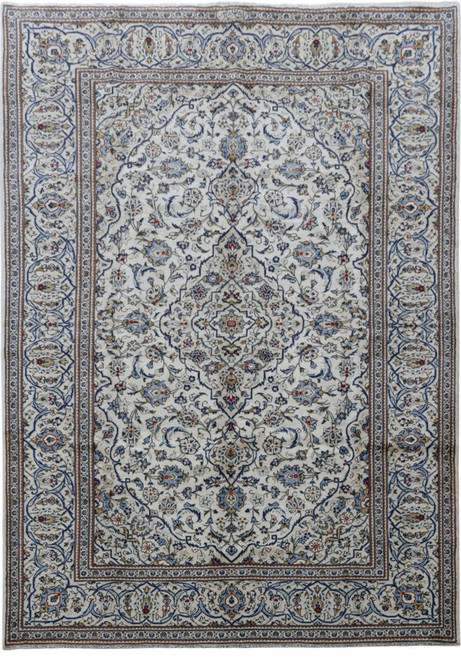
Woven in the 1960s, this 8'2" x 11'3" piece is the kind of rug that has already done the hard part: 60 years of living have pulled the dyes down to a quiet, sun-warmed register that no wash can fake. The pile is hand-knotted wool on a cotton foundation, now low and evenly worn from edge to edge, with the drawing still perfectly legible right through the field and border. Classic Persian Kashan rugs are built on exactly this formula of a lobed central medallion, matching spandrels and a dense floral ground, and this one carries it at true room scale, sitting squarely in the 8x11 Persian rugs bracket that anchors most living rooms under a full seating group. A certificate of authenticity is included with every rug we ship.
Please Note About the Photographs:
The pile on this rug is low and evenly worn, which is normal and expected for a semi-antique from the 1960s. There are no holes, no bald spots and no repairs visible in the close-up photos, and the wear is consistent across the whole surface rather than concentrated in one area. That even, slightly polished nap is what gives the colors their soft antique glow. Every rug is professionally cleaned, steamed and pressed before shipping.
Design and Motifs
The center holds a layered rosette medallion in beige and ivory, ringed by a black lobed frame and finished top and bottom with slim pendant finials that reach out into the field. The same black is repeated in the 4 corner spandrels, so the eye reads a clear diamond across the middle of the rug with weight at every corner. Between them the ground is filled edge to edge with an all-over floral scheme: palmettes, open rosettes, curling feathered leaves and thin vine scroll that links one blossom to the next without ever repeating in an obvious grid. The main border is a black band of alternating palmettes and rosettes joined by a continuous arabesque, flanked on both sides by narrow beige guard stripes carrying a small floral meander. The close-up photos show how cleanly the curved lines are drawn and how the weaver resolved each corner turn in the border, which is the detail that separates a workshop Kashan from a village copy.
A Soft Rust Brick Field Against Black and Beige
The field is a soft rust brick that reads almost salmon in daylight, the result of a red that has mellowed steadily over 60 years rather than a color applied that way at the loom. Against it the border and spandrels sit in a deep near charcoal black, which supplies all of the contrast and keeps the rug from feeling washed out. Beige and pale ivory do the drawing throughout: the medallion, the flower heads scattered across the ground, the guard stripes and the outer border are all worked in those warm neutrals, so the pattern floats rather than shouts. The accents are the pleasure of this one. Small clear sage and true green rosette centers and leaves appear in the border and around the medallion, visible in the corner and back photos, along with faint apricot and gray green shading inside the larger palmettes. Slight abrash across the field, the natural variation of a hand-dyed wool batch, gives the rust ground movement under light instead of a flat printed look.
Kashan: The City That Set the Standard
Kashan sits in central Persia, north of Isfahan, and its workshops trace their drawing straight back to the Safavid court looms of the 16th century. The local wool is soft and lustrous, and city weavers there worked from full cartoons on cotton warps, which is why a Kashan holds a curved line and a symmetrical medallion the way a village rug never quite can. It is also the single most recognizable Persian design in America: when you watch Shark Tank there is a Persian Kashan on the floor. This example is a 1960s piece, old enough to have earned genuine patina and to qualify as semi-antique, and the tight, regular back seen in the fold photo shows the even knotting and straight sides of proper workshop production. If you want to understand how weave, wear and dye tell you the decade a piece was made, our guide on how to date an Oriental rug walks through the same signals we used here.
8'2" x 11'3" Persian Kashan Rug | Semi-Antique 1960s Floral Medallion | Soft Rust Brick & Black
Ask about this rug
This piece is the only one of it, so the things worth knowing about it are particular to it. If you want to talk through the size, the colour in your own light, or the weave, speak to someone here first.