| Size in ft: | Width: 8'3" x Length: 11'4" |
| Size in Inch: | Width: 99" x Length: 136" |
| Size in meters: | Length: 3.45 x Width: 2.51 m |
| Colors: | Ivory, Rust, Blue, Green |
| Shape: | Rectangular |
| Woven: | Hand-Knotted |
| Pile: | Wool And Silk |
| Origin: | Persia |
| Design: | Tabriz Mahi |
| Age: | 2000's |
| Condition: | Excellent |
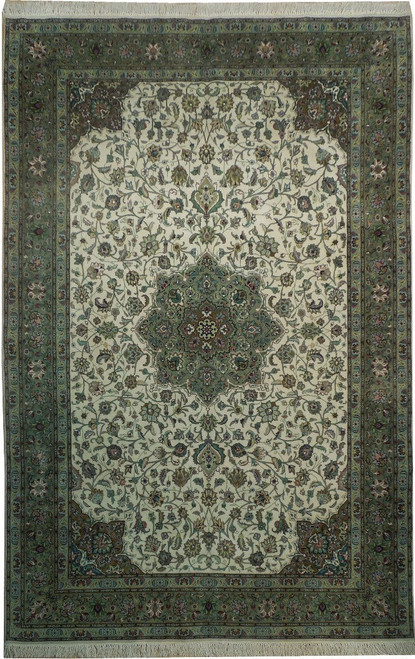
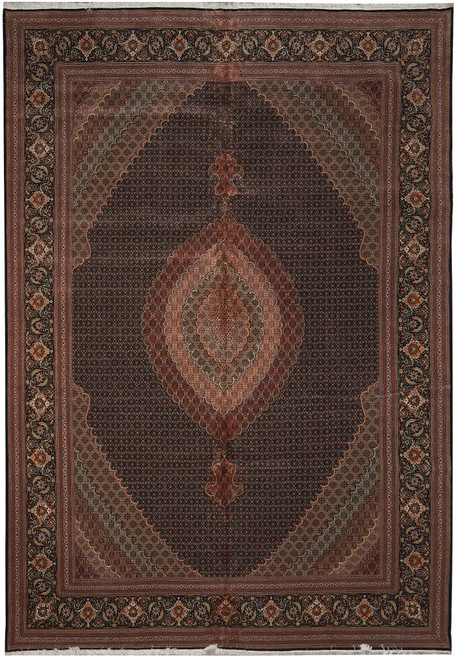
8'3" x 11'4" Persian Tabriz Mahi Rug | Ivory Fish Field with Rust Medallion | Wool & Silk, 400 KPSI
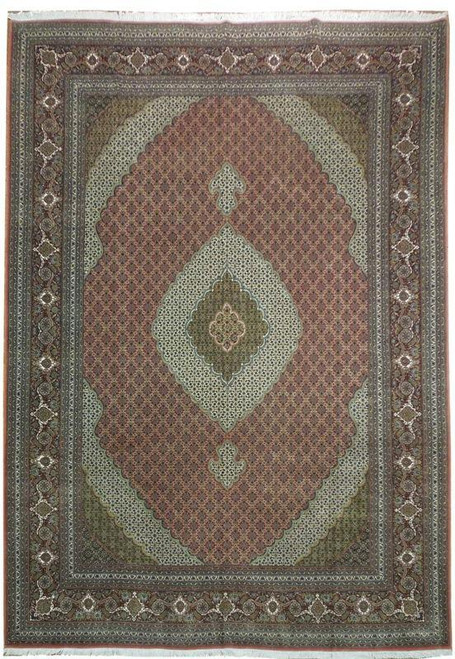
This is the Mahi drawing that made Tabriz famous, worked at a knot count most weavers never attempt. A cotton foundation carries a pile of wool with silk run through the outlines, and at roughly 400 knots per square inch the tiny fish rosettes stay crisp right across a field this wide. At 8'3" x 11'4" it sits in the most useful of all room sizes, the same footprint buyers shop when they browse 8 x 11 Persian rugs, and it reads calm rather than loud because the ground is ivory rather than red. Woven in the 2000's and kept in excellent condition, the pile is full, the ends are secure and the fringes are clean. Every rug we sell ships with a certificate of authenticity confirming origin, materials and hand-knotted construction.
Please Note About the Photographs:
In several of the floor photographs a lighter, golden patch appears to the right of the medallion. That is the silk in the pile catching the overhead lights at an angle, not fading, not a stain and not wear. Silk reflects light differently depending on which way the nap is lying, so the same area looks pale from one side of the rug and warm from the other. Walk around it and the field reads evenly ivory.
Design and Motifs
Mahi means fish, and the name describes the lattice that fills the whole ground: a diamond grid of curved leaves set around small rosettes, each pair of leaves turning toward the flower like fish circling a pond. Herati and Mahi are the same pattern under two names, and here it is drawn at miniature scale, dozens of repeats across the width, which is only possible at this knot count. A stepped and lobed medallion sits dead center in rust, filled with its own finer version of the same lattice and finished with a pale pink and ivory cartouche at the heart. Two slender pendants run off it toward each end, and four corner spandrels in the same rust echo the medallion with a scalloped ivory outline. The main border carries a procession of palmettes and boteh linked by a thin vine, framed by a pair of reciprocal guard stripes and several narrow bands of running geometric ornament that hold the whole composition tight.
A Closer Look at the Colors
The field is ivory, warmed a shade by the tan and camel of the lattice leaves so it never looks cold or bleached. Scattered through that grid are pinpoints of navy and teal blue at the rosette centers, plus flecks of rose and olive, and it is those small blues that give the ground its depth when you stand back. The medallion, pendants and spandrels are rust, closer to terracotta than brick, outlined in cream and a soft salmon that keeps the shape legible against the busy field. The main border shifts the whole palette: a muted sage green, dusty rather than bright, carrying palmettes in pink, ivory, gold and deep burgundy. Guard stripes pick up caramel, wine red and charcoal. The overall effect is a warm neutral rug with green and blue accents, which is why it settles easily next to oak floors, walnut furniture and off-white walls rather than demanding a room be built around it.
Tabriz Weaving and Quality
Tabriz sits in northwestern Persia and has been the country's most commercially serious weaving city for centuries, the place where the Mahi design was refined and where the Raj system of grading fineness is still used. Raj counts knots per gereh, about 2.75 inches, across the width: 40 Raj is ordinary commercial goods, 50 Raj is genuinely fine, and 60 Raj, roughly 400 knots per square inch, is collector grade work from the better workshops. This rug is woven at that 60 Raj level, which is why the fish lattice holds its drawing instead of blurring into texture. Tabriz weavers work on a vertical loom with a hooked knife, and the addition of silk in the outlines is a workshop signal: silk takes dye at a higher saturation than wool and catches the light, so the medallion edges and leaf tips lift off the surface. With a cotton foundation, a tight wool and silk pile and no wear worth noting, this is a rug built to be used daily for decades.
8'3" x 11'4" Persian Tabriz Mahi Rug | Ivory Fish Field with Rust Medallion | Wool & Silk, 400 KPSI
Ask about this rug
This piece is the only one of it, so the things worth knowing about it are particular to it. If you want to talk through the size, the colour in your own light, or the weave, speak to someone here first.