Watch the film
| Size in ft: | Width: 8'3" x Length: 11'6" |
| Size in Inch: | Width: 99" x Length: 138" |
| Size in meters: | Length: 3.51 x Width: 2.51 m |
| Colors: | Royal Blue, Ivory, Rust, Navy, Olive, Camel |
| Shape: | Rectangular |
| Woven: | 100% Hand-knotted | Handmade |
| Foundation: | Cotton |
| Pile: | 100% Wool | 3/8" pile height |
| Age: | 1980's | Vintage |
| Signature: | Signed | Woven cartouche in the outer border |
| Design: | Persian All Over Floral | Palmettes and vine scroll | Ivory main border |
| Origin: | Persian | Made in Persia |
| Condition: | Excellent | Ready to use |
8'3" x 11'6" Signed Persian Rug | All Over Floral on Royal Blue | 1980s Workshop Weave
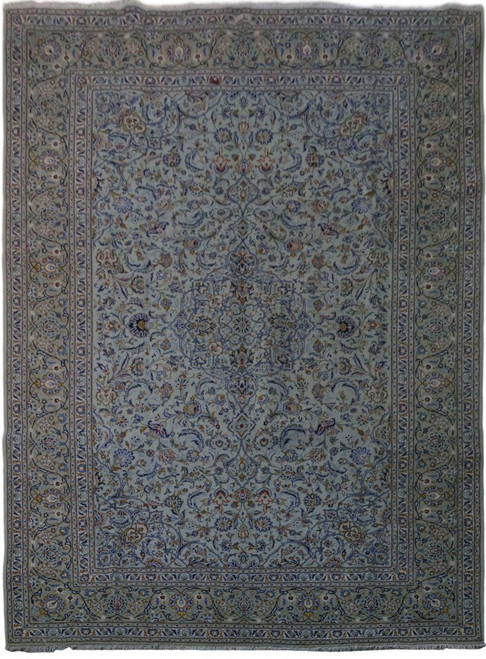
This 8'3" x 11'6" Persian rug was hand-knotted in the 1980s with a 3/8" wool pile on a cotton foundation, and the weaver signed it: a small woven cartouche sits in the outer border at one end, the mark of a workshop piece rather than an anonymous commercial weave. The field is a deep royal blue carried edge to edge by an all over floral drawing, framed by a wide ivory border and several narrow guard stripes. At just over 95 square feet it covers a full seating group or a 10 seat dining table with chairs pulled back, which puts it squarely among large Persian rugs that anchor a whole room rather than float in the middle of it. Condition is excellent, the pile is even across the entire surface, and the rug ships with a certificate of authenticity documenting its origin, materials and hand-knotted construction.
Please Note About the Photographs:
The darker shaded patches you see in the full overhead photograph are light catching the direction of the wool pile, not wear, fade or damage. A dense wool surface this large always reads lighter in one direction and darker in the other, and the effect shifts as you walk around the rug. The close-up photographs show the true color and the full pile. Every rug leaves us professionally steamed and pressed.
Design and Motifs
There is no central medallion here. Instead the weaver ran a continuous arabesque of thin vine scroll across the whole field, hanging palmettes, 8 petal rosettes, serrated saz leaves and small budding blossoms from it in a repeat that mirrors itself along the length and width. Look closely at the close-up photographs and you can follow a single pale vine as it loops, splits and rejoins, which is exactly the discipline that separates good drawing from filler. The main ivory border alternates an upright palmette with paired curling leaves and a smaller floral spray, and it is bracketed by two narrow navy stripes carrying a repeating boxed rosette, plus a fine reciprocal stripe at the outermost edge. Buyers who want that quiet, fully covered look tend to compare this piece against other all over Persian rugs, because a design without a medallion is far easier to live with when furniture has to sit on top of it.
A Royal Blue Field With Ivory and Rust
The ground is a true royal blue, closer to sapphire than to navy, and it holds its saturation right into the corners. Against it the drawing is worked in rust and a softer salmon red, chalky ivory, deep near black navy, muted olive green, warm camel and small flickers of pale sky blue. The vine scroll itself is picked out in a light rose that reads almost pink where it crosses the open blue, and that single pale line is what keeps a dark field from going heavy. The wide border reverses the balance, putting the same rust, navy and olive flowers on a warm ivory ground so the field looks deeper by contrast. In a room with cream walls and wood floors the blue reads rich and formal; under lamplight in the evening it warms noticeably and the rust tones come forward. Among blue Persian rugs this is the classic dressy version rather than a washed or muted one.
Persian Origin and Weaving Quality
Woven in Persia in the 1980s, this is workshop rather than village work: the design was drawn on a cartoon, the borders turn their corners cleanly on all 4 sides, and the two long edges match each other in width from end to end, which only happens when the loom is properly tensioned and one pair of hands stays with the rug. The back photograph shows a tight, regular knot with the pattern reading almost as clearly from behind as from the front, and the short 3/8" pile is what allows detail this small to stay legible. Signed pieces are always worth a second look, since a weaver only puts a name on a rug he expects to be judged by. If you want to understand how weave, wool, dyes and finishing all point to a period, our guide on how to date an Oriental rug walks through the same evidence we used here. Hand-spun quality wool of this grade takes decades of traffic and simply keeps polishing.
8'3" x 11'6" Signed Persian Rug | All Over Floral on Royal Blue | 1980s Workshop Weave
Ask about this rug
This piece is the only one of it, so the things worth knowing about it are particular to it. If you want to talk through the size, the colour in your own light, or the weave, speak to someone here first.