Watch the film
| Size in ft: | Width: 8'3" x Length: 11' |
| Size in Inch: | Width: 99" x Length: 132" |
| Size in meters: | Length: 3.35 x Width: 2.51 m |
| Colors: | Orient Red, Ivory, Pearl Violet |
| Shape: | Rectangular |
| Woven: | 100% Hand-knotted | Handmade |
| Foundation: | Cotton |
| Pile: | 3/8" | Wool |
| Design: | Heriz | Geometric Star Medallion | Ivory Spandrels |
| Origin: | Persian Heriz | Made in Persia |
| Condition: | Excellent | Even pile throughout |
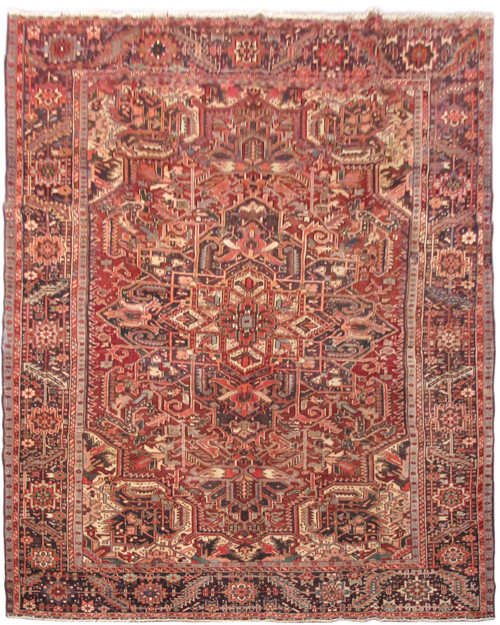
8'3" x 11' Persian Heriz Rug | Geometric Star Medallion | Orient Red & Ivory, Excellent Condition
This 8'3" x 11' Heriz is the classic northwest Persian village room rug: a heavy 3/8" wool pile on a cotton foundation, drawn entirely in straight lines and stepped angles, with one commanding star medallion anchoring an orient red field. The proportions are the useful ones, wide enough to carry a seating group without crowding the walls and long enough to run the length of most dining tables, which is why this format is one of the most requested among 8x11 Persian rugs. The wool has the firm, slightly springy handle that Heriz weaving is known for, the sides and ends are original and tight, and the pile stands even from selvage to selvage. Every rug we sell ships with a certificate of authenticity confirming origin, materials and hand-knotted construction.
Design and Motifs
The center is a stepped star medallion built in four layers: a small ivory and red rosette at the core, a ring of camel gold hexagonal lobes, a navy ground carrying serrated leaf forms in pearl violet, and a jagged ivory outline that snaps the whole shape away from the field. Two navy pendants extend north and south, each finishing in an arrow head, and four ivory corner spandrels close the field with bold hooked latch motifs, angular rosettes and blocky palmettes in wine red and violet. Across the open red ground the weavers scattered serrated vine work, small combs, hooks and stylized flower heads, none of them repeating exactly, which is the hallmark of loom-side drawing rather than a cartoon. The main border runs a navy ground with alternating rosettes and vase forms in rose and ivory, framed by camel guard stripes filled with a small reciprocal meander. If you like the frank, architectural drawing of geometric Persian rugs, this is a textbook example of it.
Orient Red, Ivory and Pearl Violet
The field is a deep orient red that shifts with the light, reading close to crimson where the pile leans toward you and dropping into a cooler garnet where it leans away. Against it the ivory spandrels and border outlines act as pure white space, giving the eye somewhere to rest and keeping an otherwise dense design legible from across a room. The third named color, pearl violet, is the quiet one that makes the rug: a soft grey lavender that appears in the serrated leaves of the medallion, in the small motifs floating on the field, and again in the border rosettes, cooling the red down so it never turns strident. Supporting those three are a dark indigo navy in the medallion ground and main border, a warm camel gold in the medallion lobes and guard stripes, and touches of mahogany brown and rose pink. Overall it is a warm, saturated palette that sits comfortably with wood floors, leather, brass and plenty of other red and burgundy rugs.
Heriz Weaving in Northwest Persia
Heriz is a cluster of villages east of Tabriz on the lower slopes below Mount Sabalan, and the district owes its reputation to two local facts. The first is the water, heavy with minerals that help the wool take dye deeply and hold it. The second is the wool itself, from sheep grazed at altitude, coarse in the best sense, with a high lanolin content that makes it resilient underfoot and resistant to crushing. Heriz weavers work from memory and from the village idiom rather than from a detailed cartoon, which is why the drawing here is angular, symmetrical in intent but never mechanically identical side to side. Village weaving of this type is normally built under 200 knots per square inch, a deliberately robust structure rather than a fine one, and that is exactly the point: a Heriz is made to be walked on for generations. This one has been kept well, the pile is full, and it is ready to go straight down in a room that gets daily use.
8'3" x 11' Persian Heriz Rug | Geometric Star Medallion | Orient Red & Ivory, Excellent Condition
Ask about this rug
This piece is the only one of it, so the things worth knowing about it are particular to it. If you want to talk through the size, the colour in your own light, or the weave, speak to someone here first.