Watch the film
| Size in ft: | Width: 8' x Length: 11'3" |
| Size in Inch: | Width: 96" x Length: 135" |
| Size in meters: | Length: 3.43 x Width: 2.44 m |
| Colors: | Red, Ivory, Navy Blue, Teal Blue, Camel Gold, Rose |
| Shape: | Rectangular |
| Woven: | 100% Hand-knotted | Handmade |
| Foundation: | Cotton |
| Pile: | |
| Design: | Heriz | Geometric Star Medallion | Ivory Spandrels |
| Origin: | Persian Heriz | Made in Persia |
| Condition: | Excellent |
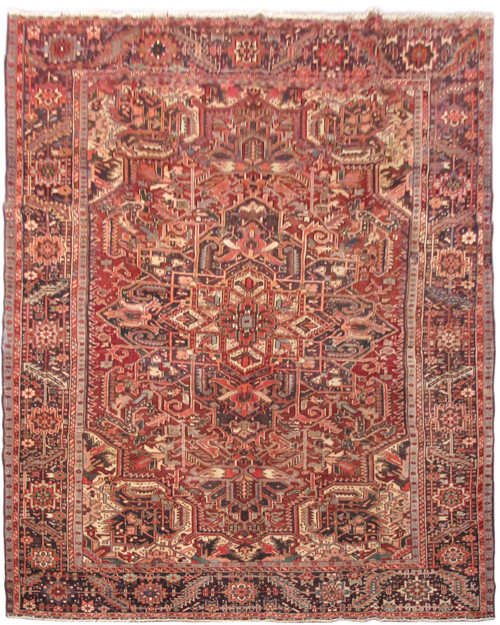
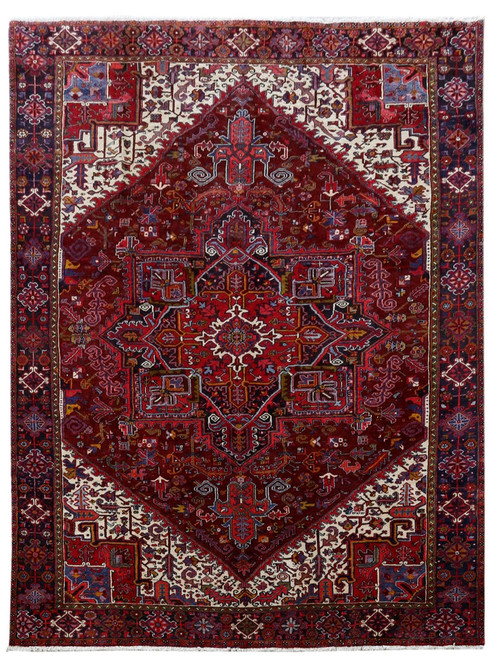
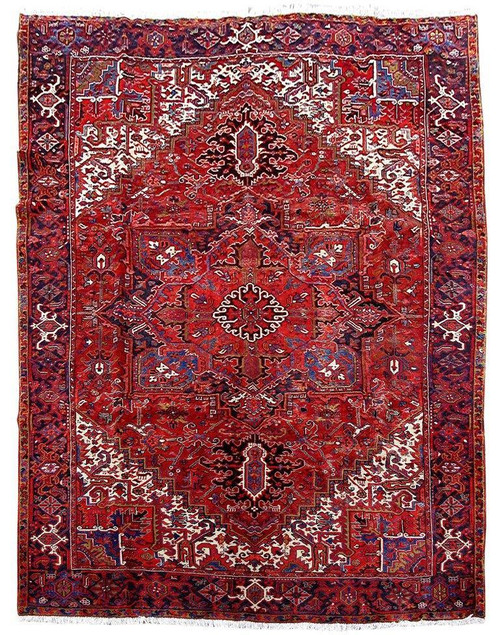
8' x 11'3" Persian Heriz Rug | Geometric Star Medallion, Ivory Spandrels | Excellent Condition
This is a classic village Heriz in the size most American rooms are built for. It measures 8' x 11'3", hand-knotted in 100% wool on a cotton foundation, with a dense, tightly packed pile that still stands up straight under the hand. The drawing is pure Heriz: a large angular star medallion floating on a brick red field, ivory corner spandrels that cut in at hard stepped angles, and a deep navy main border of linked palmettes and rosettes framed by camel gold guard stripes. Handling it in the showroom, the wool has that dry, slightly glassy Heriz sheen that only comes from the fleece of the mountain flocks, and the pile shows no bald spots or restoration. Condition is excellent throughout, with even pile height corner to corner and original white cotton fringe at both ends. It ships with a certificate of authenticity documenting origin, materials and hand-knotted construction. If you are shopping 8x11 Persian rugs, this one gives you full coverage with an old-school village design that does not date.
Design and Motifs
The center holds an 8 point star medallion built from straight lines and stepped diagonals, with a small ivory rosette at its heart set in a black core and ringed by teal blue tracery. Serrated leaf arms and small ivory cartouches radiate out from the medallion, each filled with miniature blossoms and hooked stems. Above and below it, long dagger shaped pendants reach into the field toward the ends of the rug, a detail the Heriz weavers use to stretch the composition across a long room. The field around the medallion is not empty: it is packed with angular vinework, split palmettes, boteh-like hooks and small quadruped figures rendered in the flat, blocky vocabulary of geometric Persian rugs. The 4 corner spandrels are worked in ivory with navy and teal blue rosettes and forked leaves, and the main border carries alternating shield medallions and 8 petal rosettes on navy, with two camel gold guard borders of small repeating flowerheads closing the whole thing off.
Color Palette
The field reads as a warm brick red with madder depth rather than a flat modern crimson, and it shifts gently between lighter and deeper passages as the light crosses the pile, which is the signature of hand-spun wool taking dye at slightly different rates. Against that red, the ivory spandrels and the ivory motifs inside the medallion do the heavy lifting, giving the eye bright resting points at the 4 corners and the center. The main border is a near-black navy that anchors the whole rug, lifted by camel gold guard stripes that carry a soft honey tone. Inside the medallion and scattered through the field are cooler notes: a chalky teal blue, a deeper indigo in the vines, and small touches of rose pink and sage green in the leaf tips and rosettes. There are also charcoal and aubergine passages in the field that read almost brown under lamplight. The overall effect is warm and saturated, and it sits naturally with walnut and oak floors, leather, and both cream and deep green walls.
Heriz Origin and Weaving Quality
Heriz is a group of villages east of Tabriz, on the slopes below Mount Sabalan in northwest Persia. The water there runs through mineral-rich rock, and local weavers have always said it is why the wool from those flocks is unusually tough and takes copper-toned reds so well. Heriz weavers work from memory and from village cartoons rather than the fully drawn curvilinear designs used in the city workshops, which is why the line here is angular: straight runs, stepped corners, and medallions built from flat planes instead of curves. That approach suits a coarser, heavier knot, and a Heriz is judged less on knot count than on wool quality, dye quality and the confidence of the drawing. This piece scores well on all 3. The pile is thick and springy, the selvedges are tight, the back is even, and the weave is dense enough that the design stays crisp at the medallion tips. A rug built this way is a working floor covering that holds up under furniture and traffic for decades, which is exactly why Heriz has stayed the most collected village weave in Persia.
8' x 11'3" Persian Heriz Rug | Geometric Star Medallion, Ivory Spandrels | Excellent Condition
Ask about this rug
This piece is the only one of it, so the things worth knowing about it are particular to it. If you want to talk through the size, the colour in your own light, or the weave, speak to someone here first.