| Size in ft: | Width: 8'3" x Length: 12'4" |
| Size in Inch: | Width: 99" x Length: 148" |
| Size in meters: | Length: 3.76 x Width: 2.51 m |
| Colors: | Ivory, Burgundy, Blue, Olive Green |
| Shape: | Rectangular |
| Woven: | 100% Hand-knotted | Handmade |
| Foundation: | Silk |
| Pile: | Wool and Silk |
| KPSI: | Approx. 500 |
| Age: | 2000's | Unused |
| Design: | Tabriz-style Medallion | All-over Floral Field |
| Origin: | Persian Isfahan | Made in Persia |
| Condition: | Perfect | Never used |
8'3" x 12'4" Persian Isfahan Rug | Wool & Silk on Silk Foundation | Approx. 500 KPSI | Never Used
Pick this one up by the corner and you can feel where the money went: a silk foundation, a wool and silk pile clipped low, and a knot count of roughly 500 per square inch that lets the drawing curve instead of step. Woven in the 2000s and never put on a floor, the pile still stands full and even from end to end, the fringe is untrimmed, and the selvages are tight. It is a room-size piece at 8'3" x 12'4", large enough to anchor a formal seating group yet still readable as a single composition from a doorway. Every rug we sell ships with a certificate of authenticity recording origin, materials, size and knot count.
Please Note About the Photographs:
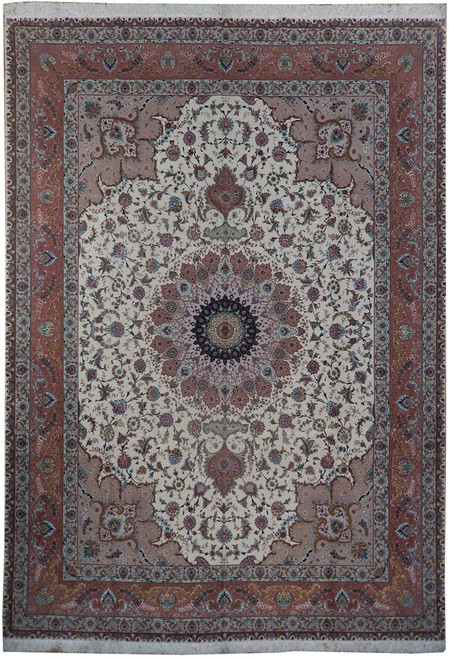
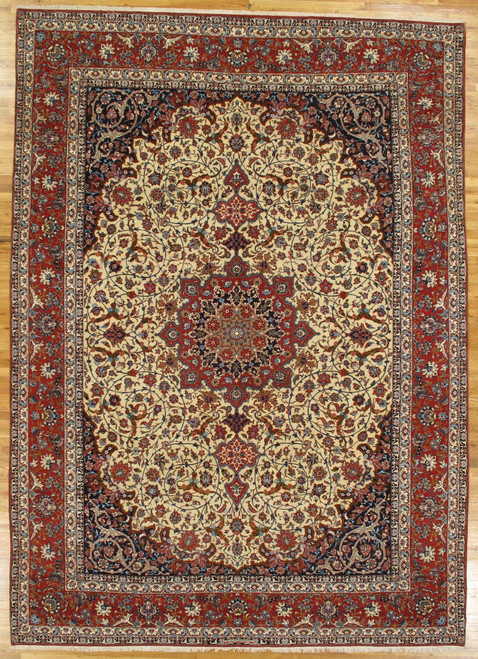
The first full overhead photograph reads slightly deeper and cooler than the rug is in person. The close-up and floor images show the true tone of the border, which is a clear warm red with burgundy shading rather than a plum or purple. Silk highlights also shift with the light, so the field will look brighter or softer depending on the angle you view it from.
Design and Motifs
The center holds a many-lobed rosette medallion built in concentric rings, a small blue eye at the core, then a ring of scrolling leaf work, then a ring of heart-shaped palmettes that radiate outward like petals. Around it the ivory field is filled edge to edge with an all-over system of thin vines, curled saz leaves, open blossoms and small palmettes, drawn so the two halves mirror each other exactly across both axes. Four dark navy panels sit at the inner corners of the field and act as spandrels, each packed with its own miniature vine scroll. The main border runs a red ground with alternating floral cartouches and eight petal rosettes joined by a continuous meander, and it is framed on both sides by ivory guard stripes carrying a smaller repeating blossom, with a narrow navy stripe closing the outer edge. It is a Tabriz-style medallion layout executed with the fine curvilinear line of a city workshop.
A Detailed Look at the Colors
The field is a warm ivory, closer to unbleached cream than white, and it is the reason the design reads so clearly at a distance. Against it the palette is built from burgundy and a clear warm red in the medallion and the main border, deep navy in the corner panels and outlines, and a whole family of blues in between, from dusty mid blue to a pale powder blue used in the flower heads. Olive green appears throughout the leaf work and gives the vines their weight, while soft taupe and beige fill the larger palmettes and keep the medallion from going flat. Small touches of rose and terracotta show up in the outer border blossoms. Because the pile mixes wool with silk, the highlights sit a shade brighter than the wool around them and the ivory ground shifts between warm cream and pale gold as you walk past it.
Isfahan Weaving and Workshop Quality
Isfahan sits in central Persia and has been a court weaving center since the Safavid workshops of the 16th century, and its reputation rests on drawing: the curved line, the flowing vine, the precision of a repeated motif across a field this large. That only works at a high knot count, which is why the best Isfahan looms use a silk foundation. Silk warps are thinner and stronger than cotton, so the weaver can pack more knots into the same span and the design holds its curves instead of breaking into steps. At roughly 500 knots per square inch on silk, with a low clipped wool and silk pile, this piece sits in the upper tier of modern Isfahan production, and the back detail with the ruler shows how tight and regular the knotting is. If you want the background on the town and its ateliers, read our complete guide to Isfahan rugs, and our Persian silk rugs guide explains what a silk foundation actually changes underfoot.
8'3" x 12'4" Persian Isfahan Rug | Wool & Silk on Silk Foundation | Approx. 500 KPSI | Never Used
Ask about this rug
This piece is the only one of it, so the things worth knowing about it are particular to it. If you want to talk through the size, the colour in your own light, or the weave, speak to someone here first.