| Size in ft: | Width: 8'6" x Length: 8'6" |
| Size in Inch: | Width: 102" x Length: 102" |
| Size in meters: | Length: 2.59 x Width: 2.59 m |
| Colors: | Navy Blue, Ivory, Brown, Touch of Burgundy |
| Shape: | Square |
| Woven: | 100% Hand-knotted | Handmade |
| Foundation: | Silk | Foundation of a Handmade Rug |
| Pile: | Wool & Silk | Wool and Silk Rugs |
| KPSI: | Approx. 500 | KPSI Explained |
| Age: | 2000s | Never used |
| Signature: | Woven cartouche reads "Iran Esfahan Afshari" |
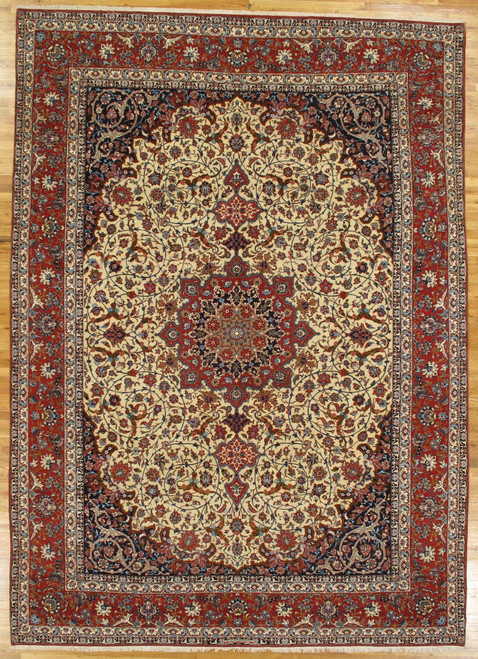
| Design: | Isfahan | Round Floral Medallion | Arabesque Vine Border |
| Origin: | Persian Isfahan | Made in Persia |
| Condition: | Perfect | Never used |
8'6" x 8'6" Square Persian Isfahan Rug | Signed Wool & Silk on Silk | Approx. 500 KPSI | Never Used
A true square is one of the hardest formats to find in fine Persian weaving, and this 8'6" x 8'6" piece is a workshop-grade example: wool and silk pile knotted on a silk foundation at roughly 500 knots per square inch, with a signature cartouche in the upper border reading "Iran Esfahan Afshari". It has never been on a floor. The pile still stands crisp, the silk highlights still flash when the light moves across the field, and the ivory fringe is untrimmed and original. At this fineness the drawing behaves almost like painting, which is exactly what buyers look for in Persian Isfahan rugs. Every rug we sell ships with a certificate of authenticity documenting origin, materials and knot count.
Design and Motifs
The composition is built around a perfect circle, which is the correct answer to a square format: a large round navy medallion fills the center of the field and is ringed by a thin silk-toned band that reads like a halo. Inside it, an 8 point rosette of layered palmettes radiates from a small blue-green flower head at the exact center, surrounded by scrolling vine, curled saz leaves and open blossoms that spiral out to the medallion edge. The 4 corners carry soft mushroom-toned spandrels drawn with arabesque scrollwork and small paisley forms, set against an ivory ground that is itself filled with fine vinery and flowering tendrils. The main border runs a stately palmette and vine repeat on ivory, flanked by narrow guard stripes of blush and pale blue meander. Detail at this scale only holds together because the knot count supports it: petals have outlines, leaves have veins, and the stems never break.
A Navy Center Framed in Ivory and Blush
The field of the medallion is a deep midnight navy, dark enough to read almost black in low light and to make every ivory blossom stand out with real contrast. Around it the tone lifts completely: warm ivory and cream across the corners and border, with a soft blush mushroom pink through the spandrels and the outer guard stripe that gives the whole rug a quiet, pearly cast. The drawing itself is carried in cocoa and chestnut brown, which is what keeps the pale areas from washing out. Accents do the rest of the work: small burgundy and rose cabbage flowers scattered through the medallion, pale powder blue in the petals and rosette centers, and touches of sage and sea green in the leafwork. Where silk has been used in the highlights, those areas shift lighter or darker as you walk around the rug, so the medallion appears to breathe.
Isfahan Weaving and the Afshari Signature
Isfahan sits in central Persia and has been a court weaving center since the Safavid workshops of the 16th century. Its reputation has never rested on size or color alone but on drawing: the curved line, the flowing vine, the symmetry that holds across an entire field. That standard is only reachable at a high knot count on a stable foundation, which is why the best Isfahan looms use a silk foundation rather than cotton. Silk warps are thinner and stronger, so the weaver can pack roughly 500 knots into every square inch and still keep the back flat and even, as the ruler photograph shows. The signed cartouche places this piece with the Afshari workshop, and a signature on an Isfahan is not decoration; it is a weaver putting his name behind the piece. Unused, square and signed, it is an uncommon combination at this level.
8'6" x 8'6" Square Persian Isfahan Rug | Signed Wool & Silk on Silk | Approx. 500 KPSI | Never Used
Ask about this rug
This piece is the only one of it, so the things worth knowing about it are particular to it. If you want to talk through the size, the colour in your own light, or the weave, speak to someone here first.