Watch the film
| Size in ft: | Width: 8'3" x Length: 9'9" |
| Size in Inch: | Width: 99" x Length: 117" |
| Size in meters: | Length: 2.97 x Width: 2.51 m |
| Colors: | Ruby Red, Ivory, Brown, Olive |
| Shape: | Rectangular |
| Woven: | 100% Hand-knotted | Handmade |
| Foundation: | Cotton |
| Pile: | Wool and Silk |
| Age: | New | Never used |
| Design: | Mahi Tabriz | Herati fish pattern | Diamond medallion |
| Origin: | Made in India |
| Condition: | Perfect | Never used |
8'3" x 9'9" Wool and Silk Mahi Tabriz Design Rug | Ruby Red Herati Field | Never Used
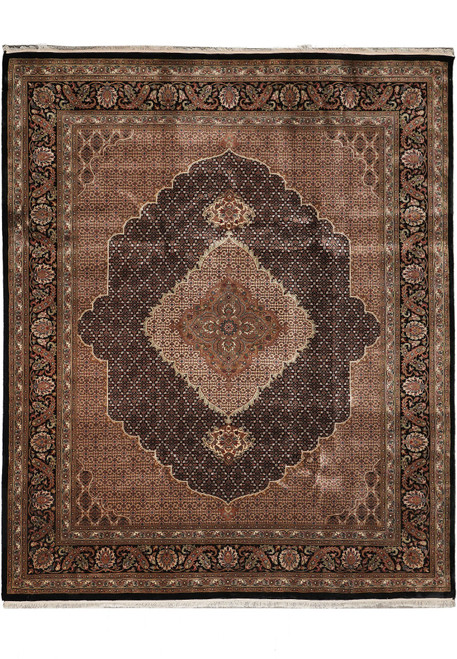
This is a fine, brand new hand-knotted Oriental rug woven in wool with silk highlights, measuring 8'3" x 9'9" and drawn in the classic Mahi Tabriz layout. The knotting is tight and even, the pile is clipped low so the small repeating motifs stay legible, and the silk catches light along the vine work and the medallion tips. At 99" x 117" it belongs squarely in the 8x10 rug range, the most useful footprint in the house, and it has never been on a floor. Every rug we ship travels with a certificate of authenticity confirming that it is hand-knotted, along with its exact measurements, materials and origin.
Please Note About the Photographs:
The lighter, coppery bloom that appears across parts of the ruby field in the overhead photographs is pile direction sheen from the silk, not wear, not fading and not damage. Walk around the rug, or turn it a quarter turn, and that same area reads deep ruby again. This piece is new and unused, and it is professionally steamed and pressed before it leaves our warehouse.
Design and Motifs
Mahi means fish, and the name comes from the four small leaves that curl around each rosette inside a diamond lattice, reading like fish circling a pond. That lattice covers the entire ground here as a true all over Herati field, with ivory 4 petal blossoms punctuating the repeat at regular intervals so the eye has somewhere to rest. At the center sits a scalloped diamond medallion on an ivory subfield, its black-outlined core holding 4 large lobed cartouches filled with brown, olive and soft blue flowerheads. Matching pendants float above and below it, and a smaller rosette anchors each side. The surrounding field is framed by a large scalloped cartouche outline, with quarter versions repeated in all 4 corners. The main border runs on an ivory ground with big curled acanthus leaves, red palmettes and a rhythm of olive medallions, flanked by an olive minor border of small flowerheads and thin ivory and black guard stripes. The outermost band is plain ruby, which gives the whole composition a clean stop at the edge.
A Ruby Red Ground With Ivory, Olive and Brown
The field is a deep, saturated ruby red that leans toward burgundy in low light and warms to a wine tone under a lamp, and because the lattice is outlined in near-black the ground reads darker and richer than the yarn itself. Against it, the ivory is the workhorse: ivory blossoms across the field, an ivory subfield under the medallion, ivory pendants, and a broad ivory main border that lifts the whole rug and keeps it from going heavy. Olive green does the drawing, running through the leaf tips, the vine work and the minor border, and it is the color that keeps this palette from being a straight red and cream rug. Brown appears in the palmettes, the medallion cartouches and the border rosettes, sometimes shading toward a dusty rose where the silk sits. Small accents of slate blue and terracotta flicker through the lattice at close range. The silk content shows itself as a shift in value rather than a shine: the same ruby looks lighter from one end of the room and deeper from the other.
Where It Was Woven and How Well
This rug was made in India, and that is a mark in its favor rather than a concession. India is where most of the world's best contemporary hand-knotted work is now produced, with master weavers working from full cartoons on cotton warps and finishing to a standard that would have been reserved for workshop pieces a generation ago. The Mahi Tabriz drawing is one of the hardest all over designs to execute cleanly, because a single dropped knot throws the whole lattice out of alignment across 117" of length, and here the repeat holds true from selvage to selvage. The weave is dense and fine enough to carry the small fish leaves at full detail, the pile is shorn low, the selvages are tightly wrapped in ruby wool, and the cotton fringe is even and full at both ends. The back shows a crisp, legible knot grid with no lumping or slack. It is a serious weaving that will take decades of traffic and only improve in color as it settles.
8'3" x 9'9" Wool and Silk Mahi Tabriz Design Rug | Ruby Red Herati Field | Never Used
Ask about this rug
This piece is the only one of it, so the things worth knowing about it are particular to it. If you want to talk through the size, the colour in your own light, or the weave, speak to someone here first.