Watch the film
| Size in ft: | Width: 8'5" x Length: 12'2" |
| Size in Inch: | Width: 101" x Length: 146" |
| Size in meters: | Length: 3.71 x Width: 2.57 m |
| Colors: | Beige, Coral, Sage Green |
| Shape: | Rectangular |
| Woven: | Hand-Knotted |
| Pile: | Wool |
| Origin: | Turkey |
| Design: | Hereke |
| Age: | 1900's |
| Condition: | Very Good- Low Fine Wool Pile |
8'5" x 12'2" Antique Hereke Rug | Ivory Beige Field, Coral Border | Woven Inscription Cartouches, 1900s
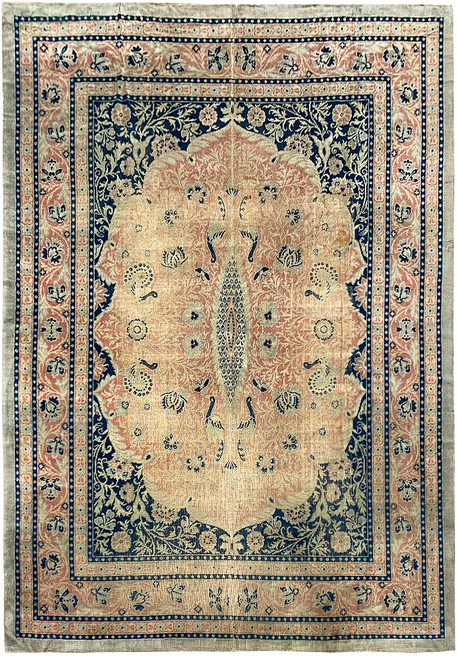
This 8'5" x 12'2" antique Hereke rug was hand-knotted in wool in Turkey in the 1900s, and it has the quiet, sun-softened surface that only a century of honest life gives a rug. The field has mellowed to a warm parchment beige, the main border reads coral over rust, and the drawing throughout is finer and more deliberate than the size alone suggests. The pile is low and even, the way a well-kept antique should be, with the knot structure clearly legible on the back. Two woven cartouches carry script in the border, and the wool still holds a soft sheen where the light crosses it. Pieces of this age and drawing sit among the more interesting antique Oriental rugs we handle, and every rug ships with our certificate of authenticity.
Please Note About the Photographs:
The pale diagonal lines in the flat overhead photo are fold marks and shadows from pallet storage. They are not wear, not fade and not damage, and they relax once the rug is laid flat. Every rug is professionally steamed and pressed before it leaves our warehouse. The low, even pile visible in the close-up photographs is the natural character of a rug woven in the 1900s, not an area of damage.
Design and Motifs
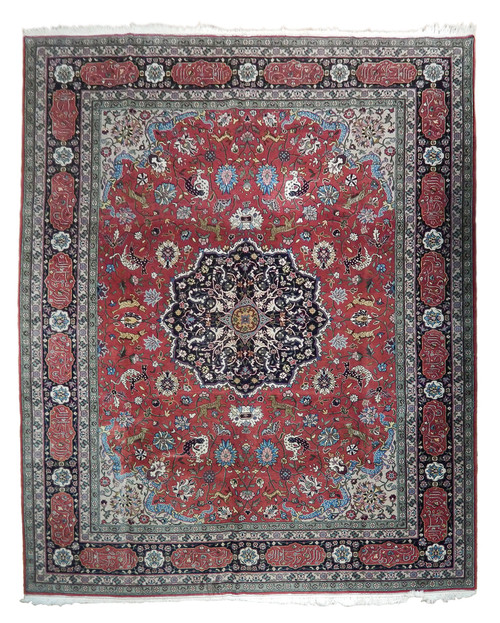
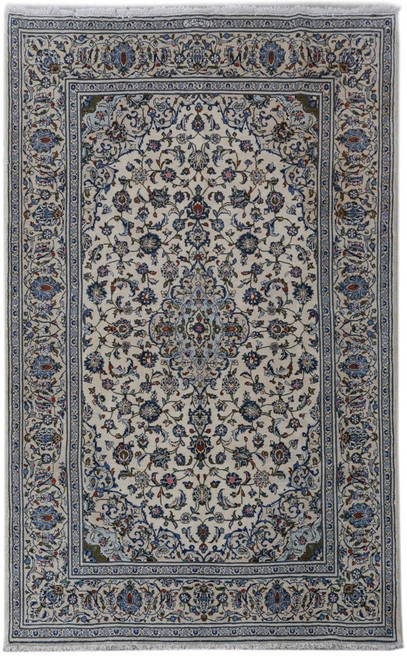
The composition is anchored by a scalloped oval medallion set almost exactly at center, built in coral and plum around an ivory heart with an 8 petal rosette at its core. Sage and ivory palmettes ring the medallion, and small pendant cartouches float above and below it. Around that, the field runs as a true all-over drawing: thin scrolling vines that loop corner to corner, serrated saz leaves, tulips, carnations and open blossoms, with cloud-shaped coral cartouches placed in the 4 corners of the field to answer the medallion. The main border is a coral ground carrying rosettes and curled leaves, framed on both sides by charcoal guard stripes filled with a small rosette and leaf meander, then an outer olive band. Two large inscription cartouches interrupt the border at the ends, drawn in plum script on an ivory panel, and they are the detail collectors look for first on a rug of this type.
A Beige, Coral and Sage Green Palette
The field is a warm beige that shifts between parchment and pale wheat depending on where the light falls, and it is this soft ground that makes the rug so easy to live with. Against it, the coral is the dominant accent, appearing as a deep rust in the border and as a brighter tomato coral in the medallion, the corner cartouches and the small serrated leaves scattered through the field. Sage green carries the vinework and many of the palmettes, cooling the whole palette down, while saffron gold turns up in the small flowerheads and rosettes and plum to aubergine appears in the medallion core, the script and a handful of blossoms. Charcoal outlines the guard stripes and a few of the leaves, giving the drawing its definition, and ivory is used throughout for the small flowers that keep the field from ever looking crowded. The overall reading is warm, faded and low contrast, the palette that decorators go looking for and rarely find in a genuine antique.
Hereke Weaving and Quality
Hereke is a town on the Sea of Marmara east of Istanbul, and its imperial manufactory was established in the 1840s to supply the Ottoman court. That court standard is what separates Hereke from ordinary Turkish village weaving: a fine, tightly packed knot on a cotton foundation, curvilinear drawing that holds its line through every vine and every letter of the script, and the discipline to keep an all-over field balanced across more than 12 feet. You can see that quality on the back of this piece, where the knot rows are small and even, and in the way the low pile has worn without the pattern ever going soft. An Oriental rug from this workshop tradition is judged first on drawing and second on color, and this one holds up on both counts. If you want to understand how weavers, dyes and wear are read to place a piece in its period, our guide on how to date an antique rug walks through the same evidence we used here.
8'5" x 12'2" Antique Hereke Rug | Ivory Beige Field, Coral Border | Woven Inscription Cartouches, 1900s
Ask about this rug
This piece is the only one of it, so the things worth knowing about it are particular to it. If you want to talk through the size, the colour in your own light, or the weave, speak to someone here first.