Watch the film
| Size in ft: | Width: 9'5" x Length: 12'2" |
| Size in Inch: | Width: 113" x Length: 146" |
| Size in meters: | Length: 3.71 x Width: 2.87 m |
| Colors: | Kaamel, Blue, Sage Green |
| Shape: | Rectangular |
| Woven: | Hand-Knotted |
| Pile: | Wool |
| Origin: | Turkey |
| Design: | Hereke |
| Age: | 1930's |
| Condition: | Excellent |
9'5" x 12'2" Antique Turkish Kayseri Rug | Hereke Medallion Design | 1930s Camel & Navy
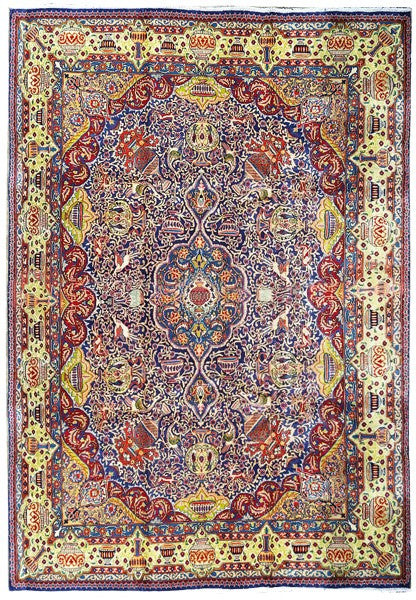
This 9'5" x 12'2" antique Turkish Kayseri was woven in the 1930s in the Hereke manner, with one enormous lobed medallion filling almost the entire camel ground and a deep indigo frame closing around it. Nearly a century of quiet living has taken the wool down to a low, even nap and pulled the dyes into a pastel register of rose, ivory, ice blue and sage that no modern reproduction gets right. The back is clean and the handle is supple, the drawing is still crisp everywhere, and the wide plain sage green outer band is an unusual finishing touch on a room-size piece of this age. It ships with a certificate of authenticity, and as a true 9x12 antique area rug it sits comfortably under a full seating group or a 8 seat dining table.
Please Note About the Photographs:
The close-up photographs show genuine antique patina, not damage. The pile sits low and even across the field because the rug has been walked on since the 1930s, and the colors have mellowed with light and time. The ends and sage green outer band show the honest softening you expect on a piece of this age. Every rug is professionally cleaned, steamed and pressed before it leaves our warehouse.
Design and Motifs
The drawing is a single scalloped medallion so large it reads as an open field of its own, edged in a cusped ivory outline and set against navy spandrels at the 4 corners. Inside, a fine tracery of rose vine scroll runs corner to corner, with a slender columnar cypress at the exact center built entirely out of tiny navy dots and leaves. Around it sit pairs of facing long-necked birds, small ice blue quatrefoil blossoms with navy centers, tulip and palmette heads, curling boteh drawn as dotted wreaths, and scattered pinwheel rosettes. The navy spandrels carry large ivory and sage rosettes on a heavy leaf vine, a clear workshop cartoon rather than village improvisation. Framing all of it are 5 bands: a broad salmon main border of paired rosettes and serrated leaves, a navy floral band of sunflower heads on scrolling stems, dotted star guard stripes on either side, and finally the wide undyed sage green skirt that gives the rug its unmistakable silhouette.
A Camel, Navy and Sage Green Palette
The ground is camel, warm and slightly golden where the light hits it, drifting toward bone ivory through the center of the field and blushing into soft rose wherever the vine work is dense. That rose is the color that carries the rug from across a room: a faded salmon, closer to old terracotta than to pink, and it repeats in the main border so the frame and the field talk to each other. Against it the indigo blue is the anchor, nearly black in the spandrels and the guard stripes, brighter and more inky where single motifs are outlined. Pale sage green does double duty, first as the muted celadon of the birds and leaf tips, then as the wide plain outer band that cools the whole palette down. Small amounts of ice blue and a trace of soft yellow appear in the flower centers. Gentle abrash runs through the field, which is the signature of natural dyes maturing at their own pace rather than any printing or chemical wash.
Kayseri Weaving and the Hereke Tradition
Kayseri, the old Caesarea of central Anatolia, became the commercial heart of fine Turkish weaving in the late Ottoman and early republican years, and its best workshops copied the court cartoons of Hereke with real discipline. This piece shows it: wool pile knotted on a cotton foundation with the symmetrical Turkish knot, tight enough to hold hairline vine work and dotted motifs at a small scale, and a pattern that repeats accurately across a 12 foot length. Because the design language belongs to a workshop rather than a nomadic camp, this is an antique Oriental rug in the strictest sense, and buyers comparing weaving regions can read the difference between Persian and Oriental rugs before they choose. The 1930s attribution rests on the palette, the wool, the plain sage skirt and the way the back has aged, the same evidence used to date an antique Oriental rug in the trade.
9'5" x 12'2" Antique Turkish Kayseri Rug | Hereke Medallion Design | 1930s Camel & Navy
Ask about this rug
This piece is the only one of it, so the things worth knowing about it are particular to it. If you want to talk through the size, the colour in your own light, or the weave, speak to someone here first.