Watch the film
| Size in ft: | Width: 8' x Length: 10'6" |
| Size in Inch: | Width: 96" x Length: 126" |
| Size in meters: | Length: 3.20 x Width: 2.44 m |
| Colors: | Blue, Brown, Olive, Salmon |
| Shape: | Rectangular |
| Woven: | 100% Hand-knotted | Handmade |
| Foundation: | Cotton |
| Pile: | |
| Age: | 1980's | Approx. 40 years old |
| Design: | Tribal | Stepped Geometric Medallion | Salmon Spandrels |
| Origin: | Persian Ardebil | Made in Persia |
| Condition: | Excellent | Perfect |
8' x 10'6" Persian Ardebil Rug | Tribal Stepped Medallion | 1980s Wool Pile
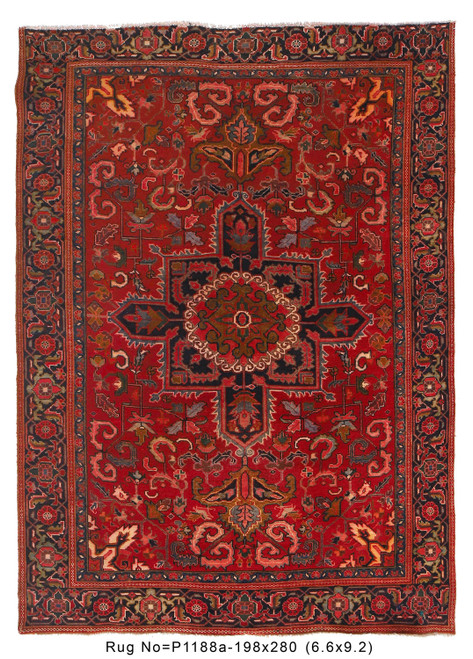
This is a village-woven Ardebil from northwest Persia, knotted in the 1980s and kept in condition that still reads as perfect: full pile edge to edge, straight sides, original flat-woven ends and clean ivory fringe. The drawing is confident rather than fussy, a single large stepped medallion carried on a soft salmon ground, and the wool has the dry, slightly glossy handle that good Azerbaijani flocks give after a few decades of settling. At 8' x 10'6" it covers a standard seating group or a six-seat table without crowding, and it sits comfortably among 8x11 Persian rugs that need to do real work in a busy room. Every rug we sell ships with a certificate of authenticity recording origin, materials, knotting and age.
Design and Motifs
The field is built around one broad geometric medallion with notched, stepped outlines that echo out into matching quarter-spandrels at all 4 corners. Inside the medallion the weaver has packed curling ivory cloudband scrolls, crowned palmettes, 8 point stars and a stacked central column of blossoms, the kind of composition that repeats top to bottom but never quite copies itself stitch for stitch. The salmon ground carries angular serrated leaves in dark brown, small comb and arrowhead fillers, and 4 large teal rosettes set like buttons at the shoulders of the medallion. Three borders frame the whole thing: an ivory main band of hexagonal cartouches and rosettes, flanked by narrow navy guard stripes of reciprocal diamonds. It is drawn in the honest, slightly irregular hand of the best tribal Persian rugs, where the pattern is memorized rather than traced.
Colors: Navy, Salmon, Brown and Olive
The two dominant tones are a deep indigo navy inside the medallion and a warm salmon that runs across the open ground and corner panels, reading closer to soft copper or terracotta in daylight and cooler, almost blush, in lamplight. Against that pairing the weaver sets clean ivory for the scrollwork and main border, dark chocolate brown for the serrated leaves, and a bright teal blue that flickers through the rosettes, stars and small blossom heads. Olive comes in quietly, mostly in leaf shading and the occasional cartouche filler, and it keeps the warm and cool halves of the palette from separating. The close-up photographs show the pile at an angle and under stronger light, so the blues look more saturated there than in the flat overhead view; the ground colour is the softer salmon seen in the full-rug images.
Ardebil: Weaving Town and Build Quality
Ardebil sits in the far northwest of Persia, high on the Azerbaijani plateau near Mount Sabalan, a cold-winter region whose sheep grow long, springy, high-lanolin fleece. That wool is the reason Ardebil rugs wear the way they do: the pile compresses under furniture and comes back, and the colour holds rather than going chalky. The back of this piece shows an even, well-packed knot line on a cotton foundation with no skipped rows or slack selvedges, the mark of an experienced village loom working at a steady, moderate knot count rather than chasing fineness. Wool pile, cotton warp and weft, hand-knotted throughout, and roughly 40 years of settled age behind it, this is a rug bought to be walked on for another 40.
8' x 10'6" Persian Ardebil Rug | Tribal Stepped Medallion | 1980s Wool Pile
Ask about this rug
This piece is the only one of it, so the things worth knowing about it are particular to it. If you want to talk through the size, the colour in your own light, or the weave, speak to someone here first.