Watch the film
| Size in ft: | Width: 8' x Length: 10' |
| Size in Inch: | Width: 96" x Length: 120" |
| Size in meters: | Length: 3.05 x Width: 2.44 m |
| Colors: | Rust, Ivory, Sage Green, Black, Salmon |
| Shape: | Rectangular |
| Woven: | 100% Hand-knotted | Handmade |
| Foundation: | Cotton |
| Pile: | |
| Design: | Sumak | All-Over Floral | Black Border |
| Origin: | Made in India |
| Condition: | Excellent | New |
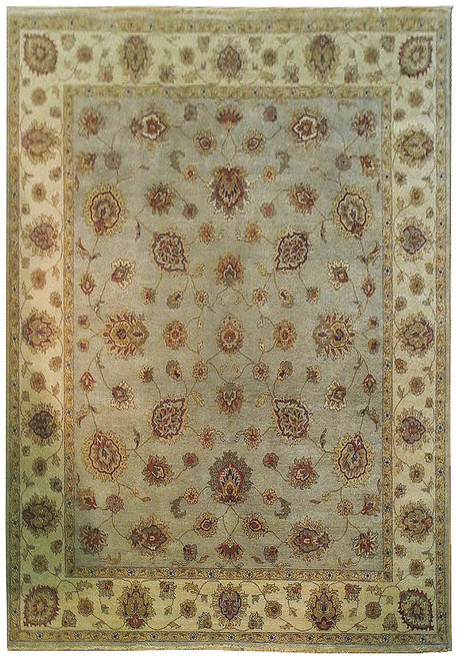
8' x 10' Indian Oriental Rug | Rust Sumak All-Over Floral, Black Border | Excellent Condition
This is a clean, confident piece of contemporary hand-knotted work: a rust field covered from edge to edge in ivory and sage flowerheads, shut in by a border so dark it reads as black until you get close. The pile is wool clipped to 3/8", short enough to keep the drawing crisp, and the foundation is cotton, which is why the rug lies dead flat (see the second photo). At 8' x 10' it is the most liveable of the large formats, and if you are comparing options we keep the full run of 8x10 Oriental rugs in one place. It is in excellent condition, has never been laid in a home, and ships with our certificate of authenticity.
Design and Motifs
The Sumak drawing is a medallion-free, all-over floral design built on a split-leaf vine that climbs the length of the field and mirrors itself across the center line. Along it sit big lotus palmettes with notched petals, open 8 petal rosettes, curled serrated leaves the size of a hand, and small 4 petal buds filling the gaps so no stretch of ground is left empty. Look at the close-up photo and you can see how each flower is outlined first in a darker rust, then in soft green, with a few petals dropped into deep charcoal to give the shape weight. The main border runs alternating palmettes and long saw-edged leaves on the dark ground, and it is held between two narrow ivory guard stripes carrying a small repeating flower and tendril meander. There are no corner mismatches worth noting: the border turns cleanly at all 4 corners, and the field pattern stops at the inner stripe rather than being cut off mid-motif.
A Rust Field Against Charcoal and Sage
The field is a warm terracotta rust, slightly brick in the light and slightly brown in the shade, with gentle abrash banding across the width that tells you the wool was dyed in batches. Over it the motifs are worked in cream and antique ivory, pale wheat gold, and a muted sage or celadon green that keeps the whole thing from going orange. Small salmon and coral flowerheads appear mostly in the border and the guard stripes, with black used as an accent inside petal centers and leaf veins. The main border is a near-black charcoal that pushes the rust forward, and the outer selvage returns to a solid rust brown before the ivory fringe. It is a palette that sits easily with walnut and oak floors, cream plaster, and worn leather, and it belongs with the softer, warmer rust rugs rather than the bright reds.
Made in India: Where Fine Hand-Knotted Weaving Lives Now
This rug was made in India, and that is a selling point, not a caveat. The Indian weaving belt turns out most of the world's good contemporary hand-knotted production today, with workshops running classical floral cartoons on cotton warps with hand-spun wool pile, exactly as here. The Sumak name refers to the design family, not the construction: the back photo and the ruler shot show a genuine knotted pile with clear rows and a hand-finished selvage, not a flatweave. If you want the broader context on how this tradition relates to the older city weaving of Persia, our piece on what actually separates a Persian from an Oriental rug is worth 5 minutes. On the floor, the practical result is a dense, even weave with a short pile that takes chair legs and foot traffic without crushing.
8' x 10' Indian Oriental Rug | Rust Sumak All-Over Floral, Black Border | Excellent Condition
Ask about this rug
This piece is the only one of it, so the things worth knowing about it are particular to it. If you want to talk through the size, the colour in your own light, or the weave, speak to someone here first.