Watch the film
| Size in ft: | Width: 8' x Length: 11' |
| Size in Inch: | Width: 96" x Length: 132" |
| Size in meters: | Length: 3.35 x Width: 2.44 m |
| Colors: | Red, Ivory |
| Shape: | Rectangular |
| Woven: | 100% Hand-knotted | Handmade |
| Foundation: | Cotton |
| Pile: | |
| Design: | Heriz | Geometric medallion | Ivory spandrels |
| Origin: | Persian Heriz | Made in Persia |
| Condition: | Excellent |
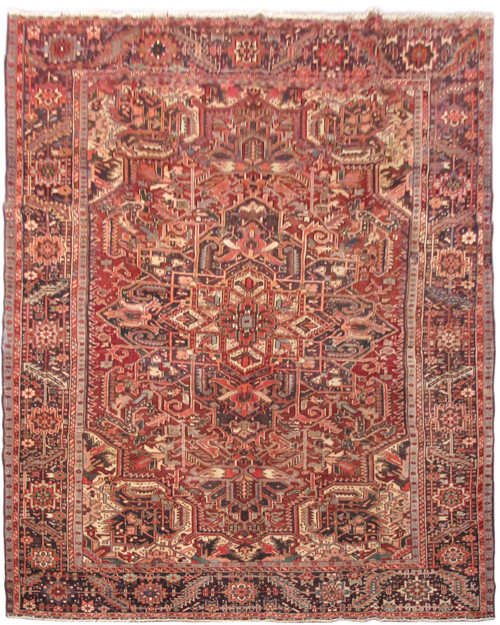
8' x 11' Persian Heriz Rug | Red & Ivory Geometric Medallion | Hand-Knotted Wool, Excellent Estate Piece
This 8' x 11' Persian Heriz is an estate piece that has been cared for properly, and it shows: the 3/8" wool pile is even from end to end, the selvedges are intact, and the cotton fringe on both ends is clean and original. It is a classic village weave, hand-knotted one knot at a time on a cotton foundation, with the heavy, honest handle that makes a Heriz the rug people put in the busiest room of the house and forget about for 30 years. At 8 feet by 11 feet it sits squarely in the most useful room size there is, and it ships with a certificate of authenticity confirming it as a hand-knotted rug made in Persia. If you are comparing pieces at this footprint, our 8x11 Persian rugs are grouped together for that reason.
Please Note About the Photographs:
The first image is a high-contrast studio capture and reads darker and more saturated than the showroom floor photographs that follow. The floor shots, taken under warmer light, are closer to how the red field and ivory corners look in a normal room. Nothing in the difference is wear, fading or damage.
Design and Motifs
The drawing is pure Heriz: everything is built from straight lines, right angles and stepped edges rather than curves. A large stepped medallion holds the center, outlined in ivory and filled with a cross-form rosette and small framed cartouches, with a long anchor-shaped pendant reaching top and bottom into the field. Around it the red ground is packed with angular palmettes, hooked leaves, serrated vine stems and tiny latch-hook devices, all radiating outward from the medallion so the eye keeps returning to the middle. The 4 corners carry ivory spandrels drawn with the same angular vocabulary, which is what gives the rug its strong diagonal frame. The main border runs a dark ground with alternating rosette medallions and stylized floral panels, flanked by narrow guard stripes of small repeating flowerheads. It is one of the best-resolved examples of geometric Persian rugs, and the corner detail photo shows how cleanly the weaver resolved the border turns.
The Red Field and Ivory Corners
The field is a deep true red with a slight raspberry cast where the light catches the pile, and it is not a flat block of color: the wool takes dye unevenly by nature, so the ground moves between a darker brick tone and a brighter crimson across the width. Against it, the ivory spandrels read as soft cream rather than white, warmed by age and framed with thin outlines. Inside both field and corners the weaver worked in a surprisingly wide secondary palette: charcoal and inky navy in the medallion core and the main border ground, salmon and rose pink in the small leaves and framed panels, muted olive and sage in the vine work, and a few touches of light blue in the smallest details. The dark border pulls the whole composition together and keeps the red from taking over a room. On a wood floor, as in the showroom photographs, the red warms noticeably and the ivory corners do most of the work of lightening the piece.
Heriz: The Villages East of Tabriz
Heriz rugs come from a cluster of villages east of Tabriz in northwest Persia, on the slopes below Mount Sabalan. Two things made the district famous. The first is the water, which is heavy with minerals and gives the local sheep a wool so tough and lanolin-rich that a Heriz pile resists crushing for generations. The second is the drawing method: village weavers worked from memory and from small scale drawings rather than a fully painted cartoon, which is why the curved court designs of the city workshops were translated into straight lines, stepped edges and bold angular masses. Village Heriz work is normally woven under 200 knots per square inch, and that is by design, not a shortcut. The coarser knot on a stout cotton foundation, with a thick wool pile, is exactly what makes these rugs the workhorses of the Persian tradition. Turn this one over, as in the last photograph, and the weave is regular and tightly packed, with the ends finished and the original size label still attached from its estate life.
8' x 11' Persian Heriz Rug | Red & Ivory Geometric Medallion | Hand-Knotted Wool, Excellent Estate Piece
Ask about this rug
This piece is the only one of it, so the things worth knowing about it are particular to it. If you want to talk through the size, the colour in your own light, or the weave, speak to someone here first.