Watch the film
| Size in ft: | Width: 8' x Length: 23' |
| Size in Inch: | Width: 96" x Length: 276" |
| Size in meters: | Length: 7.01 x Width: 2.44 m |
| Colors: | Copper Orange, Multi-Color, Navy, Ivory, Saffron Gold, Green, Sky Blue |
| Shape: | Runner |
| Woven: | 100% Hand-knotted | Handmade |
| Foundation: | Cotton |
| Pile: | |
| Age: | Antique | Circa 1900s |
| Design: | Mahal | All-Over Floral Lattice | Navy Palmette Border |
| Origin: | Persian Mahal | Made in Persia |
| Condition: | Excellent |
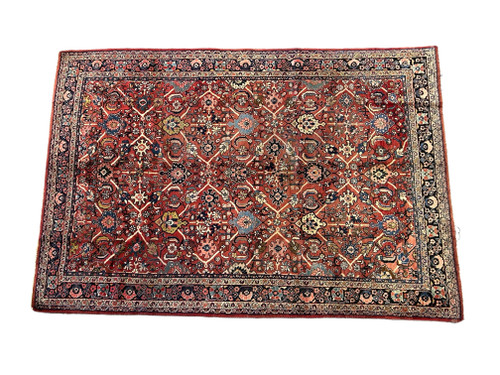
8' x 23' Antique Persian Mahal Long Runner Rug | Copper Orange All-Over Floral | Circa 1900s
Runners this long almost never survive in this condition. At 8' x 23' this antique Persian Mahal is a true gallery piece, wide enough to furnish a room and long enough to carry an entire hallway or center hall from door to door without a seam or a join. It was woven around the turn of the 20th century on a cotton foundation with a hand-spun wool pile that still stands a full 3/8" high, and the wool has aged into the low sheen that only a century of use and careful washing produces. Pieces of this length belong with oversize Persian rugs rather than with standard runners, and they are the hardest single category to find in original condition. It ships with a certificate of authenticity.
Please Note About the Photographs:
The first full-length image renders lighter and more golden than the rug actually is. The in-room and close-up photographs show the true color: a deep copper orange field with a navy border. Judge the color from those images.
Design and Motifs
The field carries an all-over floral design built on a soft diamond lattice, with no medallion and no open ground anywhere along the 23' length. Each lattice compartment holds a large ivory or sky blue rosette ringed by smaller star flowers, and the compartments are separated by long serrated leaves in pine green and by dark navy arrowhead palmettes that give the repeat its rhythm. The drawing is village drawing in the best sense: the curve of the vine is confident but not mechanical, and the repeat shifts slightly as it climbs, so no two rows read identically. The main border is a navy ground carrying alternating saffron gold and rust rosette palmettes joined by a meandering vine, flanked by ivory and gold guard stripes with a running flower head. The 4 corners are resolved by hand rather than mirrored, and one corner panel finishes in a raspberry ground, a small weaver's decision that is visible in the close-up photograph and is typical of authentic period work.
A Copper Orange Field Against Navy and Gold
The ground is copper orange, a warm madder-derived terracotta that sits between rust and salmon and changes noticeably with the light, reading brick under lamplight and softer apricot in daylight. Gentle horizontal abrash runs the length of the field, the natural banding you get when hand-spun wool is dyed in separate lots, and it is one of the surest signs of a natural dye palette. Against that warm ground the border is a deep inky navy that is almost black at the corners, which frames the copper without competing with it. The motif colors are genuinely multi-color: chalk ivory, saffron and mustard gold, pine and sage green, sky blue, soft rose and small notes of raspberry. The greens and blues have held their depth, while the ivories have mellowed to cream, so the whole surface has the settled, low-contrast glow of an antique rather than the brightness of a new weave.
Mahal Weaving in the Sultanabad District
Mahal rugs come from the villages of the Sultanabad district around Arak in central Persia, the region that supplied the great Western export houses from the 1880s onward. The weave is a medium village weave on a cotton foundation, never as fine as a city workshop piece and never meant to be, because the value of a Mahal lies in the wool, the dyes and the scale of the drawing. The local fleece is long-stapled and high in lanolin, which is exactly why a rug woven more than a century ago still has a full standing pile and even wear across 23 feet. The back photograph shows steady, regular knotting with clean rows and no repairs visible, and the selvages and both ends are intact. If you want to understand how a piece like this is placed in time, our guide on how to date an antique rug walks through the dye, wool and weave evidence that puts this runner in the early 1900s.
8' x 23' Antique Persian Mahal Long Runner Rug | Copper Orange All-Over Floral | Circa 1900s
Ask about this rug
This piece is the only one of it, so the things worth knowing about it are particular to it. If you want to talk through the size, the colour in your own light, or the weave, speak to someone here first.