Watch the film
| Size in ft: | Width: 9'11" x Length: 13'1" |
| Size in Inch: | Width: 119" x Length: 157" |
| Size in meters: | Length: 3.99 x Width: 3.02 m |
| Colors: | Multi |
| Shape: | Rectangular |
| Woven: | Hand-Knotted |
| Origin: | Persia |
| Design: | Isfahan |
| Condition: | Excellent |
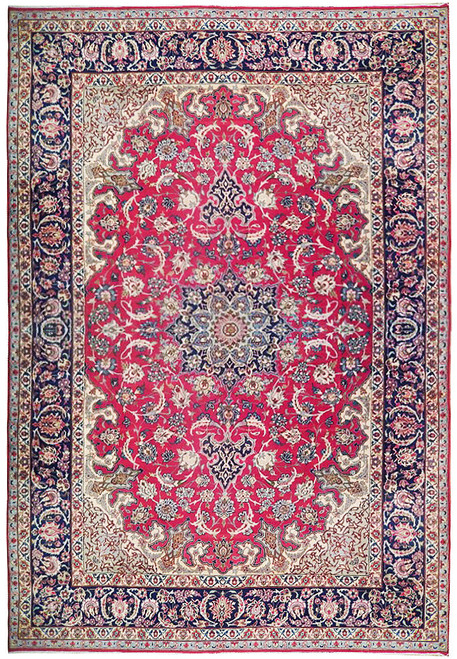
9'11" x 13'1" Persian Najafabad Rug | Isfahan Garden Panel Design | Excellent Condition
This is a room size 9'11" x 13'1" Persian Najafabad rug, hand-knotted in the Isfahan tradition of central Persia with a cotton foundation and a tightly clipped wool pile. The field is divided into a grid of small arched garden panels rather than organised around a single medallion, which is the older and more demanding way to draw a Persian city rug: every compartment is a separate composition and the weaver has to keep more than 50 of them balanced across nearly 13 feet. Condition is excellent, with even pile from end to end, straight sides and full original fringe, and the drawing stays crisp right into the corners where panel grids usually collapse. It ships with a certificate of authenticity confirming origin, materials and hand-knotted construction. At just under 10 by 13 feet it sits squarely in the most useful large room format, and it is worth comparing against our other 10x13 Persian rugs before you decide.
Design and Motifs
The field is a khesti, or brick, layout: 6 panels across and 9 rows deep, each one framed by a thin braided guard stripe so the grid reads like the walled beds of a formal garden. The panels rotate through a fixed set of subjects. Tall weeping willows with drooping ranks of leaves fill the ivory and cream boxes, stylised cypress and flowering shrubs rise from small footed vases, broad arched cartouches carry a single curling boteh, and open compartments are scattered with carnations, rosettes and tulips on fine vine. Several panels sit on a delicate diamond lattice ground, which gives the eye a change of texture between the solid ivory and solid red boxes. The main border is a wide brick red band of interlocking palmettes and rosettes on a blue arabesque vine, punctuated at intervals by pale oval cartouches, and it is flanked inside and out by narrow ivory meander stripes that stop the pattern from crowding the field. Close up, as in the detail photographs, you can see how small the individual motifs are drawn, with flower heads only an inch or two across and outlines carried in a single dark row of knots.
A Multi-Color Palette Built on Brick Red, Ivory and Sky Blue
The rug is a true multi-color piece, but it is held together by three dominant tones. Brick red, a warm tomato red rather than a cool burgundy, carries the wide main border and repeats through roughly a third of the panels, so the frame and the field speak to each other. Against it sit ivory and soft cream compartments, some closer to oatmeal, which lift the grid and keep an almost 13 foot rug from reading heavy. The third note is a pale sky blue, used for whole panels and for the arabesque vine in the border, and it is what gives the rug its cool, airy quality in daylight. Working inside the panels are sage and olive green for the willow foliage, a muted gold and mustard for vase bodies and flower centres, plum and rose pink for the smaller blooms, and a deep navy used sparingly for outlining. Small touches of bright coral red appear in individual flower heads, visible in the close detail image. Photographed from different angles the same rug can look cooler and greyer or warmer and redder, which is the normal behaviour of a low pile wool surface catching light along and against the nap.
Najafabad and the Isfahan Weaving Tradition
Najafabad is a weaving town a short drive west of Isfahan in central Persia, and it works from the same design vocabulary that made the Isfahan workshops famous from the Safavid period onward: curved line, flowing vine and precise, disciplined drawing. Najafabad weavers built their reputation on room size and oversize pieces in that idiom, produced in sturdier wool and slightly larger format than the tiny Isfahan workshop rugs, which is exactly why a 9'11" x 13'1" garden panel rug like this one exists at all. The back, shown here against a rule, is tight and regular, with small clean knot nodes and straight rows that run true across the full 119 inch width, the sign of a properly tensioned loom and an experienced pair of hands rather than village guesswork. The pile is clipped low so the fine outlines stay legible, and the wool has the dry, slightly lustrous handle of good central Persian fleece that burnishes rather than mats underfoot. That combination of durable wool, careful city drawing and a genuinely usable large format is what keeps well kept Najafabad rugs in demand among people furnishing a formal room they do not intend to redo.
9'11" x 13'1" Persian Najafabad Rug | Isfahan Garden Panel Design | Excellent Condition
Ask about this rug
This piece is the only one of it, so the things worth knowing about it are particular to it. If you want to talk through the size, the colour in your own light, or the weave, speak to someone here first.